
Mapping the China AI Ecosystem with Rui Ma

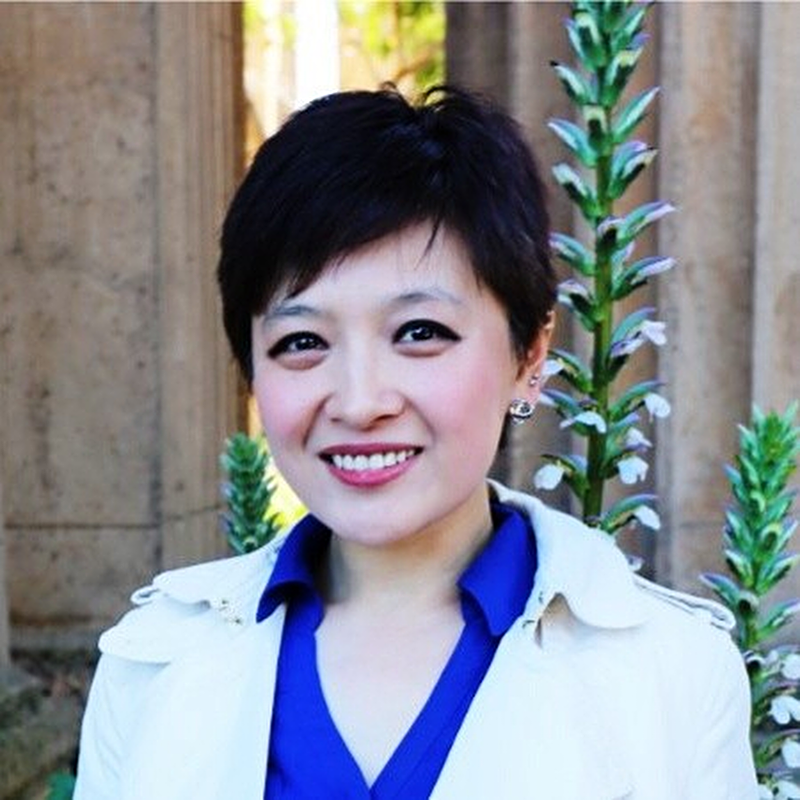
Fresh out of the studio, Rui Ma, founder of TechBuzz China, returns to examine China's AI ecosystem on its own terms rather than as a horse race with Silicon Valley. She maps the atlas of China's labs by strategy, from DeepSeek's "cost curve rebels" to the big-tech war over office agents, and explains why cheap intelligence comes from brutal domestic competition rather than an export plan. She also unpacks why robotics enjoys a homegrown market that pure AI lacks, why robot hardware and software must co-evolve, and how China prices insurance for brain-computer interfaces before the devices ship. Last but not least, Rui Ma shows how Chinese municipalities now act as startup service providers, raising the floor for everyone while letting markets pick the winners.
"The [Chinese] government's not looking to build a multi-trillion dollar AI behemoth. The government is like, 'What is the best outcome for my society?'The best outcome is that the best technology survives. I don't want it to go bankrupt, right, and die too early. But the best technology survives and it is deployed at scale using my own whatever self-sufficient tech stack. It is not subject to foreign interference and it is also increasingly cheaper, right ..." - Rui Ma, Creator of Tech Buzz China
Profile: Rui Ma, Creator of Tech Buzz China (LinkedIn and X)
Here is the edited transcript of our conversation:
Bernard Leong: Welcome to Analyse Podcast, the premier podcast dedicated to dissecting the pulse of business, technology, and media globally. I'm Bernard Leong, and today we return to China with a different question. Instead of treating artificial intelligence as a horse race between Silicon Valley and China, we want to understand the distinct industrial logic taking shape inside China: how its major AI labs are organised, why intelligence is becoming cheaper, how infrastructure and manufacturing change the economics, and why robotics may be where the story becomes most visible. With me today is an old friend, Rui Ma, founder of Tech Buzz China, investor, and longtime analyst of China's technology ecosystem. Rui has spent many years moving between the US and China, speaking with founders, investors, and operators, and most recently building research products that map China's AI labs, semiconductor stack, and physical AI ecosystem. Rui, welcome back to the show.
Rui Ma: Hi, thanks for having me back. It's been a while.
Bernard Leong: It has. Let's start with the main question. What happens when intelligence becomes cheap enough to embed everywhere, from enterprise software to factories and robots? What does China's ecosystem look like when we analyse it on its own terms today?
Rui Ma: I think that is exactly where China is trying to get to: intelligence that is, quote unquote, "too cheap to meter." Part of it is simply market reality. China is a very price-sensitive market. It has much lower per capita GDP and income than many developed countries, and a fundamentally different economic shape, with manufacturing carrying far more weight in both the economy and the workforce.
Personally, I'm a techno-optimist. I just took a quiz from some kind of frontier innovation society in America, and I came out as a defensive accelerationist. Apparently that means I'm for acceleration, but not because I think AI is going to take over and destroy the world.
I think it will be far more useful as a tool to defend ourselves against bad actors, and to create solutions for all the problems we have. So I'm an optimist, and I hope that future comes to pass.
Bernard Leong: I'm pretty much an optimist too. Since we last spoke in 2023, what have you been up to? How have you gone deeper into AI, semiconductors, manufacturing, and robotics, particularly across the US and China tech ecosystems?
Rui Ma: Wow, 2023 is a long time ago. That was right at the ChatGPT moment.
Bernard Leong: That's right.
Rui Ma: I spent two years at an AI startup in Silicon Valley, overseeing sales and some limited operations. We were very small, so I got a good taste of how enterprise AI was growing at the time.
The main difference in both environments since then is that the conversation has been completely overtaken by AI, robotics, and deep tech. If you look at which investments people are most excited about in Silicon Valley, it's overwhelmingly those three areas.
China might look a little different, and we've substantially adjusted TechBuzz China's research focus. Back in 2023, we were probably still at least half e-commerce: online-to-offline platforms and the like. Now we're almost exclusively looking at AI, robotics, some new energy, and a little semiconductors as they relate to AI.
The world has really changed. If you look at which companies have gone public, or are planning to, it's those same sectors.
Bernard Leong: That's interesting, because the Z AI IPO gave us a first glimpse of a real AI company generating revenue, with profit centres built on large language models. I think their stock went up earlier this year after they published GLM 5.3.
How often do you travel between China and the US now? Is it every three months, given how much is changing on both sides?
Rui Ma: Right now I'm doing about two to four weeks every quarter, and I'm going back again in December. Partly there's a lot to keep up with, but we also take many investors and executives to China. We even have a spin-off programme running youth trips.
There's simply a lot in Chinese tech that people want to learn about, and that's different from investing. I always get asked, "Are people going over there to invest in the companies?" Not necessarily, unless it's part of their mandate.
Most people go because it's such a large economy. The US and China are the G2. You cannot get away from what Chinese companies are doing, no matter where you invest. Even in very traditional industries, you'll find yourself affected by decisions made by people on the ground there. So it's a good idea to form your own opinion.
Bernard Leong: I agree with you totally. I'll actually be spending an entire month in China in December, starting with the famous Zhuhai Air Show, through my aviation work with my former company, Airbus. After that I'll take the family to Shanghai and Beijing. I want to expose my kids to China. I keep telling them about its scale, but I don't think they'll grasp it until they see it for themselves. Then they'll understand how big China really is and what it's really about.
Back to our conversation. Three years ago, we were asking why China missed the initial ChatGPT moment. Since then we've had DeepSeek, Kimi K3, and all the open-source models. Looking at the ecosystem today, what has changed most dramatically since we last spoke?
Rui Ma: Probably the confidence of the Chinese tech ecosystem. Some variation of two views: either they're very confident they will be setting the frontier in due time, or they're pursuing a strategy that still puts them at the frontier, which may differ a little from the US approach.
It depends on who you talk to, because everyone is pursuing a slightly different model. In China, there are several axes of competition. In the US, the model wars are dominated by two independent labs, OpenAI and Anthropic. China has its independent labs too: MiniMax, StepFun, Zhipu, which makes GLM, and, of course, DeepSeek.
Then you have labs inside the big companies that remain very competitive: ByteDance, Tencent, Alibaba. You even have players you might consider less technical, such as Xiaomi, Meituan, and Ant, all entering the foundation model game.
Each has a very different rationale. Some do it because they have distribution and can sell additional services. Some do it because they have a large cloud business. Others do it because it will help their core business a great deal.
Meituan's outward narrative, at least, is: "This will help us with our small-business customers: how we interact with them, how we serve them, and how they run their own operations." Then there are the independent labs chasing AGI, ASI, RSI, whatever the acronym is at the moment.
Ultimately, it's about getting to superintelligence, which, it sounds like, both of us think is not far off.
Bernard Leong: Where I live, you're exposed to models from both sides. Frankly, besides many Anthropic and OpenAI users, I also see plenty of Kimi K3 and DeepSeek users. The picture for me is mixed. It's actually quite difficult to work out how China's ecosystem really works. Say I take a whiteboard and map China's major AI labs by strategy rather than benchmark scores. How would you segment DeepSeek; Alibaba with its Qwen models; and ByteDance's Seedance, which surprisingly keeps all its models closed and now leads the video and image categories on LLM Arena?
Then there's Tencent Hunyuan, with Tencent Buddy, which I find very interesting. I've been using it, because I always sample both sides' apps and interfaces. Then Moonshot's Kimi, MiniMax, Zhipu, which we now call Z.ai, and the next tier of players. How would you draw that map for someone who has just arrived in China and asks, "What am I looking at?"
Rui Ma: It's funny, because we built what I call the China AI Atlas, at ai.techbuzzchina.com, where we gave these labs nicknames so they're easy to remember. DeepSeek, for example, we call the "cost curve rebels," because that's what they're known for: compressing costs. That takes us back to the start of the show, intelligence being too cheap to meter, and why that matters as a component of AGI.
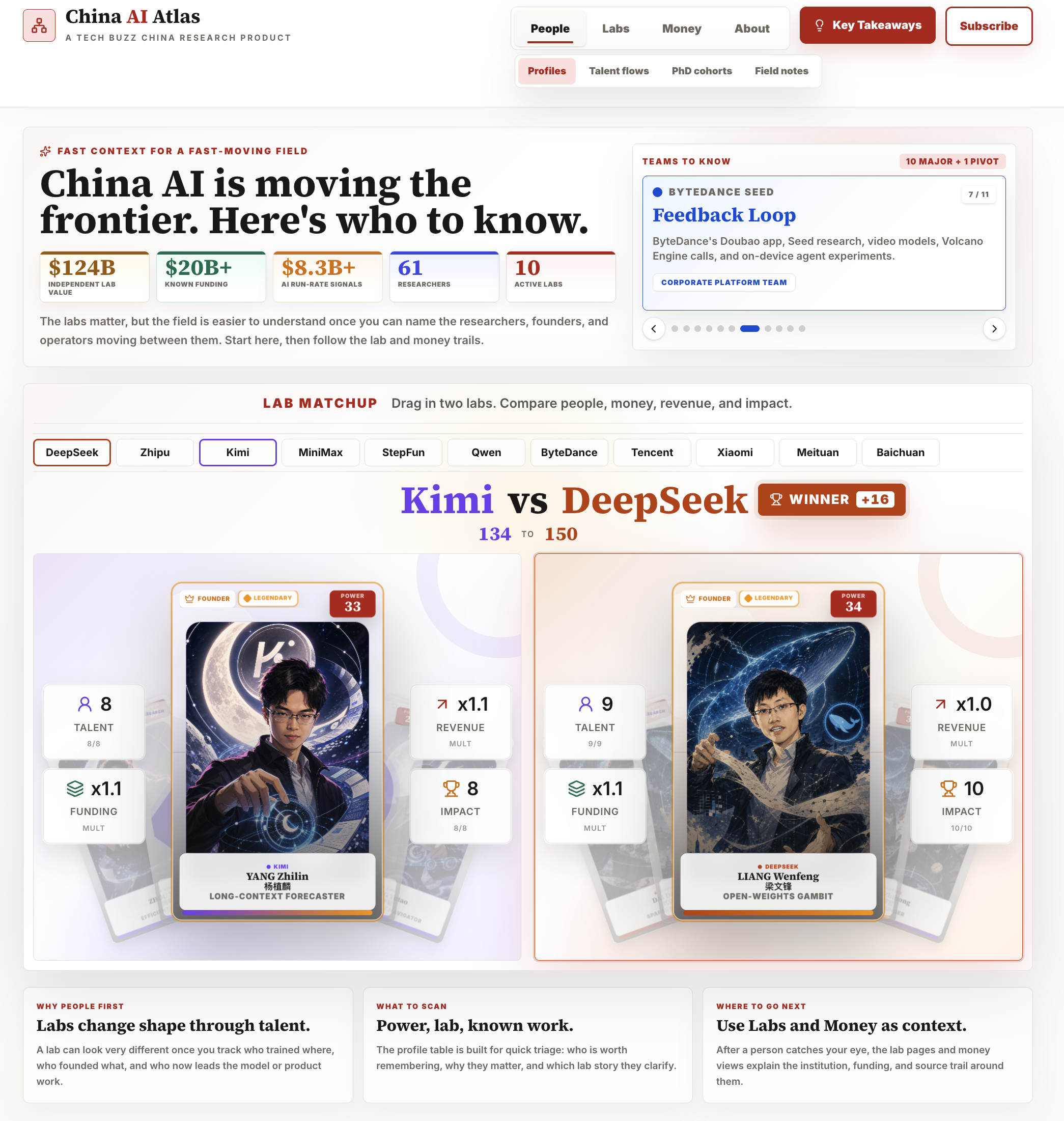
Because of the compute restrictions, they're also going down into the chip design layer, and having real success with their work on Huawei chips. Zhipu has historically had more of an enterprise model, doing on-prem deployments.
Now they're going head-to-head with Anthropic and OpenAI, saying, "You're doing coding; we'll excel at coding too. We'll also excel at enterprise and agentic workflows." Moonshot is also strong at coding, but historically it has focused on the long context window as its differentiator.
Some of their published research shows how deep they've gone into that. I've heard from the founders that they genuinely believe context windows should be infinite. Why stop at a million tokens? They think there's a way to get there. We'll see.
MiniMax has been multimodal and global from the start. I think they stumbled onto a pretty good video model and stayed with it, but they've since realised coding is a very lucrative place to be, so they're trying to catch up there. I think they'll still be known for video, which brings me to ByteDance. You said everyone knows them for video, but I wouldn't count them out elsewhere in AI, because they're very ambitious and very well resourced.
They haven't necessarily competed overtly in the model-serving space, but they've been very competitive at the application layer. There's currently a mini war over office agents. Tencent, Alibaba, and ByteDance are fighting over what you might call the next evolution of enterprise software in China.
Enterprise software in China was never very big to begin with, but now it's evolving.
Bernard Leong: Correct. The analogy I'd give, though it isn't entirely fair, is something like Grok Bot, Dots, or even Muse, but for the enterprise. As an application, it's a very different thing. I use Tencent WorkBuddy and keep playing with it, and it satisfies me far more as an enterprise user than as a consumer. Maybe my interpretation is different. When you think of Muse, you think of booking air tickets, something much more casual and consumer-driven. Instinct is the other one everybody has been talking about, but unfortunately I don't have access to it yet in my part of the world.
Rui Ma: I've had these apps installed, but I give them very limited access, because I don't trust them. So they're not necessarily —
Bernard Leong: Especially when you have kids.
Rui Ma: It's not about that. For me, the consumer case is obvious. They're launching consumer agents in China too, because there's clearly a big need. But I think it will look very different, because so much value is already unlocked through a WeChat account. If WeChat closes that off — and things there are already so streamlined, like mini apps. They're not agentic, but they're significantly easier to use than many standalone apps here in the US.
So the ecosystem already looks fundamentally different. For enterprise, which we recently wrote about, it depends on the permissions you can grant. If you own your company and grant the permissions, the agent can access whatever you allow. For consumers, it will depend on what the platforms open up to each other. Amazon has already closed itself off to Muse. If you're shopping, there are still plenty of websites that will let you in, but Amazon is something like 50% of the e-commerce market here.
Bernard Leong: It feels like the walls are going up right in the middle of this, and at some point the Chinese government will say, "Okay, everyone, please open up your walled gardens." What's interesting is that in the rest of the world, where we can access models from both sides, we see it a little differently. We start with a top-tier US model, from Anthropic, OpenAI, or an equivalent, then gradually substitute Chinese models task by task. The reason is cost: cost per outcome rather than cost per token, because cost per token is too simplistic. From your point of view, what belief about Chinese AI do Western observers hold most strongly that is simply outdated and not even close to the real picture?
Rui Ma: I live in Silicon Valley and know many AI founders, so plenty of people here are well aware of what Chinese models are good for. But early on, maybe a year and a half or two years ago, what people didn't realise was how complete the suite of solutions was.
Chinese model families often have more variants, the Qwen family for example, right from the start. Part of the reason is that they had to segment so clearly for price-conscious customers. For many workflows, you don't need the frontier model, and sometimes the frontier model wouldn't suit you at all.
Take voice interaction. There are many models now, but rewind a year: to avoid sounding like you were talking to a robot, you needed small models with super-low latency. Some of those weren't available from the frontier labs, because that wasn't a business focus for them.
In China, for whatever reason, there were models available that worked well. So it depends on the specific use case. Today, at least in Silicon Valley, though I can't speak for the rest of the world, my impression is that people know what these models are good for and that there's a large selection.
What the average person, as opposed to the technologist, tends to be suspicious of is that inference is being served inside China and their data is going there, or that the models are badly inaccurate on topics the government censors.
People do believe these things. But for most people using these models in workflows, it isn't a problem. You're using them for coding, for agents, to complete tasks, fetch information, and write. You're not using them to write papers on —
Bernard Leong: I find the distillation argument very misleading as well.
Rui Ma: Okay. The distillation argument.
Bernard Leong: It's super misleading. I think it was Nathan Lambert who said there's good distillation and bad distillation, and something along the lines that what the Chinese labs are doing is simply good distillation.
On the flip side, you could say the frontier labs are also distilling, by buying physical books, shredding them, and digitising them. That's another form of distillation. But I want to go deeper into the economics behind these models.
Chinese AI models have pushed model and inference prices down very aggressively. It almost feels like EVs and solar panels: through the Belt and Road Initiative, China exports intelligence in exactly the same way it exported EVs and solar panels.
So is cheap intelligence simply the result of brutal competition within China? As someone who reads Chinese WeChat articles, I can feel the intensity, but I don't see it in the Western media. Or is it a deliberate route to wider adoption around the world, the same way China has scaled other technologies by making them inexpensive and ubiquitous?
Rui Ma: Cost is an advantage; we can't deny that. It becomes its own form of distribution. If something is virtually free, you'll get eyeballs. That said, I don't think it's the primary motivation. Everyone would love to make amazing margins.
It's really the result of competition in the domestic market. If you remember, Chinese prices were never anywhere near Anthropic's or OpenAI's because of market conditions, but they were higher before DeepSeek came along and demonstrated similar, or even more advanced, capabilities.
DeepSeek is the reason everyone lowered their prices. Every time DeepSeek releases something — and they have adjusted their pricing since, sometimes upwards — they're the cost curve rebels, the price to beat.
Realistically, you cannot be priced ten or twenty times higher than them in the domestic market, because customers will simply move to the more economical model, especially when capabilities are similar. Of course, there's also a narrative, and I wouldn't call it mythology because it's true, that Chinese companies cut their own margins even before competition arrives.
They believe high margins attract competition, which is true. If everyone sees you making 90% margins, someone will say, "I can do that at 80%," and it becomes a spiralling price war. There's a bit of that. But if people could have their way, without such brutal competition, they would absolutely love to have the same margins as US providers.
Those US margins are also coming down from their idealised level.
Bernard Leong: I'll reveal a little here. I had the chance to see OpenAI's investment memo, and they pride themselves on margins of somewhere around 90% per token; I won't give the exact number. Their biggest fear is Chinese models commoditising them down to a tenth of those margins, which is really scary.
The counter-argument is that as tasks become more complex, token usage rises another 1,000 or 2,000 times, so overall token spend hasn't really fallen that much. If foundation model margins compress, where does the profit pool in the Chinese AI ecosystem go?
Is it cloud, enterprise software, consumer distribution, devices, industrial systems, or the applications on top? My working question about China is whether I should measure price per token at all, or cost per completed task, or eventually, with robotics, which we'll get to shortly, cost per unit of physical work.
Rui Ma: Every company obviously wants to make money. But if you're ByteDance, you don't worry much about model training costs. You believe you can earn it back through massive distribution, or through cloud and bringing other customers on board.
That isn't at all the case for some independent labs, especially open-weight ones. They don't necessarily make money from on-prem deployments of their models outside China. Within China, perhaps they can also be the service provider.
From the government's and the ecosystem's perspective, I don't think the government cares. It isn't looking to build a trillion-dollar or multi-trillion-dollar AI behemoth. It's asking, "What is the best outcome for my society?" The best outcome is that the best technology survives. So I don't want it to go bankrupt and die too early.
The best technology survives and is deployed at scale on my own self-sufficient tech stack —
Bernard Leong: The energy stack too.
Rui Ma: Exactly, the energy stack as well. It isn't subject to foreign interference, and it keeps getting cheaper. Only then do we talk about whether to export it.
I think the talk of China exporting tokens is a bit overblown. Depending on where you sit in the stack, of course you want to export as much as possible; as a model provider, you can charge more outside China. But that doesn't necessarily hold for the entire ecosystem.
There are many difficulties, depending on who you are. If you're an investor, you have to look at each part of the stack very differently. But if you look at the ecosystem as a whole, this is quite clearly the strategy.
It's the strategy across Chinese economic development generally. The example I like to give is fintech: payment systems there don't make money, but they enable an enormous number of transactions. Overall, you accrue net economic benefit, but it doesn't accrue to any specific layer or player.
Bernard Leong: So if I hear you correctly, the way to look at Chinese AI is to break the stack into its components and see where each is competitive, and where it isn't, for the rest of the world.
Rui Ma: Yes, I think so. Geopolitics matters too. I always say that investment in these deep tech sectors is effectively decoupled. Are sales fully decoupled as well? Not really, because there are so many dependencies. Data centres here use Chinese optical transceivers and so on.
Those dependencies are risky, and finding those names takes a lot of research. We don't go to that level of detail ourselves, but we read plenty of analysts who do. Betting on a single layer is too simplistic.
MiniMax has a very different business plan and competitive advantage from Zhipu. If DeepSeek goes public in the near future, it will look totally different again, in my opinion. You can't just say, "I'm long on Chinese foundation models." No.
Bernard Leong: I had Jing Yang, Asia Bureau Chief of The Information, on the show, and I was surprised by how tightly DeepSeek has locked in its investors. They run reverse due diligence, and it will be a long time before they want to IPO. They control their own destiny in a different way.
Let's move to the most exciting part, because I really want to get to a world where I have robotic assistance, real robots. The World AI Conference, WAIC, in Shanghai is now a mainstay. I believe President Xi Jinping spoke there this year.
Looking at 2026, your analysis argues that China increasingly measures AI progress at the level of the system rather than the model. Help me unpack that, because I'm watching it too and trying to make sense of it. When it comes to robotics, how much of the story is the combination of manufacturing, energy, chips, data centres, models, and deployment?
Rui Ma: I think about robots differently from AI; I just did an interview on this. With AI, it's very clear that the most profitable deployments are probably overseas, the highest-margin revenue is probably overseas, and some of the strongest competitors are overseas.
With robots, you don't just have homegrown talent; you also have a homegrown market. The deployments are in China. It's accelerating faster, there's government support, the capital is ready, the capital markets are willing, and you get a very different flywheel.
With pure AI and LLMs, monetisation is hard. I'd argue that if Anthropic and OpenAI weren't this successful, far fewer people would be investing in China's foundation model companies, because they'd say, "I don't see near-term revenue for independent players."
It makes more sense for the platform players, because they have distribution, but it looks difficult for the independents. There's so much enthusiasm for the whole sector right now that this is being overlooked, and we're among those overlooking it.
Bernard Leong: Therein lies the interesting thing. I monitor China's robotics ecosystem, so I can name more than a handful of companies. The most prominent, Unitree and UBTECH, have already gone public, and they're doing relatively well.
But look at the US, and you see Tesla, maybe Figure AI, and not many others, because of the manufacturing gap.
Do you think that advantage in manufacturing will play out on its own? Here's what I tell my son, who's interested in robotics.
I say, "If you really want to do robotics, move to China, forget what people tell you about work-life balance, and go 996." I know it sounds brutal, but unfortunately that's the way, especially coming from Singapore.
I'd say there's no other path, because the critical materials and manufacturing components are all there.
Rui Ma: Yes, the magnets. That's roughly what I was trying to say: China also has the market. In the US you do have a couple of unicorns, very highly valued ones, and a growing number of funded robotics companies, but they're less visible, because there isn't the same pressure.
In China, if you invest, the question is, "Where's your pilot? Where can I see it?" Because everyone else has one, and everyone else has a pipeline of orders. Many of those orders aren't that meaningful. They're not at scale; some are government orders. But there have to be orders, and investors want to see, quote unquote, "scaled-up" manufacturing, even if the bar isn't that high.
It's something like 1,000 units a month, but that's not what US companies are working towards. US investors expect something different: a breakthrough. They don't care about the near-term pilot; they look at your R&D roadmap. So those robots aren't out in the wild.
In China you can see them, especially entertainment robots. They're in shopping centres and retail stores now. You still have to look for them, but they're not hard to find. Here, I think I've seen exactly one Unitree robot, at an investor session for a China-focused ETF.
I've heard, though I haven't seen it myself, that in Shenzhen you now see young women out and about walking their robot dogs.
Bernard Leong: Have you seen the UBTECH humanoid robots?
Rui Ma: We've visited UBTECH's factory and their showroom. We've also been to a data-gathering centre.
Bernard Leong: Am I right that there's already a company in China called East World, aiming to do what Westworld imagined? I was quite amused when I saw the name.
Rui Ma: Oh, really? I didn't see that. That would be the bionic robots. You don't see those very often; the good ones are mostly at trade shows.
Compared with last year, I thought they were much better this year. They're very difficult to make, especially the facial expressions. We visited Noetix, which makes the tiny $1,000 companion robots as well as bionic robots.
They have a bionic robot where you can see inside, and it has 32 micro-actuators in the face alone. Even that doesn't make it look great, so it needs more. But 32 is a lot.
Bernard Leong: There's still the latency, too. In some TikTok videos where people talk to these robots, there's a delay of a few seconds before the robot answers. It's nowhere near as fast as two people having a multi-turn conversation.
Rui Ma: That's because they're connected to an LLM. In demos where the robot simply mirrors your face via a camera, the latency is actually very good. If it's only mimicking you, it's excellent. But if it has to go up to the cloud to answer you, then yes, it's slower.
Bernard Leong: So an on-prem LLM in the robot would seem quite important.
Rui Ma: When I visited AgiBot, I asked about exactly that. It isn't impossible; it's just not really cost-effective.
Bernard Leong: Working in the AI industry where I live, on-premises is a big market.
Rui Ma: Yes, I think people fail to understand that. Having worked on enterprise AI deployments, I can say open source isn't necessarily about being cheap. That may be true for small developers. For large companies, it's about security.
Bernard Leong: I think constraints sometimes produce better engineering. Limited access to frontier compute makes Chinese teams structurally better at efficiency across models, hardware, software, and co-design. Where does that argument break down, where the constraint genuinely hurts?
I'm thinking of semiconductors. I think that's the only real constraint they have now. Or have they already found a way around it?
Rui Ma: There's been a lot of progress, more than many people in the US expected. Huawei came up with the supercluster idea, where you run thousands, up to around 10,000 chips, as a single machine. Then you don't have to compete chip for chip.
You compete cluster to cluster. But it's not power-efficient, and it's very large. If they had access to advanced semiconductor manufacturing equipment, they probably wouldn't build it this way. Personally, though, I think it's good for the world to have at least two different systems.
Bernard Leong: I agree. The world ultimately needs two systems competing, because competition drives better innovation. If the US alone dominates AI and robotics, we'll be dealing with monopolies all the time, whether we like it or not.
Rui Ma: I'm happy to move on to the next bit. Just kidding.
Bernard Leong: If you asked me, "Where should I invest in robotics?" — and we say this half-jokingly — I'd go back to basic human needs.
Show me the robots that come closest to humans, and the services around them; that's my investment theme. The oldest profession never changes, whatever we say. But coming back to this, there's another angle I'm very interested in.
I'm getting older, and I'm looking ahead to the day when I'll depend on help to move around properly. That brings in embodied AI. I believe parts of China are doing a lot with exoskeletons, especially in healthcare, because the low birth rate is going to change China's population profile.
So why has embodied AI captured so much attention and capital in China? What does China actually possess? Is it simply the supply chain, the motors, batteries, sensors, actuators, and factories, that changes the economics of robotics compared with the LLM race?
Rui Ma: In my head, embodied AI is just robotics in general, plus smart devices, I suppose. The Chinese government has clearly signalled it's a major area for growth and investment. A big reason is that China already has much of the supply chain, but it also has a huge market, particularly in healthcare. I have ageing parents too, and I was looking at a senior-tech conference in Shanghai that featured a lot of these innovations.
I even posted a video about one: a self-locating toilet. Going to the bathroom is a real risk for elderly people, because they can fall. What if the toilet came to your bedside, you relieved yourself, and then it emptied and cleaned itself?
There are many innovations like this. When you look at how China tackles this differently from the US, the country I know best, and it may be different in Singapore, China isn't just building technology and products. It's building the entire ecosystem.
In the US, I'd expect anything touching elder care to face enormous liability and insurance questions: how does it interact with your existing healthcare providers, and so on. China clears all of that away from the outset, because it treats this as a complete solution package.
Nowhere is this more evident, if I may pivot slightly, than in brain-computer interfaces. We just wrote about this and visited several of these companies in China. Only one device has been approved, a very limited device for people with a specific injury, which connects certain brain signals to a pneumatic hand.
Yet within the same timeframe as that single approval, they had already approved a whole series of health insurance measures for brain-computer interfaces.
Bernard Leong: So it's much more end-to-end. Insurance is mapped onto these technologies too, because they want the policies in place ahead of time.
Rui Ma: Exactly. The policies need to be in place, because otherwise no one knows who pays or how much it costs. To be clear, the devices themselves are still unpriced. But the implant surgery is already priced, and in many provinces it's already covered under national healthcare.
So as a patient you can decide: "As soon as this is approved for my condition, am I willing to pay?" It's a modest amount, too: around US$1,000. Aftercare might be much more expensive, as might the device itself, but the infrastructure is all laid out.
That's my point. If you want to touch anything in healthcare, not just elder care, it has to be a solution that fits into a person's entire life. It can't just be, "This one device works. Done."
Bernard Leong: That sounds like the kind of regulators we have in Singapore, too. Here's the funny part. This is exactly the example I think of when people in the US talk about AI doomerism, with companies saying, "We need to pause the frontier" and so on.
"We need the government to regulate it." I say no, the Chinese have already worked that out: the legislation and the safety. Don't lecture them about safety; they put laws in place much earlier than you did, so stop accusing them of having the wrong ones. I actually took the trouble to read the EU AI Act, China's legislation, and whatever I could find from Japan, Korea, and Singapore.
What I found is that China's AI legislation is fairly advanced. It's quite close to the European Union's, but it doesn't go as far as a system that blocks all innovation. That's one misconception I find many people hold.
They seem to think China just wants AI and forgot about legislation. I don't think that's right.
When you start to dive deeper, you realise a lot of these common narratives don't hold up.
Now a reality-check question. The demonstrations keep getting better, but getting to useful work is, as we agree, a much higher bar. What would convince you that Chinese robotics will cross the chasm from impressive demos to true economic deployment? Productive hours, failure rates, payload, autonomy costs, or something else?
Rui Ma: Right now, for industrial robots, I'd say only picking and sorting comes even remotely close to human performance, and even then it falls short of true human performance. But if you visit the picking and sorting demos, I think they're basically as fast as I would be.
Maybe not as fast as a professional sorter, but if it were my first hour on the job, that's about my speed.
Bernard Leong: It's probably been trained on professional sorters' data for a long time. That's why it's already better than you or me at the same task.
Rui Ma: If you go to Huaqiangbei in Shenzhen, you can watch people sorting packages. It's incredibly fast, and I thought, "I can't do that."
So the robot already beats me. But right now that's the only task where I look and think, okay, that makes sense. The technology already seems fairly generalisable; you see all sorts of demos that need very little training.
But move to something else, like carrying things, and first, the humanoid form factor doesn't necessarily make much sense, and second, it's just very slow, much slower than a person, maybe even than a person with an exoskeleton. So for humanoid robotics to really cross the chasm, or at least robots with dexterous hands, because I hate being stuck on humanoids when some of the most impressive demos I've seen were literally just —
Bernard Leong: Robots shouldn't be humans. Humans aren't designed to be efficient. I don't understand why everyone keeps telling me a robot has to look like a human being.
Rui Ma: For that, I don't think we're close, but progress is non-linear. I only see one category of tasks, and I'm not yet seeing orders at scale. I'm not seeing logistics being replaced wholesale.
Specialised robots are a different story. Take AGVs, the autonomous ground vehicles in warehouses: adoption is effectively 100%. I don't think there's a newish factory in China that doesn't use them.
Bernard Leong: There are already very advanced factories using them. I've seen fully automated screen production. I was at BOE in Beijing, and it was amazing. They supply screens to practically the whole world; whatever smartphone you have, the screen likely came from them.
I saw how automated it was, and that was in 2019. I can't imagine what it looks like now.
Rui Ma: Specialised robots, yes. We're also doing a project on maintenance and cleaning robots, and that's effectively solved. We know they're better than humans.
Bernard Leong: I'm curious, then. China is funding world models and embodied intelligence at breakneck speed. Is the bottleneck shifting from building the robot's body to teaching it? Or will a data flywheel from factories and deployed robots become the big advantage?
Rui Ma: I don't think it's that simple. They have to be co-developed. Software, the intelligence, is a bottleneck. But so is the hardware as currently designed, because hardware is shaped by what the software can do.
The best example came from someone at Zynova, a leading robotic-hand company. He told me, "I don't believe you can be a detached software company, or a component company that only makes hands." Think about the human brain: it processes an enormous number of signals at any given moment. Today's robotic hand handles something like 10 signals a second. So you design the hardware to fit the software, because that's all the software can handle. As the software improves, you can improve the hardware. If the robot's brain can only take 10 signals at a time, of course you won't cover the hand in sensors.
That may not be the perfect description, but you get the idea. Once the brain can process hundreds of signals, you'd design the hardware very differently. It's a co-evolving, co-improving process.
I'm not 100% certain, but I lean towards China having the advantage in robotics precisely because of this. Many people look at Unitree, which is mostly the hardware shell, and say, "I'll just buy a Unitree from China and install my own software."
But first, it's not that easy. Second, that doesn't necessarily get you the best hardware. The best hardware is the hardware designed for your software.
Bernard Leong: That's a really good insight. One final question. Set the US aside for a moment. For listeners around the world, in Southeast Asia, Europe, the Middle East, and Latin America, what should they learn from China's approach that they won't learn just by watching Silicon Valley?
When we speak again, which I hope will be soon, not in another three years, what development today will we realise mattered far more than we appreciated?
Rui Ma: Let me talk about one thing the innovation system does that many people don't realise: municipalities have become, first and foremost, service providers. VCs in Silicon Valley are always saying, "We have all these platform services. We can get you talent. We can get you grants. We can do this and that for you." In reality, that may not be quite so —
Bernard Leong: It's not true.
Rui Ma: Some funds probably do it very well. Not all funds do it equally.
Bernard Leong: Some funds even disparage their own portfolio companies in front of other portfolio companies. I won't name names.
Rui Ma: In China, surprisingly, the government has become very good at this. There are many government incubators that have realised they can provide this service. People assume the government is investing in you, but in fact it's very risk-averse with its actual cash. What the government does well is say, "We'll provide services and infrastructure, see who pulls ahead and does well, and those companies will get some of our hard-earned cash." So you get very little cash upfront. It's mostly rebates or something similar which by the way, you can get in the US as well.
Bernard Leong: I was talking to some Chinese robotics founders, and I discovered how much Tsinghua University in Beijing, for example, supports alumni who found robotics companies. As you said, they provide municipal-style services, such as free office space for I don't know how many months. Try that in Singapore, and the official responsible would be gone within six months.
Rui Ma: It's not just that, because offices are a minor thing. It's connecting you with customers, getting in front of them on your behalf so that they actually come and meet you. They'll find the decision-maker for you and bring that decision-maker to the meeting. That's really different, and it's very rare. It surprised me, because ten years ago it wasn't like this. When I spoke to a number of incubators in China, they laughed and said the governments now do more than they do. Governments do it partly because they compete with each other for the best talent in all of China. Why go to Nanjing? Why not Wuxi?
The cities that have done well, especially in their chosen sectors, like Suzhou in biotech, put in a lot of work. They have large teams doing what I think are very thankless tasks that don't immediately show up as ROI on paper for the city. But overall it becomes a self-reinforcing system where the ecosystem grows very dense. People think, "Why go anywhere else? I can come to this one block, go from floor one to floor ten, and meet all my suppliers." I think people really underestimate the value of infrastructure building, and how much it should probably be a public service. It's too onerous for a private provider, and it doesn't make economic sense for one.
Bernard Leong: We see this in Singapore almost every day. When I worked at a construction conglomerate, the government was the one bringing the latest technology from China, Israel, and elsewhere to Singapore, and I met these companies far more often than I'd expected. I thought, "Shouldn't this be a private-sector function?" Perhaps that's because of my Western education. But in hindsight, it's not a bad idea at all. It takes half the discovery process off my hands, because the companies are already filtered for me. Why not make use of it?
Rui Ma: Exactly. You're raising the floor for everyone but still letting market forces decide who ultimately wins, and that's where people get confused. People think China is king-making. Of course it does in certain super-CapEx-intensive industries like semiconductors. But in most industries it isn't king-making. It's simply trying to raise the floor and improve the odds that better companies emerge. Those better companies, usually through market forces and less and less through corruption, become the winners and capture more of the resources. That's how it works.
Bernard Leong: Many thanks for coming on the show. I really appreciate the conversation, and I want to keep having it with you. Two quick closing questions. Any recommendations that have inspired you recently?
Rui Ma: Inspired me recently? Conversations, or…?
Bernard Leong: Books, or anything else. You don't have to stick to my usual format. Recommend something you think is completely off the beaten path for me.
Rui Ma: It's not off-topic, since it's related to tech and AI. I've been spending a lot of time on using software to homeschool my kids, which I plan to do in a few years. I've gone really deep, talking to all sorts of parents, many of whom use technology in very interesting ways. One father I met has basically everything managed by a team of AI agents. When I asked him what he does for a living, he forwarded my email to his AI agent, and the agent replied to me. It was great.
Bernard Leong: Wow. I have a couple of friends in the Bay Area; one of them, a Singaporean if I remember correctly, homeschools his kids too. Where can my audience find you?
Rui Ma: On Twitter. I'm very active there, as R-U-I-M-A. We're also on Substack and basically everywhere else, but Twitter is the easiest place to reach me.
Bernard Leong: You can Google us anywhere, or maybe now ChatGPT us anywhere. Rui, many thanks for coming on the show, and I look forward to speaking with you again soon.
Rui Ma: Thank you.
Podcast Information: Bernard Leong (@bernardleong, Linkedin) hosts and produces the show. Proper credits for the intro and end music: "Energetic Sports Drive" and the episode is mixed & edited in both video and audio format by G. Thomas Craig (@gthomascraig, LinkedIn).