Simular AI and Computer Use is the Final Frontier in AI with Ang Li


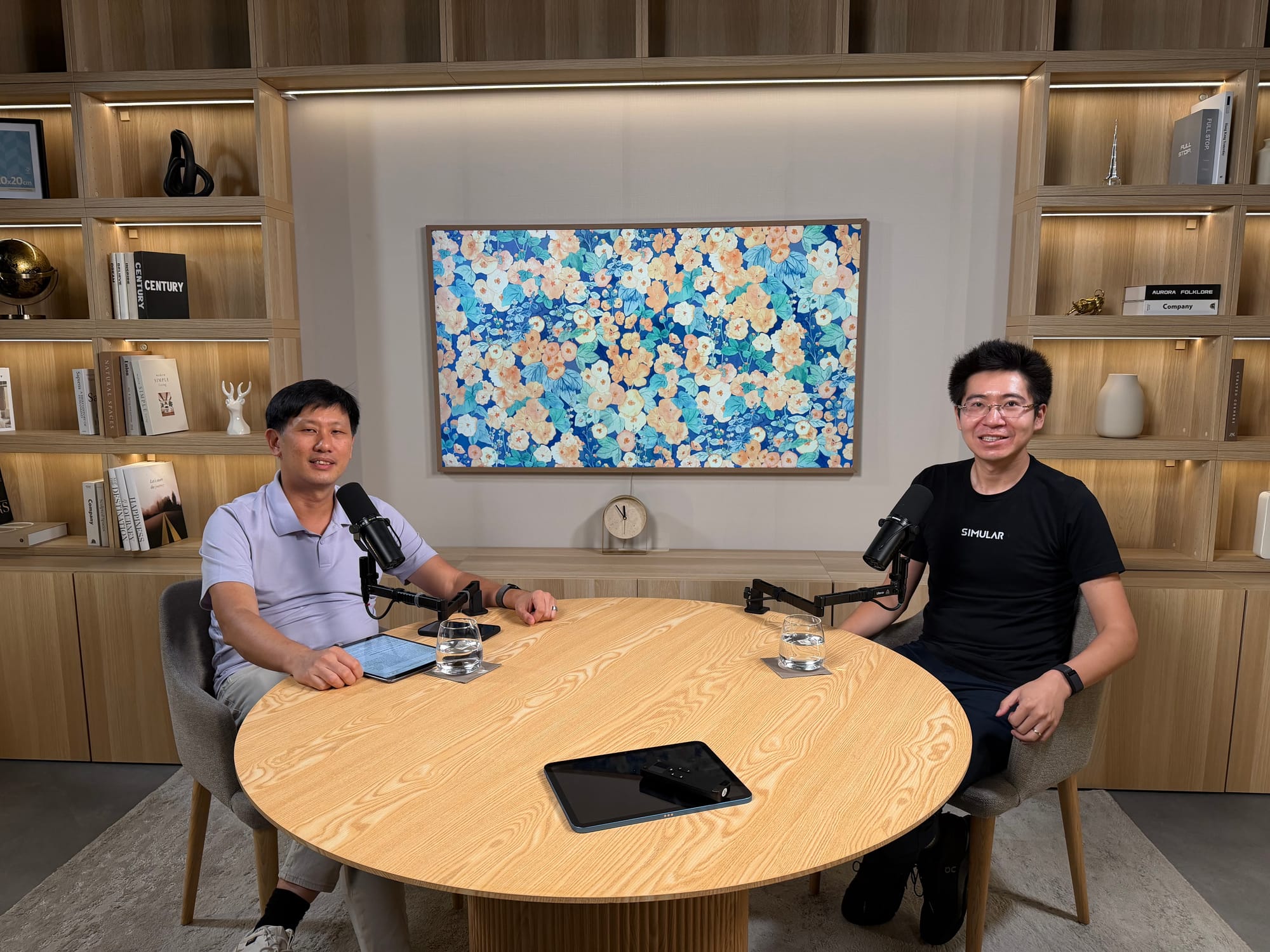
Fresh out of the studio, Ang Li, CEO and co-founder of Simular and previously a research scientist at Google DeepMind, joins us to explore why computer use is the last mile to AGI. Ang traces his path from studying catastrophic forgetting and continual learning at DeepMind to founding a company on a single conviction: models break in production because the data distribution never stops moving, and the only place to close that loop is the real world. He explains why the chatbot metaphor misleads enterprise buyers, why the right unit of measurement is tokens per task rather than price per token, and how the power law of practice should make an agent cheaper every time it repeats the same work. He separates capability from reliability and argues that deterministic work belongs in code rather than in a model, and makes the case that frontier labs exist to sell tokens while Simular exists to remove them. On frontier AI, Ang shares his test for AGI — one you feel rather than see — and what it will take to bring autonomous work down to the cost of water. Last but not least, he shares what great looks like for Simular AI in the future.
"So when I go to the gym, [doing] the same workout everyday, as I do this more and more, more reps, more sets, I don't even need to think. It's called muscle memory. I just do the same in a standard way, my consumption or my tokens in my brain dramatically drops. And there's a term describing this behavior in human cognition called 'the Power Law of Practice'. So that's the whole idea. Do we see power law practice in AI agents? We don't have that yet." - Ang Li, CEO and co-founder of Simular AI
Profile: Ang Li, CEO and co-founder of Simular AI (X, LinkedIn, Simular AI)
Here is the edited transcript of our conversation:
Bernard Leong: Welcome to Analyse Podcast, the premium podcast dedicated to dissecting the pulse of business, technology and media globally. I'm Bernard Leong and last December, a computer use agent crossed the human threshold for the first time — 72.6% against a human baseline of 72.36%. Yet the agent that succeeds once often fails the second time it runs. That gap between capability and reliability is where the entire enterprise opportunity now sits.
Today we take three angles: what an autonomous computer actually is, the economics of the agent token, and whether computer use is the last mile of AGI. With me today is Ang Li, CEO and co-founder of Simular, and previously a research scientist at Google DeepMind. We recently had a very good panel at SuperAI, and the feedback was really good. We will discuss where computer use agents go over the next three years. Ang, welcome to the show.
Ang Li: Thank you so much. Thank you for having me. It's a great pleasure to be here.
Bernard Leong: We are starting with a new format, so the first thing I'm going to ask you is this. Everyone pictures AGI as a humanoid robot or a smarter chatbot. You say it arrives when a machine can fully use a computer. Why are the mouse and the keyboard the last mile?
Ang Li: That's a good question. The goal is to let computers do all the work on their own in the digital world — I'm not going to talk about the physical world. We see a lot of people sitting in front of a computer, working all day long. I believe that's not a natural way for humans to work. The natural way is that we should be able to move around, without having to think about where we are. We can go into nature and do the work. That's the goal: a general purpose computer that can do all of the work for us.
Then the question is what the technical limitation is — what kind of technical problem we need to solve to reach that goal. In the digital world, people write code, they build apps, and they want their code to be useful to downstream applications, so they build APIs. An API is a protocol you can call directly to get the job done.
When we looked at this problem, we realised that even with all the APIs and all the code we have, it is still not good enough. There are so many pieces of software living in our daily life and our daily work that people have to operate with a mouse and keyboard. Take the legacy systems in most traditional industries — transportation and logistics, insurance, regulated industries that require compliance. The evolution of that software is extremely slow. We're still using software from maybe 30 years ago running on a Windows operating system. It has no API, and there is no plan to expose one for you to use. That occupies a huge percentage of the digital workflows we use nowadays.
Bernard Leong: I recently had Aneesh Raman, the Chief Economic Opportunity Officer from LinkedIn, here. One of the comments he left on my podcast was that we actually never left the industrial age. The way you describe it to me is almost that the way our work is structured around the keyboard and mouse is factory work, except it is knowledge workers doing it. What you're saying is that computer use is the next frontier of the user interface.
Ang Li: Exactly. That's the headline I want to mention. Computer use is the next frontier in AI. It is the last mile for us to achieve AGI, because only when the agent has the capability to use the mouse and the keyboard can we accomplish all human activity in the digital world. Otherwise we cannot.
Bernard Leong: I'm a fan of the anime Solo Leveling. The protagonist always snaps his fingers, says "arise," and his shadow army comes. What I really want is for you to provide me that too — when I snap my fingers and say "arise," my AI agents show up. Is that going to happen?
Ang Li: Everything will show up. For now I use my phone more, so what I would say is that if your computers are fully autonomous, then I don't need a computer. An iPad is fine. It's something I can carry, I can read everything on it. You should just have one device you use to communicate with your agents. You might have a hundred agents in the cloud working on different tasks for you. You communicate with all of them, get the jobs done, and they send the results back to you.
Bernard Leong: You have a very grand vision, but I want to take a step back. I want to know your background. You joined DeepMind in 2017, when Google engineers were still saying machine learning never works in production. What did that room teach you that research papers did not?
Ang Li: That was a very interesting observation about the whole industry. I did my PhD in computer vision, and during that time there was still a division between computer vision and natural language. No one really talked about AI. It felt like a buzzword. I was a researcher, so I published a lot of papers, then I went to Google DeepMind as a research scientist. People knew you had papers, that you did research on this or that method for training machine learning models to be better. The reality is that these methods seldom work in practice.
That's actually one of the core topics I worked on at Google, because I represented DeepMind while sitting in Google headquarters in Mountain View. I had the opportunity to talk to all of the Google production teams. This was the biggest phenomenon we found — a gap between applied work and research. The question was why, so we had to study it. We studied all of the products, and it turns out there's a fundamental thing no one really talked about. Today's machine learning is based on statistics.
Bernard Leong: That's right.
Ang Li: Statistics. There's no causal inference.
Bernard Leong: I used to do it as supervised machine learning.
Ang Li: That's right. Everything is co-occurrence, correlations. If it's based on statistics, then there's a very important concept underlying most of the methods, called i.i.d. Let me use plain English to explain it. The idea is that you collect a fixed data set, and when you train the model you randomly draw samples as the training data.
Bernard Leong: It's a sampling mechanism.
Ang Li: It's the same mechanism. The important part is that you have a fixed set of data that has already been collected. Even today this is still happening. Everyone still collects a bunch of data as a benchmark or a training data set and trains models by randomly drawing from it. There's a problem: in real world applications, you don't have a fixed data set. Everything is changing. The real world is changing. I still remember the day a certain keyword in Google Search suddenly rose to become the dominant keyword. It was called Covid.
Bernard Leong: Oh yes.
Ang Li: Suddenly it went up. Can you imagine language models knowing this keyword before that day? They didn't. That's the problem.
Bernard Leong: The way I would think about it is that your DNA is this: models break in production because the data distribution never stops moving. When you decided to build Simular, how much of that was a direct answer to that problem?
Ang Li: That's the direct answer to the problem. The first half of my time was spent thinking about why, and then we figured out why. I led the research agenda in DeepMind called evolving learning over evolving distributions. Exactly what you mentioned — evolving distribution. How do you learn over that? The technical term is continual learning.
How do you let machines continually learn? I believe this is also the last mile to AGI. I was training large models even in 2016. We knew the scaling law was going to work. It gives you a pretty good model. But is that going to be AGI? It's not, because if you have a model that works today, how do I guarantee the model works next month or next year? I have to keep training the model, and whenever I need to train, I need to break the i.i.d. assumption. I need to ensure our models can adapt to the evolving distributions over time.
There's an interesting concept here. When we train neural networks, there's an important problem no one has a solution for: catastrophic forgetting. Whenever you train models, the weights change, and the model catastrophically forgets what it learned in the past. This is the core problem we tried to solve by proposing continual learning approaches — the model doesn't forget catastrophically while you're feeding it more data on different data distributions.
Our research agenda is about whether we can have this kind of feedback loop. You have a system that actively collects data reflecting the real world data distribution, feeds that data back to the model, the model learns continually without forgetting, and the system deploys that model to interact with the real world. What's the best way to do this? The loop only works by putting your AI system into the real world, which means you need a product.
Bernard Leong: I see.
Ang Li: If you look at the company right now, we are building this continual closed loop.
Bernard Leong: Just to make sure, because I have a lot of audience who watch the show — can you help us with what i.i.d. means? The terminology.
Ang Li: Independent and identically distributed. Every time you draw a sample from the distribution, the probability is independent each time, and it's identically distributed.
Bernard Leong: Most of the traditional sampling methods are Markov chain Monte Carlo. There are three other sampling techniques as well. Now, your line is that AGI can only be achieved in real life, not in a lab. What convinced you that the learning loop has to be commercial rather than academic? That's the point where you decided to take the bold step and build a company.
Ang Li: In academia, most of the time you have a curated environment, benchmark and data set that's fixed. Only in the real world is the data distribution evolving. I don't have a choice. In order to solve this problem, I have to go to the real world.
Bernard Leong: Which brings us to the main subject we want to talk about: Simular. We want to talk about autonomous computing, agent reliability, and the economics of computer use. Most people now hear the word "AI agent" and picture a chatbot with tools bolted on. I know that's totally the wrong frame, because I teach AI on both the engineering and the business side. The correct frame is a computer. How do you convince people that the chatbot metaphor is wrong?
Ang Li: This is a very interesting topic that I've brought up a lot recently. My argument is that chat is fundamentally different from work. You're in a company. You might see two types of people, introverts and extroverts. You might also see another two types: some people always go to meetings and talk about things, and another type always sits in front of the computer doing things and never talks.
Bernard Leong: Yes — individual contributors, they call it.
Ang Li: Naturally this happens in the human world. A chatbot only chats. It doesn't actually do things for you. What is the work? The AI worker is about getting things done. If that happens, does it also have to have the best communication? It's hard to have both in the best shape. That's why we need multiple agents to collaborate. This is the future form of the AI system I see. If you just want to chat, you have a communication channel between each other.
Bernard Leong: Your view is that this autonomous computer is what triggers the workflow, triggers whatever action the company's real world use case requires.
Ang Li: Correct. We have to look at the fundamental work every company is trying to build. Every company is trying to build a repeatable playbook so they can scale. We have to look at the playbook — your work needs to be recurring and repeatable. Everyone is trying to figure that out so they can scale quickly. That's the compounding factor of your company: everything you do, next time you spend less energy doing it. Chat is one time. Chat is more like, I just chat with you, I can talk about random keywords, and I don't have to be the same each time.
The properties of these two types of applications are fundamentally different. This is the opportunity for us to see whether there's an AI system that allows us to accomplish this kind of recurring task — almost the same task every day — in a reliable way, because chatbots are not reliable.
Bernard Leong: Also non-deterministic output, because of the...
Ang Li: Non-deterministic, because of the neural nets.
Bernard Leong: One interesting thing is that we're right at the period where people are talking about token maxing. Everybody is now freaked out about the Chinese models being cheaper, so the industry argues that everything is price per token. One thing that came out of our conversation earlier at the conference was that the correct metric, in your view, is tokens per task. If efficiency rather than scale is the real axis, what changes for the people or the customers who are buying agents from you?
Ang Li: That's a very interesting question. You're asking how this token economy would change in our setting. My point of view is that the current industry is still focused on chat. When people talk about open source models, or about Anthropic's Claude and token usage, they are still focused on chat, because chat is about having a model, you ask it something, it responds. There is no notion of recurring in anyone's conversation about the cost of work. We have to focus on recurring.
We have to look at it this way. Suppose I have a task and it costs this amount of tokens, and I repeat this task. What's the amount of tokens I spend? Repeat the task again — what's the amount of tokens again? We did a measurement for the current agents. For most of the current agents in the industry, if you do the same task 100 times, the token usage is basically 100 multiplied by the total tokens for one.
Bernard Leong: That's the average number you worked out for that task.
Ang Li: I used an analogy a few days ago when I gave a talk. Suppose I go to the gym. When I go to the gym, I'm doing the same workout every day. The first time, I may want to look at YouTube and ask a personal coach what kind of posture I should have. As I do more and more reps, more sets, I don't even need to think. It becomes muscle memory. I just do the same thing in a standard way. My consumption, my tokens in my brain, dramatically drops. There's a term describing this behaviour in human cognition, called the power law of practice.
Bernard Leong: Yes.
Ang Li: That's the whole idea. Do we see this kind of power law of practice in AI agents? We don't have that yet. Then the next question is whether we can build this type of system. The first time, I don't care about the token usage — you just maximise the trials to get the best result. The second time, you have already succeeded. Why do you have to spend the same amount of tokens over and over again? Is there a way for you to learn on the fly, so that next time you spend far fewer tokens?
Bernard Leong: Nowadays you also have things like prompt caching, or some form of caching of the task, which I assume is what you're thinking of. There's also the other question. Every model release is now bigger and better — that's what they say. Your position is that agents actually need more discipline rather than more skill.
Ang Li: More than just model improvement.
Bernard Leong: Where does the scaling frame actually break for computer use, then?
Ang Li: The scaling...
Bernard Leong: Scaling laws. Bigger is better. Every time a new model comes out, they tell me it will be much better. What you're trying to do now is find the reference frame to say: if I do this task ten times, and we can measure the same task ten times while the model is getting better, does that mean your concept of tokens per task scales as well?
Ang Li: I don't think so, because chat is different. Chat is more creative. The tasks we are dealing with are more deterministic. If you know how to do the task, you know how to do the task, and you don't actually need better models. There will be a point.
Bernard Leong: There are certain tasks — that is why they're called automation tasks. It doesn't matter whether the model gets better, as long as the task is done.
Ang Li: I don't need to use better models. That's the behaviour I see in the current industry. They use the best model to make it work, and if it works, they try to see whether they can use a cheaper model to handle the same work. My argument is that even the cheaper models may not be necessary, because if the task is so deterministic, you should store it in code. Code is deterministic.
Another phenomenon we see is that these tasks are a long chain of decision making based on neural nets. Each time you have some error rate, and the aggregation of the error rate will be huge. If I'm talking about a long task, do you want to risk your recurring task, every day, on that amount of accumulated error? If you store the majority of the actions as code, it becomes deterministic, and you have minimal risk in performing your task.
Bernard Leong: One question I want to ask you is this. What's the most counter-intuitive lesson you have learned about building agents — something you think most people still get wrong?
Ang Li: I believe AGI is not going to be a single model. It's not going to be a single neural net model, because there are so many fundamental things neural nets cannot solve. Many years ago people worked on symbolic AI, and I think those concepts are still useful. We try to figure out a way to build an AI system with all of those concepts together, to maximise the user experience, instead of betting on a single neural net to do everything.
Bernard Leong: What I like about that is this. The strongest case against you is that the 72.6% on OSWorld was a best-of-N peak, while your own reliability paper puts repeated-run success closer to 45%. Where is that argument wrong?
Ang Li: The point is that the frontier labs' models are even worse on the reliability test. I have to explain some terminology again. The first metric we look at is the capability metric, called pass@k, meaning I run the same task k times, and if one of them succeeds, I'm capable of doing that. The first human performance we achieved was based on this capability metric, because we wanted to see whether an agent has the capability to reach human level. We demonstrated it is capable.
Once it's capable, you have to see whether the agent can do the task reliably in a recurring manner. It's like wanting to hire a person in your company. You do an interview one time. In the interview, you can see whether the person is capable of the job. Once the person joins the company, you still have to measure whether they can perform the job reliably every day.
Bernard Leong: But you can run reinforcement learning, giving human feedback, and the person gets better at the job.
Ang Li: That's actually the point. The whole i.i.d. data distribution question is how you learn on the fly. It's not a predefined data set where you let the person train themselves all at once and sit one exam to pass the bar. That's just the beginning of the work. We're talking about the long lasting part of the work, which is recurring.
That metric is called the reliability metric, and it's called pass^k — pass to the power of k. I still run k times, but I need you to be successful every time in order to pass. That kind of measurement is much harder. We can see there is a divergence between the two metrics when you evaluate on the same task in the same benchmark, just over ten times.
Bernard Leong: In that case, would there be a power law of practice in agents — the same curve that governs human skill acquisition? Does the moat become the practice data rather than the model itself?
Ang Li: A model is a compression of a fixed data set, from my perspective. A model is a compression. A model is a database. It's a database with a higher error rate.
Bernard Leong: I can't believe that — well, I did it using machine learning in the Human Genome Project, which is what I used to do. You're probably right about that.
Ang Li: Fundamentally a model is a database, and it's a more efficient database than a traditional one. Everything is about data. If you have good data, the model will be better. Then we have to look at how you utilise the data, because for work the task is exactly the same. We don't actually need you to generalise on the prompt. This is the first problem we try to solve — the problem is exactly the same every time. If that's the case, the traditional index and method in a database will be more accurate than a neural net, because I know exactly what happened for these tasks in the past. Now I just retrieve the description of the actions and replay it.
As I collect more and more experience from a task, it becomes more and more deterministic and more and more reliable, so I should see improvement in the trajectory accuracy. Suppose k increases — I should see pass^k improve over time. Because most of the behaviours become codified, the token consumption should drop as well.
Bernard Leong: Your task will also hit what I call marginal utility, because in economics you're getting so good at the task that you are always near achieving it. You eventually will achieve the task, if I understand correctly.
Ang Li: Yes.
Bernard Leong: What is the one thing you know about computer use agents that very few people do?
Ang Li: The concept of the power law of practice is not something people talk about. To my knowledge, we are the first company trying to talk about this.
Bernard Leong: Which also means that AI still has a lot of problems to solve.
Ang Li: I believe this is the last one. For now, we have demonstrated that foundation models are capable. The agents built on foundation models are capable of doing most of the tasks. Then, as I mentioned, there's a shift from chat to work, and a shift from one time to many times. What's the remaining part? Can you improve your reliability during the work every day? Can you make the work more economically affordable?
Bernard Leong: Do you think we will settle into a state where the boring work we need to do for knowledge work is taken away from us, and we have the creative work to pursue in our own time?
Ang Li: There will be more and more of a shift to creative work. That's what we want to see. We don't feel it's valuable time for you to do the boring stuff that's so deterministic, so robotic. We want more and more humans to participate in creativity and innovation, and to make the world expansive by discovering new concepts. I personally believe that's the best way for humanity to move forward.
Bernard Leong: I agree with you. People used to tell us in school that whatever you study in university, when you go out it's a totally different world. That's because you're held back by all the rote learning, all the manual tasks and all the reporting tasks you need to do. Now suddenly AI shows up and says all these tasks can be automated away, and what is left is actually the original thing you studied — the creative work you were supposed to do.
Ang Li: Human value is being creative.
Bernard Leong: I want to get a bit more in depth on Simular. Simular lets the models explore, and I think it freezes the successful path into deterministic code. The bad case is that the frozen code becomes a liability once the next model generation is simply good enough. What does it take for you to be right in three years?
Ang Li: Our goal is to democratise autonomous computers to everyone — democratising autonomous work to everyone. That means we need to make this available to people in an economical way, to bring the price down. In the end it's like water, like the cost of water. Everyone can easily access it. We don't worry about spending $10,000 to have this kind of luxury. It's not a luxury; it's a fundamental thing for everyone to have.
That's one of the goals for us. Once we have that, since we have all of the workflows, we should have the best knowledge about how all of the workflows work in the digital world. Once we have that, we create the loop that further drops the price for all of the work.
Bernard Leong: I took a look at your site, and please correct me if I get the prices wrong. Simular Pro is currently $500 a month, in insurance and healthcare. You also have a product that starts at $20. Looking back, what did that teach you about who is actually paying for computer use — the product you're offering to do the automation?
Ang Li: The biggest customer base, the biggest market pool, is coming from small and medium businesses. That's the real problem, because a lot of companies, like the traditional RPA companies, are targeting enterprises. They need human engineers to write the automations for the companies, and human engineers naturally cost more money to hire. It's not something small and medium businesses can afford.
There's a gap in the whole market. Do we have a solution around $500 every month that a small or medium business can still afford? Their real problem is that it's extremely hard for them to hire people. It's hard for them to find a skilled person to do these kinds of tasks. They cannot even find college students to do the task. It's not that they don't want to hire a human — they don't have enough supply. They are also not especially tech savvy. They don't go to LinkedIn, they don't go to a job website, so it's hard to find people.
We have an opportunity to fill the gap, because they need to get the work done immediately, before they have someone. Or some of their team members can do more creative work, so they feel their work is more meaningful. There was a VC in the US — a VC is also a small or medium business — telling me they have an admin who absolutely hated her job, because there are just so many emails. If we have an agent that can help the admin finish the boring stuff, she can do the creative part of the job. You get dragged into those tedious tasks every day, so you have minimal time to do the creative work. The admin can enjoy her work better. She can control the agents to do all the different kinds of scheduling tasks, and do something more creative herself.
Bernard Leong: In healthcare and insurance as well, since this is where you offer your products — what kind of use cases are there?
Ang Li: Healthcare and insurance are more natural. It's not something we offer them, because we are a general computer infrastructure company. We put a product out, and these categories are natural. They reach out to us. Some of them keep sending me emails every day, every month.
Bernard Leong: Isn't that good, because healthcare is very customised and high touch, and now there is actually a computer use case for them?
Ang Li: If you look at these categories, they are naturally regulated or compliance-heavy industries. Because they have that kind of regulation, it's hard for software to move in this industry. Their software is traditional, running on a Windows machine. In the beginning, our first version still worked on a Mac. We saw a lot of people in traditional industries using Windows, and we had to set up Mac virtual machines for them to run our Mac app to do their job. Then the question was, why not just do a Windows version? This year we started a new product called Sai, which has Windows virtual machines that speak more directly to their needs.
Bernard Leong: The customers did tell you something on that. One interesting part is that you have this comment that big players usually buy solutions, not tools. You have also developed Simulang, a language you're handing to developers, I assume to have people help you scale the functions and take the concept further. How does Simulang sit together with your existing business?
Ang Li: This is going to be a more philosophical concept. I once wrote a blog post about how in computer use there are lots of unities of opposites. Neural and symbolic are opposites, so we need to find a system that unifies them. Simulang is the symbolic layer for computer use, and the neural net is the reasoning engine for computer use. Simulang is naturally deterministic and reliable. The idea is whether we can move the information, the knowledge, from the neural net to the symbolic layer, make it reliable as work, and eventually deliver the work. You're not delivering the agent. People only care about whether their work is done.
Bernard Leong: A skeptic would say you're building a thin layer on top of two labs that are most likely to absorb it, since your best results run on their models. What is actually the space between you and the frontier labs?
Ang Li: That goes back to the neuro-symbolic infrastructure I described. You have to understand that the frontier labs' business model is to sell tokens. What I'm talking about is how to reduce the tokens.
Bernard Leong: And how to turn those tokens into useful work.
Ang Li: Make the tokens useful and reduce the tokens over time, so it's more economically sustainable. The goals for the two types of company are not the same. We're not operating with the same goal, so we're not competing with each other. I'm complementing them. I use the foundation model to build agents that have the capability to gradually make whatever should be deterministic — the boring part — deterministic and almost zero cost, and to expose only the creative part of the work to what a large language model is supposed to do.
Nowadays most agents ask large language models to do everything, even when the work doesn't have to spend any tokens. That's why I said everyone seems to be wasting a lot of money without realising it.
Bernard Leong: I always make this joke to my students. Why do you ask the LLM to do two times two? It costs you 20 cents.
Ang Li: I can give you an example. We have a customer who wants to generate a hundred invoices in QuickBooks — QuickBooks is accounting software — and it costs absolutely zero dollars for that to work. It's still recurring; the person triggers it almost every day. You can imagine there are a lot of people in this category still running it through the model, costing hundreds of dollars every day to do the processing.
Bernard Leong: How are you squaring this? Some enterprises now believe they should just download an open source model — it doesn't matter where it comes from, China, the US, wherever — host it on their own premises, and run it as if it's the same thing, still getting the token usage. Actually they forget they are paying the electricity bill.
Ang Li: And the CapEx. The reason you need to pay per usage is this. People who say they can just buy the hardware and put a model on it so it's free have never done anything related to data centres. They don't know. You have to understand that your time is also valuable. Your time, even the mental cost of thinking about whether this machine is still up, converts into some level of money. It's a distraction from your own focus and intelligence. To me, if you can just pay a smaller amount of token cost, offloading everything for convenience, that's actually better, because the demand here can be even bigger in the future.
Bernard Leong: You have said that intelligence needs a body, and the bottleneck is the CPU and memory rather than the GPU. Play that out for me in Asia. Who in this region is best positioned for the agent era? You've been in the region for a while — I'm trying to catch you before you get back to the US.
Ang Li: I'm not a semiconductor expert. I'm a software person. What I see is that because we are working on this system, which follows whatever humans can do — even the law of practice — the cost of work is dropping, and the dependency on foundation models, on GPU-operated models, becomes less and less. What's important in the end? Suppose most of my work is becoming deterministic and I don't rely on LLMs to do the work. Then what's important is your memory and the CPU in the operating system. Memory is understandable, because that's your context. CPU is how you take actions on the operating system.
That's why I believe Asia has a huge opportunity right now. It's just starting, because in the past everyone believed the GPU is the dominating hardware. Now we do see more and more of a transition, and we are getting a lot of virtual computers. We see this could grow, because we host the machines for you and you don't need a computer to sign up. If you have a phone, you can use the product.
What we notice is that people didn't realise that in the past you were boxed into a single computer, because physically you only have two hands. You can only have one device in front of you. You can't have ten, because you only have two hands. You cannot handle so many — people can only focus on one. This is the physical constraint most of us didn't even realise. Once you have a phone, you can talk to a virtual computer to finish the work autonomously. People will start to think: can I have ten? With nine clicks, you have ten computers doing the work for you.
You can see the supply and the demand. The demand is going to explode, because we are getting more freedom. We're not constrained in the physical world anymore. I don't even think having one computer is productive anymore.
Bernard Leong: That's what we were talking about just now. If I snap a finger and the agent shows up as a hologram, I can tell the agent to do whatever it takes, and it's translated into code.
Ang Li: That's right. That's the goal here.
Bernard Leong: Coming back to where we started, you defined AGI as a machine that can do all the work you do. What is the test for you to settle whether we are there? My definition of AGI, when people ask me this question, is that I know it when I see it. Maybe for you it's different.
Ang Li: How do you see it? My definition is that I can follow your definition when I can feel it, not see it. When I feel I'm doing all the work in the exact way I would if I were talking to a colleague in my company. The channel could be text messaging, a very simple text message. Suppose my whole day I just text, and all of my work is done. It's a fundamental Turing test. If I text one of my colleagues and things get done, and if I text the agent in the same way and things get done, how do I know the other side is AGI or human? That's basically my test, from an emotional feeling perspective, because there's no way for me to see it. Everything becomes more virtual.
Bernard Leong: We're touching the physical now. I think we are getting to the point where bits are going towards atoms, where there are going to be humanoid robots.
Ang Li: It doesn't matter.
Bernard Leong: It doesn't have to be human form. It could be something else. Do you foresee that even if that physical closeness is there — because now it's still very digital — it would be the same exact test, where you say you feel the test?
Ang Li: When there is a humanoid... I don't believe in humanoids, and I believe it's going to be a longer time horizon for that to be achieved, because I used to work on perception in cars. I know the hardware iteration is way slower than the digital world. That's why I believe it should occur in the digital world first, and the infrastructure might be similar. It's the same: I'm talking to you as a human, and maybe one day I'm talking to a humanoid. Do I feel the same? If I feel the same, that's AGI. If I don't feel the same, then it's not.
Bernard Leong: What's the one question you wish more people would ask you about autonomous computers and Simular, but they don't?
Ang Li: That's a very interesting question. There's one thing — the fundamental motivation for doing this.
Bernard Leong: Tell me, what is the motivation?
Ang Li: It's more from a humanities perspective. We are surrounded by so much technology and so many devices, and I don't feel that's natural for humans, because we come from nature. Nowadays people spend more time away from nature. That doesn't seem to be the right form of lifestyle. Personally, when I go to the forest, I feel more relaxed, less stressed. Suppose I can do my work in that kind of environment — why not? Why not make sure everyone has the opportunity to enjoy their life while the whole of humanity stays productive?
It naturally becomes a separation of workforce and humans. The workforce should be fully autonomous, instead of you babysitting and handholding all the time. They should have a communication channel with you, so they can report to you if something happens. That's basically the fundamental future vision we are looking at. Potentially we won't be doing podcasts in an office space in the future.
Bernard Leong: I hope I can still do this, but you're probably right. My traditional closing question: what does it look like for Simular over the next decade?
Ang Li: Achieving our goal. I think AGI is coming very soon, especially in our own definition, in the digital world. I'm constantly worried that the arrival of AGI creates a huge gap between humans. Personally I want this type of technology to empower everyone, not just the one who has a huge amount of money. That's why we open source a lot of our technology, and we really try to drop the price. From $500, we now try to see whether it's doable at $20, maybe free. Is it possible for us to democratise this type of intelligence into everyone's life, to empower everyone? I think that's going to be a huge success.
Everyone will feel far more productive. If they want to do something, the machines will handle it for them, and everyone will focus on what they are truly passionate about. Find your own passion and follow it. Follow your heart. Do the work as part of your life, because life is so short.
Bernard Leong: Ang, many thanks for coming on the show. A really interesting conversation. I haven't had this kind of thinking about data distribution and machine learning for a while. I have two more short closing questions. The first one: any recommendations that have inspired you recently, like a movie or a book?
Ang Li: It's not something very recent, but I always remember this from when I first joined Google DeepMind. We had a product manager, Gabe, who was very good. We used to do one-on-ones, and he recommended a book called Range. The book studies different athletes, and the core argument is whether we should be generalists or specialists — whether humans should be generalists or specialists. It's debatable and controversial, but the general conclusion is that generalists usually win.
That concept matches my own understanding. I've been working with a lot of really smart people, experts in the world, and almost all of them know a lot of concepts everywhere. They have very broad knowledge. They are specialists in their own domain, but they also have a very wide breadth of knowledge. That inspired me about agents — how agents will be shaped, and what the human role in society will be in the future.
I do see situations where humans are forced to be specialists in a narrow domain, because society needs that. You need to be a specialist. We often forget that being general is also important. This is also connected to your hiring standards. What I usually call it is T-shaped capability. People ask me, if AGI comes, will there be only one AGI system? I say no, because everything is T-shaped. This is general intelligence — artificial general intelligence — so everyone is a generalist, but in the end they still need to differentiate in terms of their own specialty.
There will be one agent that's really good at calling APIs or doing all the tasks. There will be another general AGI system really good at moving the mouse. You need to be general and a specialist at the same time, not just one. You don't want to be general with no specialty at all — that's not useful. You don't want to be a specialist who doesn't generalise, because you're stuck in a certain area.
Then it becomes a question: suppose AGI comes, what's the human role? I believe humans are extremely good at being creative, at being innovative. I don't see an opportunity for machines to take that part away. That becomes the specialist part. It's not about subject matter anymore. Humans will be more general, because you can use the tools. Everyone will be a very general generalist, because you have your agents working with you, and the creative part is actually the specialist part for humans. All of the remaining work can potentially be handled by machines — the boring job.
Bernard Leong: Where can my audience find you and Simular?
Ang Li: LinkedIn and X. I'm always there. A lot of people send me an email, but apologies in advance if I cannot reply, because it's a big volume. I still try to write back manually, because I believe that even in the AI world — AI is going to help us — it's important for me to still reply in a human way, to show some level of respect to my peers in the human world. On LinkedIn and X, feel free to reach out to me, send me messages. I always see them and I will try my best to reply if the request is legitimate.
Bernard Leong: Great to have you here.
Ang Li: Thank you so much for having me.
Bernard Leong: This did more justice than the panel we had at SuperAI. It's really great to have you here. You can find us everywhere — do subscribe. Thank you for coming on the show. Let's talk again sometime soon.
Ang Li: Thank you. Exciting to be here.

Podcast Information: Bernard Leong (@bernardleong, Linkedin) hosts and produces the show. Proper credits for the intro and end music: "Energetic Sports Drive" and the episode is mixed & edited in both video and audio format by G. Thomas Craig (@gthomascraig, LinkedIn).