

e-Conomy SEA 2026: Inside Southeast Asia's AI Economy with Nitin Gajria, Florian Hoppe & Cassie Wu


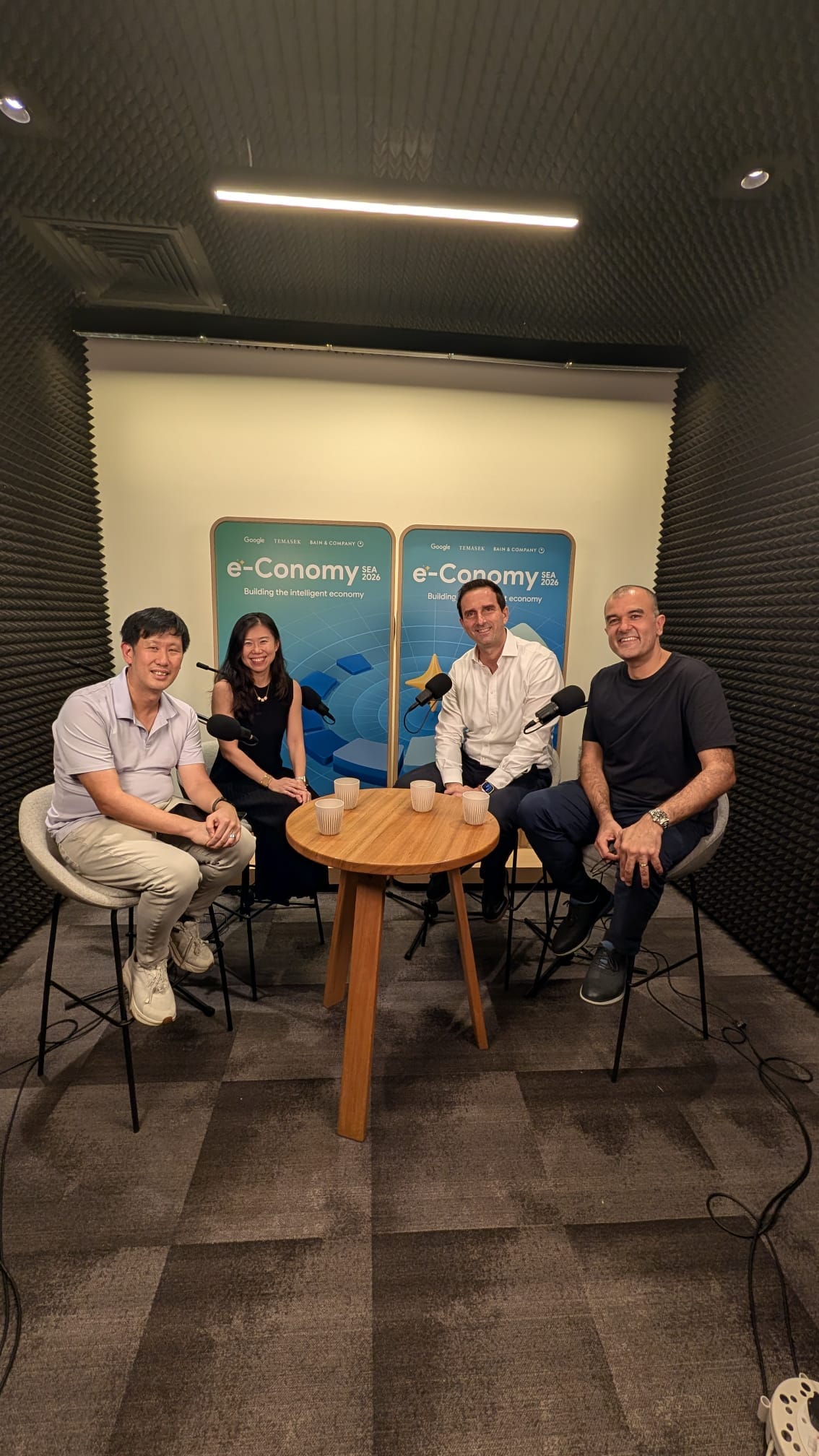
Fresh out of the studio, this marks the 11th year of the e-Conomy SEA report with Nitin Gajria, Managing Director, Southeast Asia & South Asia Frontier Markets, Google; Florian Hoppe, Partner at Bain & Company; and Cassie Wu, Director of Investments, Asia Pacific (excluding China and India), Temasek. Generative AI reached 240 million users, or 60% of the working population, in three years — a milestone the Internet took ten years to hit. Yet per capita token usage is one-tenth of the US, with the gap almost entirely in enterprises outside Singapore and Malaysia. The panel shows AI-assisted shopping journeys lifting average order value by 75%, sets four tests for durable AI companies in Southeast Asia, and argues the region's diversity is its moat as Southeast Asia enters its AI decade.
"62% of users in Southeast Asia feel more positively about AI this year than they did last year ... We're stepping into the AI decade for Southeast Asia. And we're just at the ground floor of that. So it's going to be fascinating to watch how the technology arc plays out."" - Nitin Gajria
"In Southeast Asia, I think we should use our diversity to our advantage. Our diversity is a feature, not a bug. You know, in our survey we say 70% of local usage is in local languages, that's just one reflection of that. Different culture, different cultural context, consumer preferences, user behaviors, also enterprise behaviors. And if you actually are able to build deep embedded local partnerships to have those contacts and to build tailored products for those verticals and users, I think that's important." - Cassie Wu
"We've consistently seen a picture of double-digit growth in the mid to high teens, even in countries and markets where wouldn't have expected this. E-commerce is up 17 to 18% if I quote correctly. Digital media and the whole kind of digital ad space up above 20%. Digital financial services in many pockets, like lending, is up above 20% as well." - Florian Hoppe
Profiles:
- Nitin Gajria, Managing Director, Southeast Asia & South Asia Frontier Markets, Google (LinkedIn)
- Florian Hoppe, Partner at Bain & Company (LinkedIn)
- Cassie Wu, Director, Southeast Asia at Temasek (LinkedIn)
- e-Conomy SEA Report 2026
Here is the edited transcript of our conversation:
Bernard Leong: Welcome to Analyse Podcast, the premium podcast dedicated to dissecting the pulse of business, technology and media globally. I am Bernard Leong, and the e-Conomy Southeast Asia report has been a constant staple of this podcast. We are celebrating the 11th year of the report.
This is my sixth year covering it with the people involved in the report. Today I have three guests. I have Nitin, the latest addition, who is the Managing Director for Southeast Asia and South Asia Frontier Markets at Google, Florian Hoppe is a partner at Bain & Company, and Cassie Wu is Director, Southeast Asia at Temasek Holdings. Welcome on board.
We're going to start with Nitin first. You have lived in Southeast Asia, then you moved to Africa, and now you're back. Can you tell us about your career story and share a bit about your background with my audience?
Nitin Gajria: For sure. In my most important roles, I'm a husband and a father. Beyond that, I've been working at Google for the last 12 years and have had the privilege to do a range of interesting things. I used to run our business across Vietnam, Cambodia and Laos. After that, I ran the business across sub-Saharan Africa for about four years, which was a fascinating experience.
I came back and looked after our publisher partnerships for a period of time. Now I've just taken on this new role for this exciting region with so much going on.
Bernard Leong: I want to draw on your experience. What is it like leading in a frontier market like Africa? Now you're bringing another set of experience back to Southeast Asia, which also has frontier markets. What have you learned from your role in Africa?
Nitin Gajria: One of the biggest insights I had in my four years of living in Africa was observing the technology adoption arc. When I first moved there in 2019, internet penetration was still increasing at a very rapid pace. It was fascinating to see people get onto the internet for the first time. Beyond seeing the numbers tick over, what was really fascinating was what people did with the internet once they got access to it.
There's a parallel with what's happening in Southeast Asia now with the emergence and adoption of AI technologies and tools. The growth arc in adoption is fascinating to watch. What will be even more fascinating to observe is what people do with access to these technologies.
Bernard Leong: So you're talking about leapfrogging as well.
Nitin Gajria: Leapfrogging and application. How do you use this technology to solve real, tangible problems?
Bernard Leong: One more thing I always have to ask, for the younger audience out there: what career lessons from your journey can you share with my audience?
Nitin Gajria: One theme that has always stayed with me is that growth happens at the edge of your comfort zone. I've always found a lot of value in getting out of the known and making myself a little uncomfortable along the way, putting myself in new situations. It doesn't have to be about living in a different country, working in a different region or changing career paths.
It could also be in day-to-day decisions that leave you a little uncomfortable, with less certainty on the outcome. That's where growth really happens.
Bernard Leong: Florian and Cassie, I definitely have not forgotten about you. What have you been up to since we last spoke? Last November, we said Southeast Asia is the most AI-curious region. Looking back, what did that framing get right, and what did it miss? Cassie, maybe you can start us off.
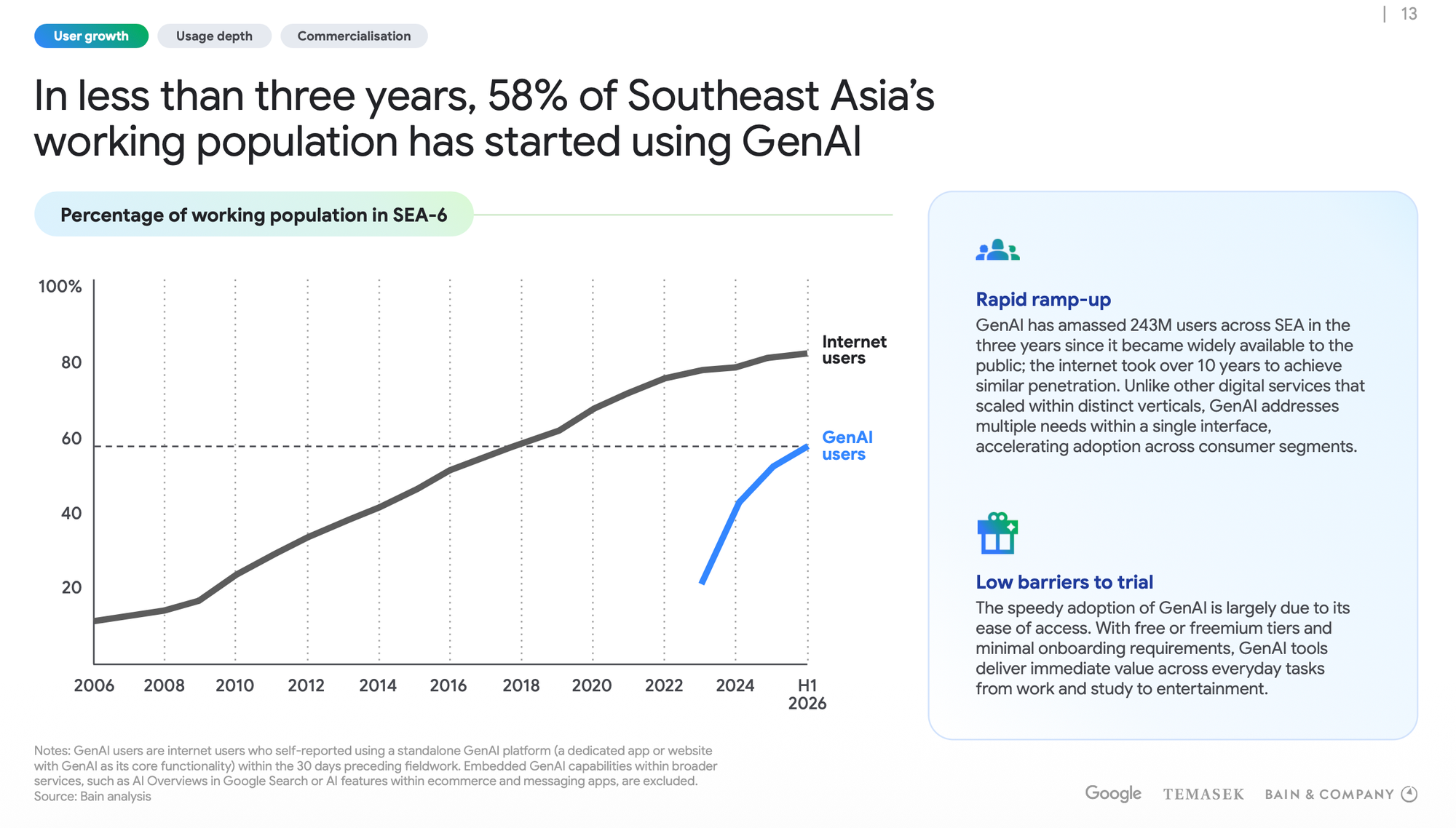
Cassie Wu: I think we got our framing absolutely right. We said Southeast Asia is the most AI-curious region. Twelve months on, we have more than 240 million generative AI users. That is 60% penetration of the working population. In all the years we've done the digital economy report, internet penetration took ten years to get to that number.
AI took barely three years. So I think we were absolutely right. I also made a bold, hopeful note last year that Southeast Asia would use this AI moment to leapfrog in technology.
I think we are moving very much in the right direction. There are still many things to work on. We are at one-tenth of the US in per capita adoption from a token usage standpoint, and our monetisation is still very early. We're certainly moving in the right direction.
Florian Hoppe: Well, I spent the last 12 months preparing for the next podcast with you.
Bernard Leong: I always ask that question.
Florian Hoppe: It's been an exciting period for AI adoption in the region. We've seen the continued diffusion of AI knowledge in the broader population, with people of all age groups getting on the bandwagon. That speaks to the power of the ease of engagement with these tools for every age group, which I think is very powerful.
As a firm, we spend most of our time helping enterprises across the region get on the bandwagon as well. That is arguably still at an earlier stage. We see exciting progress on the consumer side, which has driven the progress so far. Enterprise adoption is still lagging the US and other markets, with the possible exception of Singapore.
That's where the unlock has to happen, and where we think there's a lot of potential left for Southeast Asia: spreading AI more broadly into everyday use cases and the way companies operate, so they get to the next level. That requires more than consumer adoption.
On the data side, for example, there's a lot of work left in Southeast Asia, but there's also increasing awareness that it needs to get done. We're quite excited about the potential this brings for the region.
Bernard Leong: Let's get into the report. One of the first themes is building the AI economy. The report projects around 17% growth in the digital economy's GMV this year. What evidence tells you that AI is creating new economic activity, beyond improving businesses that were already growing?
Nitin Gajria: If we start at the highest level, 17% year-on-year growth puts us squarely on track to achieve US$1 trillion in the value of the digital economy by 2035, which is an incredible milestone to look forward to. When you look underneath that number, the biggest chunk is e-commerce, at roughly US$226 billion in GMV as of 2026.
E-commerce has grown at 18% year on year. These are phenomenal numbers. What's remarkable is the resilience the digital economy shows, even amid global economic and geopolitical uncertainty. Underneath the e-commerce numbers, we're also starting to see AI integrations coming into the e-commerce journey. We're seeing more personalised recommendations.
We're seeing discovery happening through multimodal search, and this is starting to generate incremental value. We're seeing 10% higher conversions where AI is part of the journey, and there's a lot more to come on that front. Beyond e-commerce, the next big chunk is digital media, which includes digital advertising, streaming and gaming.
That's roughly US$44 billion of GMV, and it's the fastest-growing segment at 22% year on year — again a testament to the resilience of the digital economy. In sum, what's fascinating to see is AI going from hype to providing real utility and value in industry-specific use cases. That drives resilience into the digital economy and keeps us on track to that US$1 trillion in 2035.
Bernard Leong: Is there an example where AI has changed an entire workflow with measurable results? I should thank all of you, because I've read the report and saw some of the example use cases you mentioned.
Nitin Gajria: One of the starkest examples I've seen is the way sellers on marketplaces are using AI to make their jobs easier and more effective. In a pre-AI world, if I'm selling bags or snacks on one of the large marketplaces, the process to merchandise my products and get them up for sale would look like this: getting the product in, putting it against a white background, shooting it, uploading the image, writing a product description, maybe adding the ingredients.
Then there's the ingredient listing, thinking about how I want to promote the product, setting up campaigns and so on. As my kids would put it, that's a lot of fuss. Now, with generative AI, you can bring in an image of the product and turn it into studio-quality images that you can upload onto any of these platforms.
You can generate product descriptions, ingredient listings and even a video to promote the product. You can generate campaigns and kick them off, all in a matter of minutes. That's one product with one seller, and the efficiencies it unlocks.
If you multiply this by millions of products and millions of sellers, think about the multiplier effect on the efficiency unlocked. For me, the biggest value is in the democratising effect of these AI technologies and the capabilities we're putting in the hands of small sellers, which starts to level the playing field.
These capabilities would normally have been the purview of only the largest brands and retailers with big budgets. So I'm really excited about the democratisation.
Bernard Leong: So small sellers benefit a lot from generative AI because all these tools are being democratised.
Nitin Gajria: In this example, absolutely.
Bernard Leong: Florian, I want to ask you about tokenomics — not crypto, but AI usage measured in tokens per capita. Southeast Asia now sits at roughly one-tenth of the US, if I have it right, with about 243 million generative AI users.
What is the missing bridge between experimentation and meaningful productivity?
Florian Hoppe: Good question. First, why we use tokens: we felt that, at the current stage, it was the closest we could get to a GMV metric for AI, to give any sense of the scale of activity in the region. You're right that Southeast Asia is a smaller economic region, at roughly one-tenth of the US on GDP.
On a per capita basis, we're also at about one-tenth of US AI token usage, and the delta is almost entirely on the enterprise side. Consumers are highly adapted here. As Cassie mentioned earlier, we're looking at about 240 million people in the region who regularly use generative AI tools, which is spectacular in such a short period.
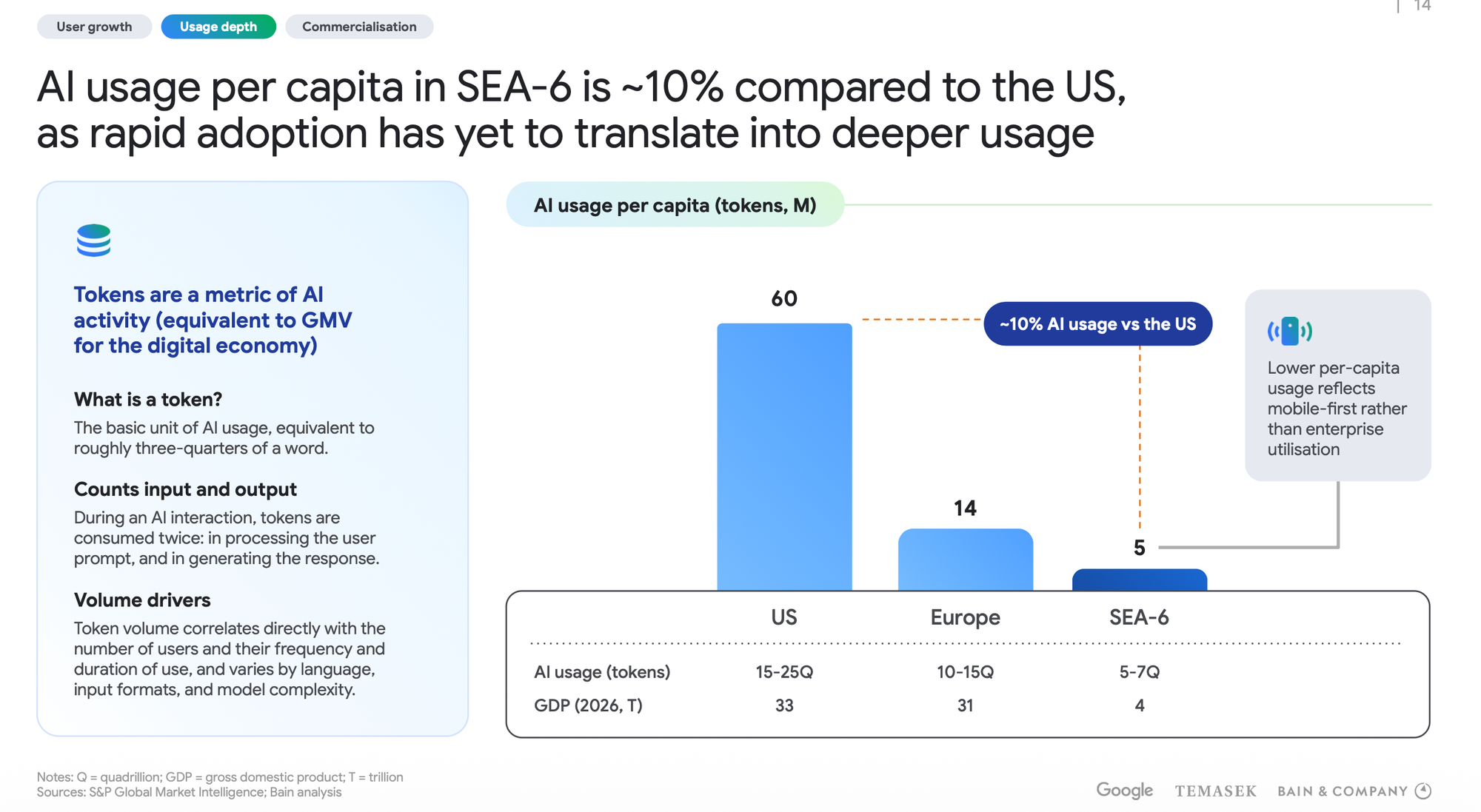
The bigger issue is that enterprise adoption is still lagging. We're not seeing the activity we see in the US. Singapore is the exception, and Malaysia to some degree, where there's been more progress. To really change the game, enterprise uptake has to go further.
The average consumer use case just isn't that intense. I'm sure all of us here are guilty of having done our vacation planning with AI. That doesn't cost many tokens. The intense, high-frequency token use cases for inference come when you do engineering work to upgrade software, or when you productise an AI workflow with a regular activity level in a finance function, in procurement or in HR. That regular volume drives further uptake.
That's something we're still somewhat short of. I think we'll see more of it now because, as in the e-commerce seller example Nitin gave, these tools are coming into the market and will see higher-frequency use. We'll start seeing more uptake on the enterprise and SME side for generative AI in the region.
Bernard Leong: Your definition of consumer-led AI includes employees using personal accounts for work. But our lives are quite different: you probably use one AI tool at work and another personally. How do you think about separating individual adoption from an organisation actually changing how it operates?
In the cybersecurity world, we call that shadow AI — when somebody links up both accounts. But many users are sophisticated enough to know these are two separate spaces.
Florian Hoppe: I think it is quite distinct. I'm sure there's some business use of personal tools, but the other way around is probably less frequent. Most people are still experimenting, so we see a lot of people using multiple tools. There's a lot of free use in the region.
Only 1 to 2% of consumers pay for their personal AI tools. Most of it is free use and experimentation. Then you've got the enterprise tools coming from the other side, which are also going to play a role.
Bernard Leong: I'm curious: what finding in this year's report most challenged your own assumptions about Southeast Asia's digital economy? Nitin, you can start, and Cassie and Florian can add.
Nitin Gajria: One thing I found insightful and surprising is the role of AI within the purchase journey. AI is not rushing or shortening that journey. It's making it a lot richer and leading to higher-value decisions. If you dig into that, what's interesting is the way discovery happens in the first place.
People are doing more multimodal searches — more searches involve voice, video or an image than we've ever seen before — and that leads to a different kind of discovery. About 19% of searches now begin on a standalone AI tool, so the starting point of discovery is evolving. Once you get past discovery, two-thirds of decision-making involves AI in helping make the final decision.
My discovery has led me to a set of options, and I consult AI to arrive at a final decision. This varies from one category to the next: higher-spec, higher-involvement categories see more involvement from AI. What I'm finding fascinating is the other end of the spectrum, the output. Consumer journeys with AI built into them result in a 75% higher average order value than journeys without any involvement of AI.
So I'm really seeing AI in the shopping journey emerge as a clarity engine. It's helping users make more informed choices, arrive at clarity and make higher-value choices.
Bernard Leong: So this is an augmentation of the journey, and it makes the journey richer from your point of view.
Nitin Gajria: Absolutely.
Bernard Leong: Any thoughts from Florian and Cassie?
Florian Hoppe: The point I would emphasise is what's exciting — and potentially, for some companies in this space, somewhat frustrating: the playing field keeps evolving. Think back to when we all started this. Desktops and laptops were still a big thing, and the mobile internet was all the rage.
That shifted very quickly to mobile and smart devices, which changed how consumers engaged, what companies looked for on the data side, and how they tracked and followed consumers. Then platforms captured consumer attention and took strong control of the consumer journey. Now the aperture has opened again with AI, which is enriching all our lives but also making life harder again for the companies operating in this space.
They all have to react to this. We're still in the early innings of experimentation around where and how AI generates value in this whole world. I'm sure many of the same players will come out of this as important parts of the ecosystem. But it is another reshuffling of the cards.
Bernard Leong: Cassie, any thoughts?
Cassie Wu: I would comment as an investor looking at how the funding landscape has evolved. What I'm very pleased to see is the broadening of participation across different classes of investors in the digital economy — which today is the intelligent economy. When we first started the report, we were very much focused on the early builders and VCs building the digital economy.
Many of those companies have now become large, profitable, growing companies. They continue to invest, and we are seeing new builders continue to build. We are seeing 80% of the companies being built have AI embedded in them, which is very promising. With the massive infrastructure build we are seeing in Southeast Asia, more capital providers are coming into the market to build the foundation of the AI economy, across infrastructure and private equity.
We're also seeing late-stage investors participate, investing in the transformation of the next stage of our digital champions. It's exciting to see such broad-based participation from a capital markets standpoint to support the AI economy.
Bernard Leong: So AI is encouraging a much earlier build-up of digital infrastructure, which in turn powers the digital economy itself. The report also talks about two kinds of AI products converging: model-centric platforms built for complex tasks, and experience-led apps built around everyday habits.
Downloads tripled in nine months. For the next 100 million Southeast Asian users, what is more important: model capability or everyday user experience?
Florian Hoppe: I would come back to my earlier comment on the reshuffling of the cards. I think it's two sides of the same coin. At the end of the day, you need the model in the back end. You now suddenly have new customer-facing front ends — these model-centric platforms that you engage with directly — and they're getting better and better at embedding themselves in different situations.
On the other side, consumers want to be caught and engaged in the moment, and where this all ends up is anyone's best guess. For me, it's a bit like the early days of the internet, when we all went onto walled-garden platforms first and then branched out into the scary World Wide Web from there.
That changed a lot over the years, and I think we'll see the same happening with AI. For now, we have slightly different worlds: embedded solutions in specific tasks, and more model-centric platforms that will keep warping and morphing. I'm sure these platforms will play a role down the road.
At the end of the day, they need strong models in the back end everywhere, and everyone wants consumer engagement to be as easy as possible. I think it will be a bit of a blend.
Bernard Leong: What is the one thing you know now about the differences between Southeast Asia's AI markets that very few people appreciate?
Nitin Gajria: We all know that Southeast Asia is a collection of disparate countries with different cultural contexts, economic contexts and so on. One of the things this report throws up that I find quite interesting is that we're starting to see two distinct cohorts emerge. It's early days, but we're seeing two distinct cohorts emerge.
One cohort consists of Singapore and Malaysia, where we're seeing a higher prevalence of enterprise use cases — roughly half of all tokens consumed in Singapore and Malaysia are behind enterprise use cases. On the other hand, the other four markets — the Philippines, Vietnam, Thailand and Indonesia — show a lot more consumer use cases.
The application layer you were talking about accounts for 65 to 80% of token consumption in these markets. It's interesting to see this emerging so distinctly. One outlier is Vietnam. From a user penetration perspective, Vietnam ranks fourth among the six markets in Southeast Asia.
When you look at depth of usage, such as weekly usage, Vietnam pops up in second place, just behind Singapore. So Vietnam is showing a slightly different dynamic. Again, it's early days, and it will be interesting to see how these two cohorts evolve.
Bernard Leong: Any thoughts, Florian?
Florian Hoppe: Nothing to add. Great summary.
Bernard Leong: What about the sector performance picture — digital financial services or other areas? How do they look this year, and which sectors challenged the assumptions you had going into this year's report?
Florian Hoppe: The first thing that really surprised me in this year's report — and we put these GMV and other numbers together every year — is that I wasn't expecting such a rosy picture, given the macro news flow this year. We've all seen the news cycle swing between tariffs, trade war and real war, and I wondered what was going to come down the pipe.
The digital economy in Southeast Asia has been incredibly resilient, even in markets that look more challenged on macroeconomic statistics, currency movements or the stock market. We've consistently seen double-digit growth in the mid to high teens across sectors and countries, even in markets where we wouldn't have expected it.
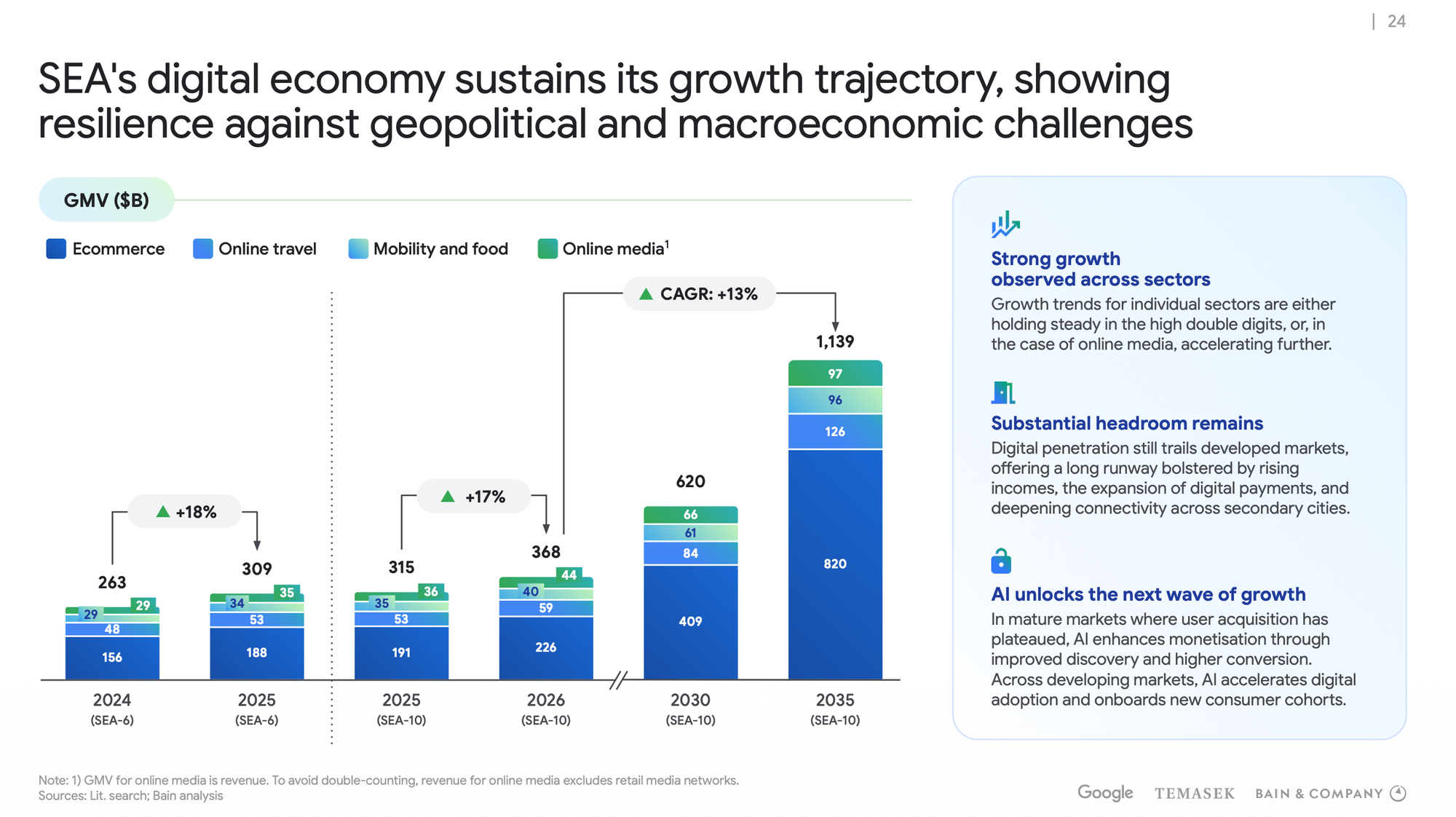
We spoke about some of these already. E-commerce is up 17 to 18%, if I recall correctly. Digital media and the whole digital ad space is up above 20%. Digital financial services in many pockets, like lending, is above 20% as well. Despite the massive base, and a macroeconomic context where growth is probably more in the 4 to 5% range, the digital economy is comfortably outgrowing it by three to four times.
That can't last forever. At some point the real world catches up with the digital economy as well. For now, the growth momentum is unbroken, and it's exciting to see the dynamics continue to unfold across sectors — partly on the back of AI, and partly on the back of increasingly strong domestic players in the region.
Over the last few years, our reports have also covered the improving revenue picture and profitability coming in. We now see profitable players in all sectors of the digital economy, and we've seen them reinvest that profitability into the marketplace. The funding landscape has decidedly shifted to AI, and the core Series A, B and C funding we used to track still isn't looking too rosy.
That is very disconnected from the operational performance of these companies. If I look at their operational performance, they actually stand out for this part of the world. It's exciting to see that continuing momentum for the digital economy out here.
Bernard Leong: A follow-up on AI in the customer journey: if the AI assistant becomes the customer's starting point, how does owning and understanding the customer shift across brands, marketplaces and AI providers in the next few years?
Florian Hoppe: You're raising a good question. In the e-commerce space, for example, about 20% of consumer journeys now start with AI, so discovery is AI-influenced — some may say for about 60% of journeys. Let's be clear: anybody in this room who spends more than US$500 on something probably checks with AI first on what the right product to buy is.
AI has become a really important influence in the shopping journey. Very few people trust just one source; most people check around. We still see a lot of "trust but verify": checking with the AI and then quickly typing it into a well-known search platform to check if the facts are correct.
That gives another AI perspective to add to the mix, plus some website links.
Bernard Leong: I find it very interesting that even though you use an AI query, you still end up doing a Google search. That makes the whole search narrative very different from what was originally forecast.
Florian Hoppe: It adds a lot of steps to people's product decisions. As an e-commerce player, a consumer goods company or a technology company trying to sell products, you have to think very multi-touchpoint. You have to make sure you're discovered by AI and present on all the key tools.
You have to make sure you have independent product reviews. You have to make sure no one talks badly about you on Reddit. It becomes a pretty complicated game for a lot of companies — another step up from the past.
Bernard Leong: If discovery now happens in the assistant, where does the ad dollar go next? Can anyone take that?
Florian Hoppe: I can start, because this may be awkward for Nitin.
I actually think advertising will just be more diversified. It's hard to see the end state. You've seen some news that the AI platforms are starting to tap into advertising. Again, that's everyone's best guess at an end state, but I highly doubt we end up in a world where AI platforms embed advertising, because then who's going to trust the results from the AI?
So it always has to be a little bit on the side. That means dollars will continue to be spread across all the potential touchpoints: influencer marketing, making sure you've got reviews for your products out there, and product placement. Very few people discover truly new products or things they want on AI.
How would that happen? You need to stumble across them somewhere on the internet. That won't go away, so the discovery journey will still be there. The closing part of the funnel is probably the most interesting one, in the commerce ad space. The big e-commerce platforms here are still far under-indexed on advertising dollars.
Compare that with Amazon in the US, where about 10% of GMV now goes to advertising. That hasn't happened here yet; they're at the early stages of this. So there's a lot of upside in ad spend at the end of the funnel.
Nitin Gajria: If I could add to that. Earlier we talked about the digital media space, and a big chunk of that is digital advertising. That's the fastest-growing sub-vertical across the digital economy as we speak, growing at 20% plus. So I don't think advertising goes away.
To Florian's point, I think advertising gets more diversified and more complex, which is an incredible opportunity for advertisers, and it's great for consumers.
Bernard Leong: Here's another interesting customer journey, which is becoming a conversation even at dinner tables. Among surveyed AI users, 75% are open to an assistant finding the best price and buying for them, assuming it is reliable. What must a business demonstrate before that willingness becomes permission for an AI agent to spend money on your behalf?
I'm probably a power AI user, and I would never — I say this, but maybe at some point I would also fall into the trap — put in my credit card to get the AI to do the shopping for me. Help me think about that: what kind of trust must a business earn?
One of the big themes from the report this year is trust in AI.
Florian Hoppe: It's a good question. That's one of those use cases where there's some early adoption, but mentally — and maybe I'm getting old here — it's hard for me to get my head around giving my credit card to an AI and letting it start shopping for me.
We asked consumers about this in this year's research, and one of the key points is trust and data privacy. They want to make sure they can trust the platform, which means it has to be somewhat independent and make the best possible decision for them. The data also has to be protected.
Then things go wrong, and that becomes a real problem. How you build trust around this is an open question, as is how these platforms can scale it.
Bernard Leong: The question that comes back to me is: if the agent makes the wrong purchase, who should be held responsible for making it right? Is it the AI assistant or someone else?
Florian Hoppe: This requires stronger regulatory frameworks. It requires governments to step in. Who purchased wrongly? If the AI screwed up, then presumably someone in the purchase flow has to step in. But if my eight-year-old son goes to my laptop while I'm away and buys all the Lego in Singapore — then what's going to happen?
There has to be a regulatory framework around this, and we'll probably see a lot of clarification come through over the years. It will take time to embed, because this is not only a consumer technology question. It's an adoption question, and ultimately a regulatory and legal question to figure out.
Bernard Leong: To add here: there's already regulation in Singapore where, even if you want to move some cash across, there's a cooling period of around 24 hours before the transaction goes through. Now I want to come to the big one, because this is where I have to talk to Cassie: funding the AI decade and what it will look like. AI applications now account for 80% of private funding.
That's at least for the first half of 2026. If I'm a sceptic, I would say AI features will become standard in everyone's company. So what makes an AI company's advantage durable enough to earn capital from investors?
Cassie Wu: I'd say the sceptic would be right. On one hand, we have seen so much more AI adoption in our new digital economy champions. On the flip side, embedding AI as a feature is becoming table stakes — it's what everybody will do.
Then what builds a durable company? We need to go back to the basics: how are companies using AI to build durable advantages, and how do they compound those advantages? In my mind, I'd put that into four categories. The first question I ask is: is the company building a product that is deeply embedded in the customer's workflow?
It is one thing to build a chatbot or a feature, and another to build a product with multiple touchpoints in a journey. Nitin mentioned the seller journey, and there are many touchpoints within the e-commerce journey where you could improve the customer experience, the seller experience and so on.
That's one e-commerce example. There are many others, and we are seeing companies build that and integrate more deeply, which makes them harder to rip out. That's point number one. Point number two: we all like the sound of proprietary data in the AI world. What does that mean?
It means the company has proprietary context that allows it to build a better product and understand the customer better. That context could be proprietary data. It could be industry partnerships that give it permission to use that context to surface the right recommendation at the right time, or to perform a certain workflow at the right time.
So the second part, proprietary context, is very important. The third point comes back to ROI: is the product producing measurable ROI? With a chatbot, it's very tough to say what ROI it provides. But many of the use cases now taking off have clear feedback loops. Coding is a clear use case where the feedback loop works very well.
You know whether a line of code works. Customer service is another use case: was the ticket resolved, is the customer satisfied, are we saving on customer support cost? All of these stimulate usage. Again, that comes back to my first point: does it promote deeper embeddedness into the customer's workflow?
Lastly, the amazing thing about AI is that if the business model is designed right, you can build a lasting compounding loop that makes the product better. The aim is to close the feedback loop, so the product keeps getting better and a feature from a competitor cannot replace the feedback loop you have and the base built upon it.
Now that AI as a feature is table stakes, we need to go back to the basics and think about what fundamentally builds a durable business.
Bernard Leong: Take a Southeast Asian company that wants to build an advantage a global AI provider would struggle to replicate. Are there mental models you can point to?
Cassie Wu: I'd go back to the four points I mentioned; a few particularly apply here. One is proprietary context — local context. In Southeast Asia, we should use our diversity to our advantage. Our diversity is a feature, not a bug. In our survey, 70% of usage is in local languages, which is just one reflection of that. There are also different cultures, cultural contexts, consumer preferences and user behaviours.
There are also different enterprise behaviours. The context of what consumers and enterprises want is important. If you can build deep local partnerships to get that context, and build tailored models and products for those verticals and users, that's important. The second is workflows — and I use the word workflow very broadly.
We are fragmented, which also means we have different payment rails, different regulatory frameworks and different logistics networks. How do we build a product that works with different workflows and customer experience flows, and embed it into them? That's very important. Putting it together, I come back to trust and distribution.
It goes back to distribution and trust. In Southeast Asia, we have 600 million digital economy users, and we already have platforms with those assets. How do we multiply on that? How do we build trust and earn permission to use that context from consumers? I feel optimistic, especially from a vertical use case standpoint. We have actually seen some early signs.
We have a very good shot at building local champions here.
Bernard Leong: One interesting part of the report is the upside scenario, where AI usage is predicted to rise 50 to 60 times by 2030. The strongest caution is that more tokens could mean more computation without proportionate economic value. I'm not so much on the sceptic's side, but I think in terms of mental models.
What would convince you that the region is capturing the upside?
Cassie Wu: That's a very good question. There's a bit of chicken and egg: you don't get compounding usage if people are not seeing ROI. How do people see ROI? I see it from two perspectives. From the enterprise standpoint, as was noted earlier, we have a bit of a dichotomy across the economies of different countries.
In Southeast Asia, we're seeing some advancement in enterprise adoption in Singapore and a little in Malaysia, with a longer runway in other countries. I think that's the right direction, and hopefully Singapore and Malaysia show the way for where the region is moving. In terms of tangible ROI, we found interesting data points through interviews with our partners, particularly in digital financial services. Partners tell us they have built a business where they can double the business with the same number of people.
We have companies who tell us that updating their credit underwriting model used to take two to three months. Now it takes a couple of days. These are very tangible outcomes where enterprises use AI to improve results, and we are hoping to see wider adoption. That's point number one.
Point number two is how we think about consumer ROI. It's very tough to measure from a consumer standpoint, but perhaps we can look at it from the merchants and consumer platforms. We've seen promising progress there. Lazada has seen that AI-guided average order value is much higher than without AI.
We're seeing a 10% increase in conversion at Shopee. All of these show tangible consumer benefit as well. Coming back to it, we have to see ROI for that upside scenario to materialise.
Bernard Leong: Let me go back to last year. Whenever I talk about Southeast Asia, everybody tells me about the data centres in Johor. US$20 billion has gone into compute and data centres in one year, and capacity will probably roughly triple by 2030. Sometimes AI today feels like 1994, when we had modems and the telcos said you're only allowed to use the internet for an hour.
That's how I feel today. I'm sure at some point this becomes ubiquitous, and we won't think about the one hour anymore; we'll think about unlimited use. So is power, not capital, now the only binding constraint for compute?
Cassie Wu: I wouldn't go so far as to say power is the only binding constraint. It depends on where you are in the cycle; binding constraints move over time. You're seeing increasing lead times in other components too.
We are seeing a massive build-out, unlike anything in such a short period in human history, so the binding constraint moves depending on when we're talking about. Having said that, yes, power is becoming an increasingly critical constraint in the AI build-out, particularly in the US.
There's a statistic that in 2025, more than 500 gigawatts wanted to get connected to power, but only a tenth actually got connected. If you want to order a transformer, that probably takes three years or more of lead time. That is a real issue. Now let's talk about Southeast Asia.
In Southeast Asia, the picture is a lot more nuanced. We're not seeing situations where power is becoming a binding constraint in this region. Look at Malaysia, where a lot of data centres are being built today. Regional transmission could be a bit of a constraint, but the government is investing behind it.
More importantly, there is diversification: people are now building a lot more in Thailand and Indonesia, so the build-out is spreading. In Southeast Asia, it's not a question of whether you're going to get power. It's more a question of when. So we do have a window.
Bernard Leong: So compute is going to be much more readily available, probably within the next three years. We all face a tragedy of the commons here: there are infinite questions I want to ask, but only finite time. I'll ask two more questions before we close.
First: what's the one question you wish more people would ask about this year's e-Conomy SEA report on the AI economy, but they don't?
Nitin Gajria: I can take that. One discussion that doesn't come up often enough is the attitude of people in Southeast Asia towards AI.
Bernard Leong: Can I point that question back to you?
Nitin Gajria: Of course. The way I would summarise it is pragmatic optimism. That characterises how users in Southeast Asia feel about what's happening with AI. Let me start with the optimism. Historically, users in Southeast Asia have had a high level of optimism towards new technologies. We saw that with the emergence of the internet and how internet adoption went in Southeast Asia, and we're seeing the same cycle with AI.
There is an interest in adopting AI tools and technologies to see how they can make my life better. 62% of users in Southeast Asia feel more positively about AI this year than they did last year. That's probably driven by first-hand experience with these models and the improved outcomes they deliver.
Users in Southeast Asia are also twice as likely as users in other parts of the world to feel that AI has the potential to be a force for good. So users here are generally optimistic about these technologies. That's the optimism part. Now the pragmatism part: users in Southeast Asia are also quite pragmatic.
They understand the risks involved and the need for the right guardrails. We talked about this earlier: the right privacy guardrails, the right guardrails around agent use cases — like putting in your credit card details — and the ability to undo any autonomous action. Those are the guardrails that reflect the pragmatism Southeast Asian users are looking for.
Bernard Leong: Florian?
Florian Hoppe: For me, the main question would be: how can we get more companies and businesses in this part of the world to truly see this as an opportunity to lead and leapfrog? We discussed this a bit earlier. In general, this has been a technology-forward part of the world.
On the consumer side, yes, but companies here have generally been very careful around technology investment. Look at the investments over the last 20 years. This is now really a window where, if you capture the opportunities right — the local nuances, the company's implicit knowledge and experience, the proprietary data it has — you can build a long-term competitive advantage. You can probably negate some of the technology investments that overseas competitors have made over the years, which would otherwise make it hard for companies here to compete ten years from now.
That means investing at the right time, embracing this change and starting to lead it within companies. Over the last two years, there's been a bit too much of a wait-and-see attitude in companies in this part of the world. Now we see this changing. In particular, executives are now all very forward on this.
Still, unlocking the budgets to drive this change requires commitment. It requires the political willpower to drive the change through, and to get employees to embrace it as well, to position companies in this part of the world for the next decades. That's something I think is critical to unlock.
To your question on the potential of AI getting us to 50 to 60 times today's usage, that's the one thing I would love to see more of.
Cassie Wu: One thing people rarely point out: when people think about the AI build-out here, they think about data centres. But the region is becoming an increasingly important part of the global AI economy from a supply standpoint, not only a demand standpoint.
Yes, that's data centres, which are now much more widespread across Singapore, Malaysia, Thailand and beyond. But let's not forget that Singapore and Malaysia have historically been strong hubs for semiconductor manufacturing. In Singapore, 6% of our national GDP comes from the semiconductor industry, and nine out of ten of the global semiconductor companies have operations here.
We have a very strong base of know-how in the semiconductor industry and connectivity globally. Malaysia has historically been very strong in packaging, testing and assembly, and there's a strong initiative under way to capitalise on advanced packaging, which is becoming increasingly important for future generations of chips.
So our story is not purely about building data centres. It's a much more holistic story across the whole chain.
Bernard Leong: I think a lot of people underestimate Intel's earlier investment into Malaysia, in Penang, which created a generation of chip designers in this market. Many of these chip designers, whether based here or not, work with manufacturing in East Asia. Now they're coming back here because of the geopolitical tensions in those economies.
There's my traditional closing question, but I'm going to go for something else. I always look 12 months ahead — I know, Florian is thinking, "Oh my gosh, he's going to hold me to account again."
Maybe I'll start with Florian first. What are the key data points or indicators you will be watching closely that you think will matter for the next report?
Florian Hoppe: One that's going to be important is continued traction in the digital economy. It's getting a bit old hat now to look at the GMV and revenue figures for the companies in this space, but that's what drives the growth flywheel for the digital economy out here.
We're seeing a continued upward trajectory at rates I frankly didn't expect, and I want to see that momentum keep going, because that's ultimately what drives success and unlocks the flywheel. I would also hope to see more specific traction on AI in two dimensions. First, on the startup side, more companies emerging in this space that go beyond seed and innovation stage to scale out of here with AI.
Second, on the corporate side, higher metrics on enterprise adoption — and, less of a data point, some world-leading use cases emerging from this part of the world that are truly productised in large companies. That would make a big difference. The consumer journey momentum is very well under way and will continue tracking well.
I'd be very surprised if it gets derailed. Those two other pieces — the AI startup and innovation landscape, and enterprise scaling — are the two big things I would love to see moving.
Nitin Gajria: At the start of this conversation, I talked about the technology adoption arc. I feel like we're at the ground floor of AI. Over the last ten years of the e-Conomy report, we've talked about the digital decade in Southeast Asia. I feel like we're now settling into the AI decade for Southeast Asia.
We're just at the ground floor of that. It will be fascinating to watch how that technology arc plays out and how the user numbers progress. More important than the user numbers is how the depth of usage evolves, what use cases emerge, and what Southeast Asia-specific problems we will look to solve using this technology.
That, for me, is going to be fascinating to watch over the next 12 months.
Bernard Leong: Cassie, you have the last word.
Cassie Wu: As an investor looking at the funding landscape, one observation this year was very promising. If you look purely at the application layer, overall funding has been flat, but we are seeing more participation from later-stage investors, including in providing liquidity for early-stage investors.
We've been talking about exits for multiple reports now, and we're actually seeing them happen in various ways. One is late-stage investors coming in to take out earlier investors, refreshing the shareholder base and ushering the company to the next stage of growth. We're seeing that happen.
We're also seeing some very healthy IPO pipelines converting. We want to continue to see that, and I think it will build upon the success we've had.
Bernard Leong: In closing, I want to make sure I get this correct: where can the audience find the report this year?
Florian Hoppe: They can find the report on google.com and temasek.com.
Bernard Leong: I'm going to put a link there. Once again, I have to thank Google for hosting us face to face for the third year in a row. Thank you so much for sharing this special day with me, and we look forward to seeing you all next year. Thank you so much.
Podcast Information: Bernard Leong (@bernardleong, Linkedin) hosts and produces the show. Proper credits for the intro and end music: "Energetic Sports Drive" and the episode is mixed & edited in both video and audio format by G. Thomas Craig (@gthomascraig, LinkedIn). Here are the links to watch or listen to our podcast.