We Never Left the Industrial Age: AI and the Future of Work with Aneesh Raman

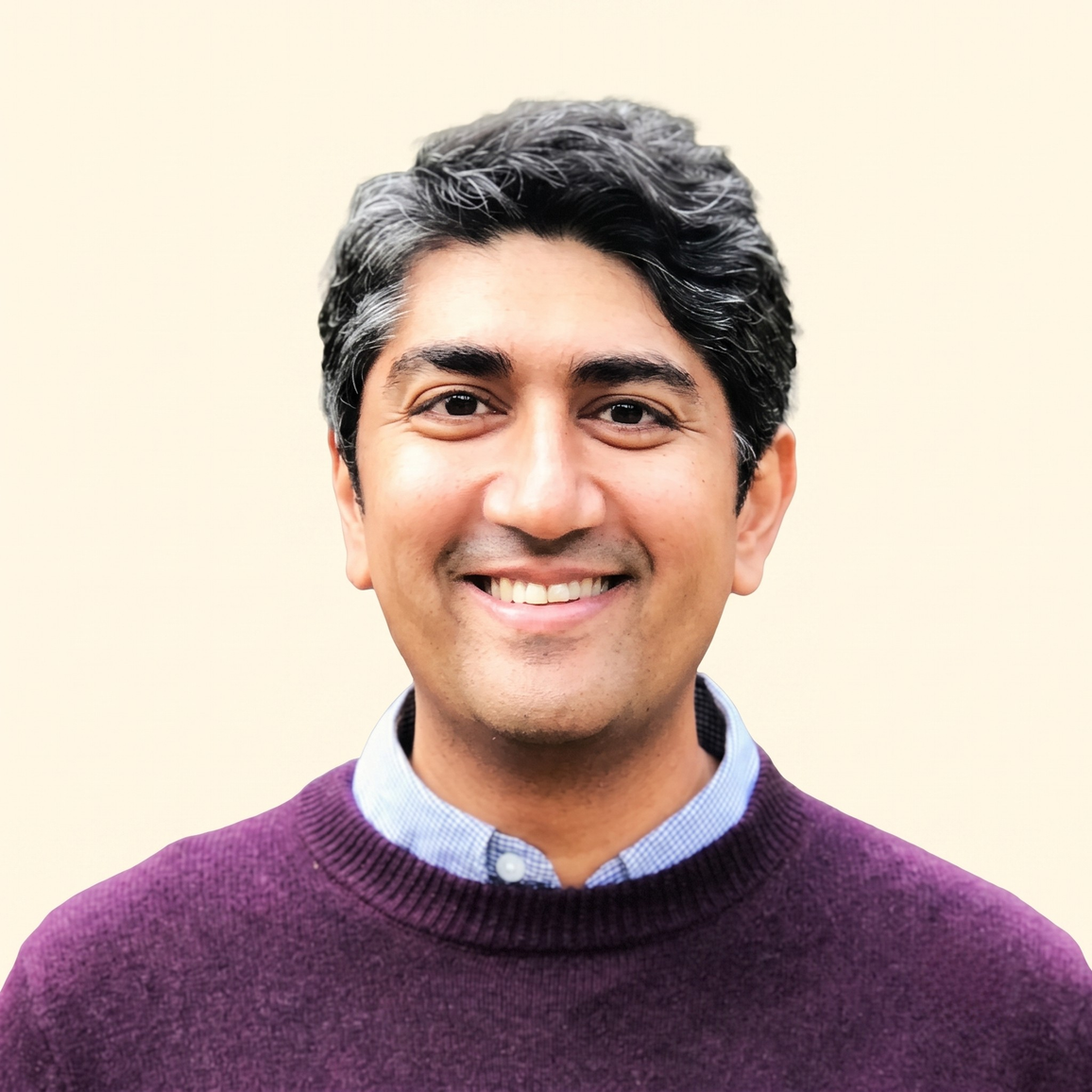
Fresh out of the studio, Aneesh Raman, Chief Economic Opportunity Officer at LinkedIn and co-author of Open to Work: How to Get Ahead in the Age of AI, joins us to dismantle the flattened narrative that AI is simply taking jobs. His counter-thesis: work is changing, not ending — and we never truly left the industrial age, only traded the factory floor for the office floor. Aneesh walks through his three-bucket framework for auditing your week, the move from the career ladder to the career wall, and why the org chart is giving way to the work chart. He closes by reframing the current AI moment as a battle of belief, urging leaders and workers to move from anxiety to agency and bet on themselves.
"We are in a battle of belief right now more than anything else. So stories matter a lot to humans. It's not just the tools we create, it's the stories we tell that have allowed us to become everything we've become. But whether it leads to better or worse... depends on the story we tell now. If we tell ourselves a story that it's going to lead to worse, it's more likely going to lead to worse. Because we have to unwind a lot of what the industrial age has told us to think about ourselves. A lot of industrial age work was about deficit management. I don't have the degree yet, I need to get it. I don't have the job title yet, I need to get it. We all started from a place of what we don't have, that we needed to get, in order to feel of value and succeed. This world..." - Aneesh Raman
Profile: Aneesh Raman, Chief Economic Opportunity Officer and co-author of "Open to Work" (LinkedIn)
Here is the edited transcript of our conversation:
Bernard Leong: Welcome to Analyse Podcast, the premier podcast dedicated to dissecting the pulse of business, technology and media globally. I'm Bernard Leong, and the labour market is going through a structural rewiring that most public narratives flatten into "AI is taking away jobs." The deeper shift is from pedigree to skills, from static job titles to dynamic tasks, and from the industrial-era organisation chart to something more fluid.
With me today is Aneesh Raman, Chief Economic Opportunity Officer at LinkedIn and co-author of Open to Work: How to Get Ahead in the Age of AI. We'll cover three angles together: why the bottom rung of the career ladder is breaking, what skills-first hiring actually requires inside real organisations, and how leaders and workers move from anxiety to agency in this transition.
So, Aneesh, welcome to the show.
Aneesh Raman: Thank you for having me.
Bernard Leong: This is a very interesting topic, but as always, I want to find the origin story about my guest. How did you start your career?
Aneesh Raman: Well, I started my career as a journalist. I was a war correspondent, a CNN Middle East correspondent, but I started journalism in middle school. It started because I grew up in a family with really loud talkers, especially on my mom's side. I was always terrified of talking, because I would get told to speak, tell a story, make a joke, and I would shut down and get really quiet.
So I found, through television, an ability to build this skill that is now core to who I am — talking — but by looking at a camera. Eventually I wrote speeches for President Obama, and now we've written a book. The through line is storytelling. But it started because I was afraid to talk.
Bernard Leong: It's interesting. You did war correspondence in Iraq — those are life-and-death situations. Then you worked as a speechwriter for Treasury Secretary Timothy Geithner during the financial crisis, which is enormously stressful. And subsequently you worked with Governor Gavin Newsom. What was the through line? In retrospect, what do you see — how did your personal history shape the way you think about the current AI transition?
Aneesh Raman: It's a great question. I grew up, more than anything else, as the child of immigrants. My parents came from India in the 70s because America was meant to be this land of opportunity. So it was very conscious from my earliest days that my life was in the shadow of their sacrifice, that I was in this country of opportunity, and I should go take advantage of it.
I lived a life that delivered on that. The harder I worked, the further I could go — to Harvard, to a job as a reporter, to the White House. But across those phases, when you're in a war zone, you see human agency at its worst. You see people smarter than you, trapped in the rubble of literal war, who can't go as far as their talent or tenacity will take them.
You get into the depths of the 2008 financial crisis, and you see people who are suddenly bankrupt, losing their homes. They can't go as far as their tenacity and talent will take them. So a lot of the early parts of my career started with this presumption that the world, as it should be, is one where everyone can exercise agency and access opportunity.
The world as it was had a lot of places where people lacked that agency, lacked that access. Then, as I got to LinkedIn, it became clear that was true in the labour market. The labour market is one of the least efficient, least transparent, least dynamic markets humans have ever created.
If the job of the labour market is to match talent and opportunity, it does a horrible job of that. It generally indexes, based on guesswork, on pedigree signals. Did you get the right degree from the right school? Did you get the right job at the right employer? Do you know the right people? That isn't access to opportunity. That's agency-reducing, if you're not born in the right circumstance.
So before AI hit, a lot of the work — with Ryan, too — was about how we bring skills to the centre of the labour market, so we can change how people access jobs. It should be the skills you have, and the question of what skills a job needs. That was dogged work, but incremental, honestly, because it was still easier to filter by degree for recruiters. The world around work was still very much indexing on pedigree signals. We could make the case, we could even provide different tools with LinkedIn, but it was only ever chipping away at the margins.
So when AI showed up, it quickly became clear to us that it was going to change work at a definitional level. There were parts of it we saw as a solution to a problem, not a challenge to a status quo we wanted to protect — which a lot of us felt, because work is going to change, and that's scary. We saw it as a potential provocation for systems change, for systems redesign around how work exists. That has started to play out, and that led to the book.
Bernard Leong: If you look back, and I asked you to prescribe some career advice to people today, what would it be?
Aneesh Raman: My advice to people today is: don't worry about all the things we don't know. How is this going to play out? Who's going to be okay, who's not? Worry about what you can control today. A lot of this book is about agency and control — what we can all control, not just at the early stage of a career. We're all at the early stage of a career now, because all of our careers are restarting, because work is changing.
All of us can control what we do every day with our time and energy. Are we using these tools to better understand them? These are the most democratising tools for access to knowledge, to expertise, to building and creating that humans have ever made. Are we, with these tools, figuring out new things we can do? Are we starting to shore up the human capabilities we argue are going to move to the centre of work — resiliency, adaptability, taking risk, being uncomfortable? Are we doing that more and more each day? That is what we can control, and that's where we have to start.
That doesn't mean the job market isn't tough. It doesn't mean it isn't exceptionally difficult for someone coming out of university right now to find a job. That's all true. A lot of that, our data shows, is the macro — interest rates, the macroeconomic data, where hiring changes as demand changes. That has always been true. But underneath it is the greatest disruption to work in human history. That's going to create a lot of agency and opportunity for people willing to go grab it. And that work, you can start today.
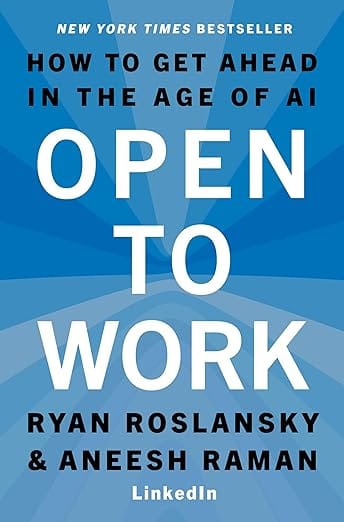
Bernard Leong: Getting to the main subject — I want to talk about your book, Open to Work, and the reorganisation of human capability in the age of AI. You've laid out how misaligned the labour market is. What is the one most counter-intuitive lesson you've learned about labour markets from sitting on top of LinkedIn's data — something that runs against the consensus view held by most of your peers in workforce strategy?
Aneesh Raman: A couple of years ago, the counterintuitive idea was that work is changing, not ending. The dominant narrative was that for some of us, many of us, maybe all of us, work was ending. We had data — it's in the book — that 70% of the skills in the average job will have changed by 2030. So work is going to change in big ways for everyone. But it's changing, not ending.
We believed that early on, when it was an open question. We've now seen it play out enough. Look at software engineers, or entry-level work — those job categories haven't disappeared. They've fundamentally changed. Software engineers do less coding and more systems thinking, more customer relations. Entry-level work is now elevated: you've got to bring more AI aptitude, more entrepreneurial mindset, but you get to meet with customers, you get to be in strategy conversations.
So two years ago, it was the idea that work is changing, not ending. Everyone's coming around to that now. The counterintuitive idea now — and it was a surprise, revelatory, as we pulled the threads on the book — is that we never left the industrial age. What I mean is, we thought when we left the factory floor for the offices, we entered a new, enlightened arena of work. White-collar work represented an escape for workers from the menial, mundane, routinised tasks of the factory floor, or the farming before that, into this enlightened office work.
Some of the most compelling data was the amount of time we spend in white-collar work chasing things down and answering emails — doing work about the work. We never left the assembly line. We just went from the factory floor to the office floor. We went from fixing things in terms of sockets or cogs to the laptop and emails. That started to liberate our thinking about what's possible.
Bernard Leong: You mention this because I had Benedict Evans on, and we agreed that one big misconception — clarify this for me — is that AI doesn't replace the job. What you've identified is that a lot of knowledge work still lives in the industrial age, not the AI age. So what's really happening looks like it's automating all the work — the boring operational work — but the creative work is different. The simple example I use: everybody can write a non-disclosure agreement, but that's not what you're hiring a lawyer for. You're hiring a lawyer for the complexity of an M&A transaction. That's the most exciting part of the job. But people conflate it. Why do people fall into this misconception?
Aneesh Raman: One of the early advantages we had with our argument was that we understood jobs were about tasks, not titles, early on — because we were doing the dogged work of skills. We were saying: jobs are tasks, people are skills, how do we match better? So when AI hit, we already started from the presumption that jobs are tasks, not titles.
Take software engineer as an example. If you think all software engineers do is code, then yes, you think AI is about to end software engineering — and that was a lot of the energy early on. But if you think about what's involved in coding, it's looking for the comma. It's a very routinised task of going through and checking for bugs. If AI starts to remove that, software engineers still exist — they're doing more client-facing work, more systems-architect work.
So, to answer your question, most people think a job title is fully and absolutely descriptive of what the job is. We have a chapter on this. The hardest thing everyone can do, that makes everything else easier, is to pretend you don't have a job title — pretend you've never had any job title — and define yourself by the skills you have and the tasks you do well.
We have three buckets in the book. Bucket one is tasks that AI can do more and more of. If you're a software engineer and 90% of your time is coding, that's a lot of bucket-one work that's about to go. What do you do with the other 10%? Bucket two is new things you're doing with AI — not just human review, but are you learning something new, are you building something new? This is where creativity comes in. Bucket three is that now we have more time to be more human at work. As machine-like work gets outsourced to machines, the machines allow us to be machinists — we're not machines. The human brain has been around far longer than the steam engine, in its ability to do big things and imagine things.
So you're going to spend more time thinking critically about your work, more time collaborating, being imaginative about what you build. As you do that, it's like a conveyor belt — you move tasks into buckets two and three. As we do that across the labour market, we're going to value skills that are more about our entrepreneurialism as humans than the routinised memorisation of facts and efficient processing of information the past eras valued, because the machines are going to out-machine us on those.
Bernard Leong: It seems a lot of people are conflating the boring and the creative parts. There's this distinction between doing things better — improving efficiency — and doing better things, which is the creative part. I want to talk about your prescription for the broken bottom rung, which is redesign: elevating juniors to higher-value work with AI doing the compilation beneath. But that prescription also requires the affected cohort to embrace AI. What does LinkedIn's current data show about how, say, Gen Z is responding — toward adoption or resistance?
Aneesh Raman: We just did a survey in Singapore — the generation with the highest confidence about AI is Gen Z. This is a generation that, even where it has scepticism about how the technology sector is rolling out AI, or how the leaders of AI are talking about it, is using these tools because they're available. Like any generation, the youngest are often the most eager and open to using new technology. So we know that's true, and that's partly why entry-level work is sustaining itself. IBM isn't exiting its entry-level hiring. Salesforce is creating a new builder programme. LinkedIn too — based on a couple of presumptions about Gen Z.
One, they have pretty good AI fluency, because they don't overcomplicate it. It's not "I need to go get a course." It's "I just need to use these tools — use it, ask it questions, have it help me, have it build stuff." Two, they're more entrepreneurial-minded as a generation, a lot of it out of survival. They don't trust that they're going to get one job at one company and be okay. They don't trust that one degree means they're set for life. They're betting on themselves, because they have to, and they're betting on multiple income streams, because they have to. They're becoming creators. They've got the gig economy, freelance work.
You don't have to go far up the generations to where the presumption was: you get a degree, you're set for life; you get a job at a company, you're set for your career. That era is done, and they're coming of age recognising that already. So in some ways the job market is really tough right now globally for new grads, but over time they're going to have an easier time adjusting to the new world of work, because it's going to build around them as they build their careers.
What I don't think we're talking about enough are the mid-career and later-stage professionals who think they're far enough along that this change won't hit them. This change is hitting all of us at once. If you've never known the career ladder, it's not a big deal to start climbing the career wall, which is a big shift we talk about in the book. If you've spent years or decades on the career ladder, it's a lot to now jump off it onto a climbing wall, where there isn't a set of rules telling you how to get ahead. You've got to figure it out on your own. So we've got to help everyone, at every stage.
Bernard Leong: If the younger generation, hit hardest by the broken bottom rung, is also the most AI-sceptical, then does your redesign theory have a foundation problem? You've seen it recently — at commencement speeches, there was a lot of booing of AI. But I don't know whether that reflects the actual job market. What are your thoughts?
Aneesh Raman: You can be using the tool and sceptical about how societies are rolling it out. That's the story of Gen Z adoption — you aren't seeing mass rejection of the tool. In fact, you're seeing slower adoption as you get further up the generations. So I don't think it's a generation that is anti-AI. They're using the tools, just like we all should, because they're easy to use and helpful, and they're trying to be thoughtful about how to use them. They recognise that if you overuse it, you'll have cognitive debt, and you've got to correct for that — and teachers like you are calling that out and helping them figure it out.
But they're also justifiably looking to leaders for a better conversation about AI. Part of why we wrote this book is that the conversation around AI and work has gotten so charged, so emotional. For years it has been fuelling so much fear, anxiety and uncertainty — and worst of all, which is what Gen Z is rejecting, it has been fuelling fatalism. This sense that everything's predetermined, that you and I, as individual workers, have no control. The CEOs know what's coming. AI knows what's coming. We're just along for the ride.
Gen Z is rejecting that story. They're not going to give in to the fatalism that just because someone says it's so, it's so — and none of us should give in to that fatalism. Part of the cause of the book is that we have more agency than we think. When we say your job is going to change, your career is going to change — no one else is figuring that out and then coming to you to say, "here's how it's changed." You don't have to hunker down in fear waiting for that knock on the door. You have to figure it out, starting now: by how you use the tools, how you do new work, how you shape your job and your career.
That can sound scary at first, because it means no one else is worrying about your career — no one's coming to save you in that sense. But as you do that work, you get to have control over your job and career in a way that wasn't true for workers in the past.
Bernard Leong: In the book you introduce a three-bucket framing — automated, augmented, and uniquely human tasks. Take me through what these three buckets are, and what they mean for how workers should audit their week.
Aneesh Raman: We try to make this big, complex moment of change as accessible as possible. One way we did that is to say: forget everything you're worried about. Forget every question about whole categories of jobs going away. Whether you're a CEO or an entry-level worker, what are the twelve things you do every week? Put your job title aside. What do you actually do every week? List twelve tasks.
Now, there are three buckets. Bucket one: tasks AI can already do. If you have anything about quick summaries, coding, first drafts, quick research — that goes in bucket one. Bucket two: what new things can you do with AI? Part of bucket two is reviewing AI's work, because you're not just going to copy-paste its answers to your boss — that's cognitive debt, you haven't checked the work. But what's something new? What could you do better with AI? Say you do a lot of presentations with customers. Now you can learn more, more quickly, about the customers before those meetings. You can create better visuals — a video instead of a PowerPoint, or a better PowerPoint instead of one slide. What's new stuff you couldn't do before that you're now doing with these tools?
And now that you have some time saved from the efficiency work — hopefully you're working less on the weekends and at night trying to catch up — are you protecting time to think more critically, more creatively, to meet with people across your company and come up with new ways to go at the problems your company faces?
When you map that out, you get a good sense of things. If more than 50% of your work is in bucket one, you need to start thinking about shifting your job. You probably have something in bucket two or three — how do you index on that more? How do you push for more opportunities to build it out? Very few of us have 100% of our jobs in bucket one. So that gives you a sense of both your vulnerability and the places you can start to build toward where work is going.
Bernard Leong: Does the framework implicitly assume there's a cognitive ceiling everyone can reach? Is there a risk of excluding those without an obvious pathway to, say, bucket two?
Aneesh Raman: Anyone who's human has opportunity in bucket two. If you think about this tool as democratising access to knowledge, you can now drive your own learning every day in all sorts of new ways. And it democratises access to building — you can build an app, a website, a video, a PowerPoint, whatever you want. You've now got help to build it. There's no one — unless you don't have access to the tools, which is where we get to the Global South and the digital divide — there's no limit to who can really push themselves in bucket two.
It's interesting. There's this term, AGI — the idea of AI getting to a level beyond anything human intelligence could be. The thing I'd say is that anything we're judging AI against, in terms of human capability, is a fraction of human capability. Human work to date has only allowed us to bring a fraction of our potential. It's been about IQ, technical skills, analytic skills. Those are important, but they aren't everything. So the idea that we even have a sense of what humans can do, based on what work has been, is faulty. As AI gets better, humans are going to get better, because we're going to bring more of who we are.
And the missing thing people often get wrong: it's not human versus AI. It's human with AI. As AI gets better, and we have this more expanded view of human capability, the key unlock — an explosion of entrepreneurialism and innovation — is the intersection of those two things. Steve Jobs used to have this line: the thing about humans is that we create tools to do things. A human running isn't the fastest, but a human on a bike is faster than any other animal. So it's us with a tool that leads to these big new things. This is another version of the human with a bicycle.
Bernard Leong: Given this augmentation between human and AI, the industrial era you alluded to earlier is pretty incompatible with AI — and as an AI practitioner myself, I think exactly the same way. You cite evidence in the book about low measurable returns despite high pilot adoption, in places like Canada. Can you describe your work-chart alternative — the fluid, project-based model you've tested in LinkedIn — and how it differs from traditional hierarchy? Last week I was at a SuperAI conference moderating a panel called "The 100x Company," and one question no one seemed to have a good answer to was how to work out how much is humans, how much is AI agents, and what the reason for that 100x actually is.
Aneesh Raman: If you're a company hoping someone has the answer to what you should do — stop hoping for that. It doesn't exist. You've got to start doing the work on your own. If you're a company that wants to be a fast follower of someone else who's figured it out, that's a dangerous place to be, because this is all going to be based on what you need to do uniquely as a company, based on your sector, your society —
Bernard Leong: Company values, as well.
Aneesh Raman: Yes. Our argument is that your org chart is done. The org chart and the career ladder emerged out of the industrial age, for logical reasons, from the steam engine. Over 300 years we went from 1 billion to 8 billion people, and the cause of business growth was entirely the speed and scale of production of goods and services, based on the technology of the time. The story of work is largely a story of technology, not humans — steam engine, electricity, internet, now AI.
The org chart first was a tree drawn by someone running a big railroad, to show information going up from leaders. Then it became the classic pyramid, with not just information but accountability flowing down from the top. All of it was about predictability, stability, order — because everything was building quickly, companies generally knew what they were trying to do, and they were just trying to do it more efficiently, with more people and more complexity.
Now it's about innovation at your company. You can use these tools to get more efficient, but eventually these tools, which everyone has, help everyone be more efficient. It's really going to be a race for innovation. Who's coming up with new ideas? Who's launching new business products? And the same tools that help you do that are available to everyone. So you need differentiated humans who are invested in your culture, invested in the creation of ideas.
Now you've got to create what we call a work chart, which is very sensibly about the work. What are you trying to do that's new, that's hard? How are you bringing people together in new ways around that work? How are you giving them agency, autonomy, permission to fail, permission to experiment their way to what comes next?
In the book we talk about some principles. Lead by design, not command from the top — it's not a pyramid anymore, it's more like a massive startup. You set some contours, but you let innovation build from the workers who are using these tools to change their jobs. You've got to see people as capabilities, not categories. Someone in marketing might help engineering build a product, because they'd use it. Someone in engineering might help marketing sell to a community, because they grew up in it. You've got to figure out a way for that to happen. And managers have to be coaches — you're not managing people's tasks anymore, you're managing people as a team, trying to get them to come up with new ideas.
A couple of early indicators from LinkedIn of how this will play out. One, you're starting to see this forward-deployed engineer, or builder — new terms that are essentially about someone, with these tools, being able to merge product, design and engineering. They can come up with stuff, test it, try it. You take an engineer, put them in with a business problem, with customers or internally, and they build a solution.
I'm an example. I'm what's called a super IC — a super individual contributor. It used to be that to get a chief title, to rise up at a company, you had to manage more people. I didn't grow up in corporate America — I've been all around except corporate, except now. But now I don't manage anyone. I produce individual contribution, like doing a book with our CEO. That's become more of a norm. So if you're a mid-level manager, and what you spend most of your day doing is managing a team, you've got to start thinking about how you're going to adapt, because that's going to be less necessary. What do I uniquely bring to this company to move something forward? What's the work product I produce, beyond just a summary of what the people who work for me have done? You're starting to see these new, blurred-line roles emerge. In most companies, sales and marketing will be completely different in five years. You're starting to hear some term where they've already started merging.
Bernard Leong: It isn't a marketing role as much. And then you have forward-deployed engineers — another new term.
Aneesh Raman: Yes. You're starting to see the signal.
Bernard Leong: You've been in the Asia Pacific. Given the diagnosis and this institutional reconfiguration, and from going around different countries — Singapore, India, Indonesia — what does a concrete, responsible AI-era workforce strategy look like for these governments and industry bodies?
Aneesh Raman: Singapore is in many ways best-in-class at the foundational level, which is that before anything else is possible, AI adoption has to be there, AI awareness has to be there. In countries like India, you're seeing great work — we have a nonprofit we call out in the book — where you can't just say, "here's the AI tool based on the English large language model," because you've got so many different cultures and languages. So there's work to be done to bring people from those communities into building language models that speak to them and their cultural know-how. There's a lot of basic stuff — the digital divide, the Global South — we have to make sure we're on that. In Singapore there's a lot happening around universal skilling, around the National AI Council.
The second stack is helping people adapt now. In some governments, for good reason, because of how it played out in the past, they're expecting and waiting for layoffs to hit. Once those layoffs hit, they'll look for employers to signal new demand — what are the new skills, the new jobs? Once they have that, they'll build new skilling around it. That's not how this is going to play out, because we don't have to wait for layoffs. People can adapt in the job they're in, on the job search they're on. And two: employers have no idea what demand they're going to need. They just know they need — as we argue in the book — entrepreneurialism, people who can figure it out, people who can be resilient. That's true for at least the next five years. Beyond that we might get more specific, but we don't know yet. So Singapore is doing good work there, with GRIT — how they're helping entry-level workers figure out how to adapt now.
Bernard Leong: GRIT [manpower policy in Singapore] was actually a COVID-pandemic-era policy, now reintroduced.
Aneesh Raman: It's really about how we help you adapt, not just wait for everything to get worse before we build back. Where I'd push Singapore, and all economies — even those with the foundational level — is that AI has to be a means to an end. It isn't just "get everyone AI and then you're done." It's "get everyone AI, and then what?" My bet is that if you want the best, safest plan to create a net gain in employment in any society, start encouraging new business starts. Start encouraging entrepreneurialism. You need to build a culture that, with these tools, is helping people build.
In Singapore, we were talking about this across the visit — that cultural shift is what's next. Helping everyone who has grown up in a culture that says there's a right path. There are different five Cs in Singapore than ours, right? Condo, Cash, credit card, Country Club, Car. Now it's curiosity, compassion, creativity, courage, communication. Take risks. Be uncomfortable. Do it responsibly, but push yourself. That's where Singapore's got to go next. No country starts with an absolute advantage or disadvantage, and no individual does. We talked about how Gen Z has certain advantages and disadvantages, and so do mid-career people. Other cultures have a lot of the hustle — I just came from India before here, and it's all about this Indian idea of resiliency, of entrepreneurialism — but they're still building a lot of those foundational AI pieces. So every country starts with some strengths and some things they've got to work on.
Bernard Leong: What are the top one or two specific interventions needed to empower businesses, across segments, or even early-career workers, to move from anxiety to agency?
Aneesh Raman: The book — it's kind of why we wrote it.
Bernard Leong: I have to finish reading it.
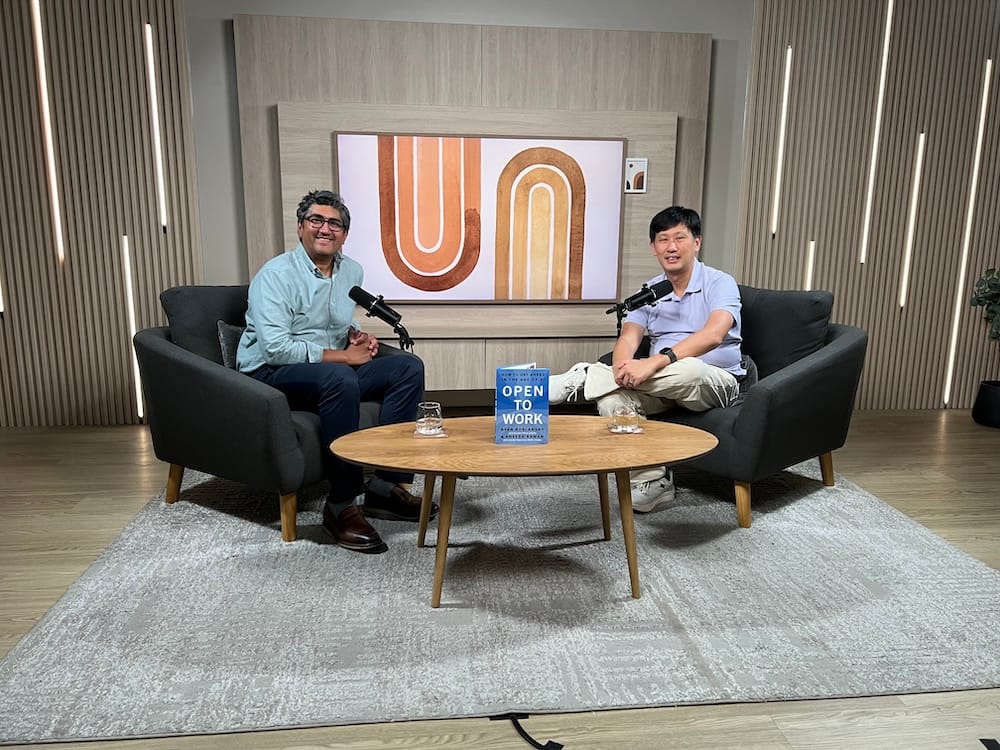
Aneesh Raman: We'd love more people to join us in simply telling the story we tell in the book: that there is agency to be had in the midst of the anxiety. There are steps you can take — small steps you can start now, wherever you're at. We are in a battle of belief right now, more than anything else. Stories matter a lot to humans. It's not just the tools we create; it's the stories we tell that have allowed us to become everything we've become.
Singapore is a story, right? It's called intersubjectivity, as Yuval [Noah Hariri] writes in Sapiens. Everyone inside Singapore, and around Singapore, has a story of what Singapore is that gives it its reality. But it's a story. Our story itself is a story. Who are we? What are we capable of? What are we good at, what are we not? It's all a story. Right now, we start the book with Kevin Scott, the CTO of Microsoft, saying: look, AI is a big deal, it's going to change everything, and it's going to take time, and it should. But whether it leads to better or worse depends on the story we tell. If we tell ourselves a story that it's going to lead to worse, it's more likely to lead to worse. If we tell ourselves it's going to lead to better, it's more likely to lead to better.
So we're in a battle of belief, and that belief starts within each of us. We write, to anyone who wants us to sign the book, "bet on yourself." That's an instruction as much as a North Star. There's work to be done for us all to bet on ourselves, because we have to unwind a lot of what the industrial age told us to think about ourselves. A lot of industrial-age work was about deficit management — I don't have the degree yet, I need to get it; I don't have the job title yet, I need to get it. We all started from a place of what we don't have that we need to get, in order to feel valuable and succeed.
This world is actually about asset inventory. What strengths do I start with? What's unique about me, no matter what stage of career I'm at? I traveled a lot as a kid, we moved around — I'm really good at translating across cultures. That'll help in a company, across functions. We all start with strengths. So you've got to articulate those, so you can bet on yourself and believe in yourself. The intervention that matters most right now is a belief intervention. And that's really on leaders as much as anyone. You cannot tell a story of AI that is just about AI, because that isn't even how this is going to work. You've got to tell a story about what AI makes possible for people.
Bernard Leong: I have one question. There's the famous analogy of the ATM machine — banks opened more branches, and teller employment doubled into the 2010s. But you also point to the darker corollary that gets left out: smartphones eventually decimated the same role decades later. That suggests the current period might be a temporary adaptation window, not a permanent expansion. So for the 45-year-old mid-career professional, whose specialised expertise is being absorbed into AI tools faster than they can pivot — looking at it honestly, how long is that window, and what should they be doing this year, not in 2030?
Aneesh Raman: The most important thing is that we all have time. We're not late. We're not rushing out of a flooding house or a house on fire. You could be mid-career, early career, a CEO — anyone, everywhere — we have time right now. We can get ahead of this. But now is the time to get ahead of it. Five years from now, it's going to feel more urgent if you haven't started the work.
So put the fear aside, put the anxiety aside, and do the honest accounting of your job. We have ways to do that in the book. How many of your tasks are vulnerable to AI right now? What are the ways you can pivot to the skills and strengths that are unique to you and unique to humans? What are the new things you can do with these tools? If you look at it this way, we're in an amazing moment of experimentation. That's going to be true for about five years, because workers are going to lead the way.
In every past moment of disruption — steam engine, electricity, internet — the transition played out over years and was top-down. By the time you, as a worker, found out what the steam engine, or electricity, or the internet, or the computer meant for you, your boss was showing up and saying, "you're laid off, you're redeployed, you've got to get this new certification in CRM management." This is different, because it's a populist technology. Everyone has access to it. The CEO at the biggest company has the same tools available as the university grad. As long as you have a phone and a laptop, you have the same technology. We're all able to experiment with it in real time. That's partly why companies are unsure how to proceed — they recognise it's not a top-down solution. They've got to create opportunities for the people in the jobs to test and try.
So it's a period of experimentation. Think of it that way — not a period of disruption, a period of experimentation. Go experiment. If you do that a little bit more every day, you have time. You've got a good five-year period. Do that, do it more, do it more by the day, and you're going to be okay.
Bernard Leong: What's the one question you wish more people would ask you about the future of work in this AI transition, but they don't?
Aneesh Raman: What's possible? The way I think about it is an innovation explosion. If you think about human history — part of the book is about anthropology — humans have been around for millennia. The human brain we have, by shape, is 300,000 years old; by its ability for complex thought, 40,000 to 70,000 years old. Most of what we know of the world is 300 years old. Everything emerges maybe 500 years ago, from the printing press on. Everything about our world — from the structures we build, to the hot showers we take, to computers, the smartphone, AI — is 500 years old.
With AI, what's powerful — and we have a chapter called "The Lost Einsteins" — is that the ability to come up with new ideas, and test and try new businesses, is now going to be available to everyone. If you think about innovation in the past, we've done a horrible job of it. Very few people got to actually innovate, because you needed money to build a prototype, to launch a business — whether it was electricity, railroads, or software and an app. Now anyone can build with these tools.
You have the ability — say I have an idea for my community — to build a company that just helps us get around better, or helps us figure out who's got the best of something. You can build for your community and make some money, without having to be a billion-dollar business. You can also build businesses that aren't just about consumer convenience and enterprise productivity, which is generally what businesses have been built around to date. If you're coming of age as an entrepreneur, you can go after climate change, after social causes like poverty or mobility. You can apply technology and entrepreneurialism to the entire gamut of human ideas and human needs. So to me, whether it's cancer and health care, or climate change — what's possible, if we do this right, roll it out right, and give everyone the right way to approach AI, is an explosion of innovation. We should be able to do, in the next 50 years, better and more than we've done in the last 500 as humans. And — oh my God — what a world that would be.
Bernard Leong: My traditional closing question: what does success mean for LinkedIn, navigating the AI transition globally, and for your book, Open to Work?
Aneesh Raman: It's to help people do more, to help people see what's possible. We're a platform that has always had, as a vision, to create economic opportunity for every member of the global workforce — all 3 billion-plus people. Prior to AI, a lot of that was helping people better understand how to get jobs, identify the skills off their profile, have recruiters find them around those skills — just creating a better match between talent and opportunity, with the feed helping people connect, learn and partner in new ways.
With AI, it's what we've always been about, but with a more urgent responsibility and opportunity: to really help people understand and navigate this moment of change, and everything I talked about in terms of what's possible. I do feel that, hopefully, it's possible in unique ways because of LinkedIn. In every other moment of disruption, everyone was kind of on their own. In this one, there's one place where the largest network of professionals ever assembled exists, where every day people are learning, testing, trying.
One of the most exciting things on LinkedIn to me is that we've seen a 4.5x increase in people building in public — posting, "I tried this agent, it didn't work, has anyone done it better?" or "I built this thing, it's kind of cool, does anyone want to build on it with me?" That's a whole different reality for people trying to figure this out and get to better. So that's my hope for us.
Bernard Leong: I hope it's the same thing. I like the point you made about the stories we tell. Every day — whether I teach, whether I build my own enterprise AI company, whether I'm doing a podcast, thinking about a deep subject — I think this is a very exciting period of time. Everyone now has the privilege of their lifetime: to be themselves in the age of AI. That's a good place to close.
So, Aneesh, many thanks for coming on the show — but I have to give you two closing questions. First: any recommendations that have inspired you recently? Books, podcasts, anything?
Aneesh Raman: Well, there's a great book called Open to Work. Aside from that, two books I finished — I like them because, if I went back to college, I'd study neuroscience. The human brain is about to be at the centre of work. We know so little of it, but what we know is amazing — neuroplasticity, the brain's ability to rewire itself. There's a book called Tiny Experiments by Anne-Laure Le Cunff, which is all about rewiring your brain around habits, and another called Little Bets, which is about how many businesses start with little bets. What's powerful about that for everyone is that it all starts small.
Bernard Leong: That's right. How can my audience find you — through the book, or what else?
Aneesh Raman: There's this platform called LinkedIn. One of the great sleeper realities of LinkedIn — my favourite part — is that you can follow people. It used to be that you had to know someone, connect with them, have them accept your connection, to see what they were saying. Now, whether it's a big business personality or someone you just heard on a podcast, you go follow them, and what they put out, you see in your feed. So it's not just who you know, as we often say — it's what they know. It's that sharing of knowledge. Go on LinkedIn and follow a bunch of people. What I do is follow people, X out posts I don't like, engage with posts I do, so the algorithm gives me a feed where every day I'm learning something new. Every six months or so, I change who I follow — I'll unfollow some people because my curiosities have moved somewhere else, and follow others. Let it feed your curiosity.
Bernard Leong: Nice. I got the tip. So, Aneesh, many thanks for coming on the show. I look forward to the success of the book, and of course the success of the correct narrative that will carry us into the age of AI.
Aneesh Raman: Thanks so much.

Podcast Information: Bernard Leong (@bernardleong, Linkedin) hosts and produces the show. Proper credits for the intro and end music: "Energetic Sports Drive" and the episode is mixed & edited in both video and audio format by G. Thomas Craig (@gthomascraig, LinkedIn).