
Dataiku Summit Singapore 2026: Two Conversations on Turning AI Into Real Value, with Sophie Dionnet and Nur Hafiza Mutalif

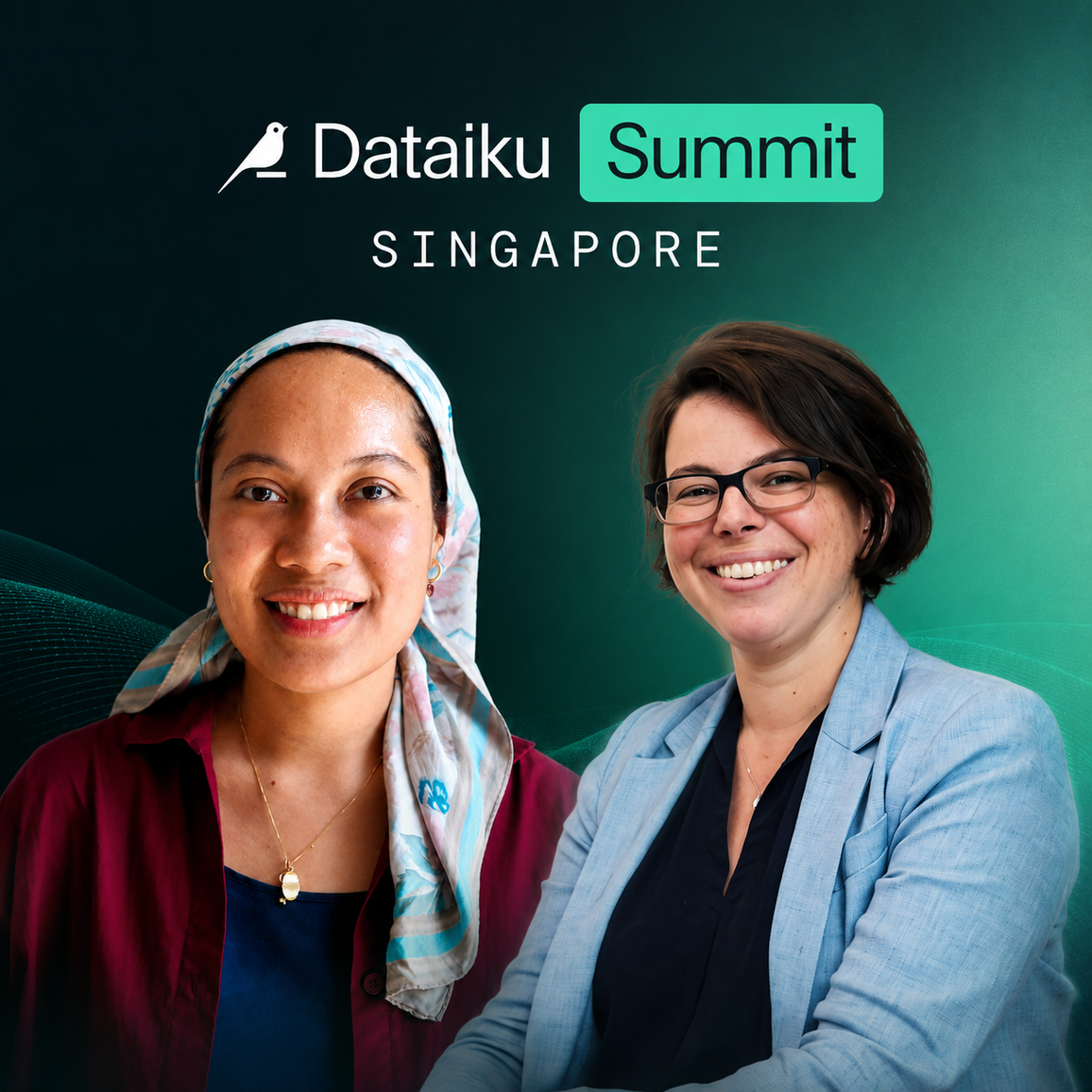
Fresh out of the studio at the Dataiku Summit Singapore 2026, two conversations make the same argument from opposite ends. Sophie Dionnet, Senior Vice President of Product and Business Solutions at Dataiku, lays out the three ingredients behind enterprise AI value — people, orchestration, and controls — and argues governance is a scaling mechanism, not a brake, pointing to Roche, where a patent lawyer built a working system of agents. Nur Hafiza Mutalif, Assistant Head of International Affairs at the Singapore Red Cross, explains why her sector's caution is a feature rather than a lag: humanitarian work must clear its do-no-harm standard before any business case. Dataiku's pro bono experts earned that trust by teaching the models and letting the Red Cross set the boundaries — freeing four staff from daily data collation and enabling a Thailand leptospirosis forecasting model. Two sectors, one lesson: trust is what lets AI scale.
"A lot of the changes that organizations need to do today actually don't require the latest model. That's not really the problem. It's about doing the hard thing, the change, the things that we talked about. It's easier to be excited by the new toy than by trying to use it. And so yes, I think this is why there is a bit of a gold rush of trying to figure out where is it going to end. We don't know." - Sophie Dionnet
"We cannot see efficiency, too, I think what I should see, as a humanitarian organization, is datasets and the different cases around the world be compressed into something that simplifies value and help us better serve communities." - Nur Hafiza Mutalif
Profiles:
- Sophie Dionnet, Senior Vice President of Product and Business Solutions at Dataiku (LinkedIn)
- Nur Hafiza Mutalif, Assistant Head of International Affairs, Singapore Red Cross (LinkedIn)
Author's Note: Our transcripts are edited to be readable.
Part 1: Sophie Dionnet from Dataiku
Bernard Leong: Welcome to Analyse Podcast, the premium podcast dedicated to dissecting the pulse of business, technology and media globally. I'm Bernard Leong. Enterprises have spent the last three years of budgets on AI, and yet most cannot point to the business value of it. The question is no longer whether the models work. It is where the value sits between the pilot and the P&L.
We take that apart across three angles: the domain knowledge models cannot supply; the orchestration problem, now that agents multiply faster than anyone can count; and the case that governance accelerates AI rather than slows it. With me today, Sophie Dionnet, Senior Vice President of Product and Business Solutions at Dataiku, who has spent six years building the platform and owns its AI governance line. We discuss why AI investment fails to become value, and what has to change.
With that — Sophie, many thanks for hosting me at the Dataiku Summit here in Singapore, and welcome to the show.
Sophie Dionnet: Thanks so much. It's an important moment for us. It's one of those moments where we have different customers and different partners coming together to have this discussion, so having someone like you here is awesome.
Bernard Leong: Many thanks. You've just come straight off the keynote, so I want to ask you: you have been with Dataiku for the past six years and you own product and business solutions. What has changed most about what enterprises ask you about enterprise data platforms and AI between 2019 and today?
Sophie Dionnet: Oh my God. If I try to summarise this, it could take us a bit of time. On the one hand, a lot of things have changed, and some have not. I will start with what hasn't changed, if I may, because I think it will create the baseline. What hasn't changed is the importance of data.
Data consciousness has continued to rise in organisations. Interestingly, there has been almost an acceleration of that over the past twelve months. There is a deep understanding now, from every single type of organisation — in the private sector, in the public sector — that if they don't have data access and if they don't have good data, they're simply not going to be able to use and develop AI.
That has been a continuous investment since I started at Dataiku. It was there at that time and we have seen this continuing to accelerate. It's not an easy problem to tackle. I get very scared, usually, when I have organisations in front of me telling me, oh my God, we've solved it all. I'm not entirely sure that's true.
That area of focus has remained. The piece that has drastically changed is the arrival of LLMs, and the new power we have seen exploding, especially since December, is massive. It raises tons of questions for organisations around what they do with this raw power. How much is it about productivity? How much is it about task automation? How much is it about redesigning their entire processes? We get a lot of questions around that. We do indeed get a lot of questions around control, also. This is a new technology, it's fascinating — but do I trust surrounding decisions to it? Open question.
Bernard Leong: I suppose one of the things I'm pretty sure you and I both feel is that this AI wave seems to come much more fast and furious. Most importantly, there's governance. You built the AI governance line within Dataiku. What made you push the company towards governance before most of the market was really asking for it?
Sophie Dionnet: I come from a financial services background. I used to work in asset management and I started my career in 2005, just before the financial crisis. What we saw with the financial crisis was, to some extent, a risk modelling problem happening at sector scale. Then very specifically in the company I was part of — I was at AXA Investment Managers — we had a particular incident happening in our quantitative equity activities, and that really highlighted the importance of deep model supervision.
When you think about what you're doing with AI, we can talk about machine learning, we can talk about LLMs, we can talk about whatever statistics — at some point in time you are modelling an activity. There is a deep correlation between trust, controls and the capacity for people to scale. That's very simple. It's usually one of the main blockers you see between organisations that manage to do two or three use cases in a very centralised manner. Usually when they do two or three use cases — very tight, tight, tight control — that doesn't scale. If you want to start scaling out, you need the type of governance environment that will allow that scaling mechanism to happen. There's a bit of deep conviction in the background.
Bernard Leong: The Dataiku line is "Everyday AI, Extraordinary People." I'd ask you to first give my audience an introduction to Dataiku — and also, what's the lesson about people that you didn't believe when you started, after you'd built the product?
Sophie Dionnet: Yeah, after we built the product.
Bernard Leong: Maybe we should start with the introduction to Dataiku.
Sophie Dionnet: It's always interesting to explain what Dataiku is in Asia. You are probably familiar with the concept of haiku. The name Dataiku comes from the idea of making data simple. Data, data science — and haiku, which are very small but very powerful poems. You put this together and that gives you the idea of the platform.
The idea of Dataiku is really: how can we facilitate, for any organisation, the transformation of data into outcomes, by bringing to the table three key ingredients? The right people — people who have both technical knowledge and business knowledge. The capacity to stitch technologies together, which we can call orchestration. The right type of supporting controls. That has been Dataiku's position for fourteen years, and this is what continues to drive us today.
Bernard Leong: After six years building the product, what's the lesson about people you didn't believe when you started?
Sophie Dionnet: That's another good question, and I haven't really thought about it. What's quite interesting is that we end up finding the best use cases in the hands of people we would not necessarily have thought would be the drivers of these use cases. The platform was designed to break that barrier to entry.
One of the best use cases we've found is coming from Roche. Roche is a big pharmaceutical company. One of the people working in their legal department, in charge of patents, has taken it as a task to completely revamp how his team operates — making decisions around patentability and answering requests from different law firms. What has been fascinating with him is to see how much he has been able to dissect his own professional expertise, encode it through a system of prompts, and create the supporting agents. Probably ninety percent of it was done completely by himself, with a little bit of IT support.
I would never have bet that one of the best use cases would have come from lawyers. Seeing this in motion — he's someone with a lot of depth, very intelligent, very smart, super dedicated to making that change happen. Knowing that he wouldn't have been able to do it without our technology is fascinating.
Bernard Leong: This is a very interesting use case. But if you look out at a lot of enterprises, they have spent the last three years putting serious money into AI, and some of them — maybe even most of them — cannot tie it to value. Is that a technology failure, an organisational failure, or a measurement failure? Which one do you see happening the most in the market today?
Sophie Dionnet: The biggest gap for me today is clearly more on the change management side than anything else. When you want to monitor value, there are many different ways of doing it. It doesn't mean that all organisations are well geared to do that. But when you know you have value, you don't necessarily need complex measurements to recognise it.
The pure potential of machine learning, of LLMs — it's here, it's established. We know machine learning can allow you to predict. We know LLMs can do tons of things. The hard bit for anyone is taking something as raw potential and putting it in motion. Anyone who has done a software installation, or who has done change management, knows how daunting it is to go from the moment you take a decision to the actual implementation.
Taking the decision is one hour. Putting it in place is like two years. It's that journey that is actually ahead of everyone. Unfortunately, it's not magical. It's not as simple as it sounds. For me, that's the biggest missing link.
Bernard Leong: Being in enterprise AI myself, every week I'm inundated with the latest model releases. There's a point you made when we were having a conversation — that the real barrier isn't model performance or infrastructure, it's connecting AI to everyday business domain knowledge. Why is that the hard part, when so much of the attention from enterprises seems to be focused on the models themselves?
Sophie Dionnet: Because when you look at these models, they're fascinating. It's the first time, I think, that you have a technology so easy for people to touch. It's the first time I've been able to explain to my parents what I do on a day-to-day basis, because I was able to sit down with them around a computer and say, this is what it is.
Bernard Leong: They can basically ask questions, right?
Sophie Dionnet: The second part is: is it designed to answer questions accurately? Yes, no. What does it do? How do you impact that? It's the first time I did that — I think it was a year ago. My parents are both translators, and for them, because of what they used to do, the arrival of LLMs is also a bit scary. They spent years learning languages. It raises a question: do you still learn languages?
Anyway, it's a technology everyone can touch, everyone can manipulate. It's so easy, and so suddenly you have a buzz of, oh yes, but this one can do this, and this one can do that, and this and this and this. Probably a lot of the changes organisations need to do today don't require the latest models. That's not really the problem. It's about doing the hard thing — the change, the things we talked about. But for people, it's easier to be excited by the new toy than by trying to use it. This is why there is a bit of a gold rush of trying to figure out where it's going to end. We don't know.
Bernard Leong: I think we're still at the very early stages. So what's the one belief about scaling AI that most of the industry seems to think is correct, but you think might not be the right direction?
Sophie Dionnet: There has been an ongoing debate for the past twenty years around what needs to be IT-led versus what needs to be business-led.
Bernard Leong: That's a good point.
Sophie Dionnet: Similarly, as you look at the organisation of companies, they move from centralisation to decentralisation to centralisation to decentralisation. It's a bit of the same. The answer is probably a balance. If you suddenly decide, oh, business is going to do it on its own, it's probably going to be a bit of a mess down the line. If you say it's only IT that can know, that can build the standards, that can do it all on its own — it doesn't work either.
I do think that over the past two years there has been a bit of a centralised move towards IT, and it can create a risk of slowdown — not of the biggest use cases, but a slowdown of the actual transformation that needs to happen on the business side, plus a risk of new types of shadow IT and shadow AI. I don't think anyone would tell you, oh yes, of course IT needs to do everything. But there needs to be a continuous balance between what is done and by whom, and I'm not sure the right balance has been figured out yet.
Bernard Leong: I've seen this happen quite a lot, where IT is in charge of the tools and, because of worries about risk and governance, they actually shut down some of the features. Then when the business teams say we need this, the IT teams say, no, sorry, we can't have it. It's almost as if they purchase a very powerful solution and then limit what it can do.
Let's get back to what you're most familiar with — governance. Throughout this conversation, I hear that what you think governance is, is a question of balance. The simplest way to act is to do nothing, but that's not an option. Where do you see leaders still quietly choosing to do nothing?
Sophie Dionnet: There are different ways of doing nothing. You have the doing nothing which is: I'm very scared to be hit by a car, so I'm never going to go out of my home. That's one way. Then you have the second way of doing nothing, which is: I know I could be hit by a car if I have my headphones on, and I'm still going to keep them on. Two ways of doing nothing.
If you play this out in an organisation, there's one way, which is to say, I'm going to have security principles that are so high no one is going to be able to do anything. Then you have the second one, which is not putting guardrails in place at all — I'm just letting it go and we'll see after the fact.
We've seen quite a bit of the first at the beginning of the wave, with some companies doing a full shutdown, trying to keep things under control that way. The permissive part, letting people do anything they wanted, has been happening also in some organisations. What's interesting is that in both cases, the outcomes are not really here.
I'm not sure that a completely decentralised, uncontrolled exercise creates maximum value in an organisation, simply because it's not just about individual innovation. Down the line, for a company to work, or a public sector organisation to work, you need to have people who take decisions. If suddenly you have people randomly vibe coding bits and pieces of everything and having conflicting information on stuff — how the hell do you expect them to still reach consensus?
To come back to your question: there is a risk if people put governance too early in the cycle, because you need to get started somewhere. There's also a risk if you don't put governance as part of your journey, or if you do it too late, because there's going to be a big dilution of effort for some, and unwanted impacts that are going to pop up.
Bernard Leong: So you think the stage at which governance is inserted is very important?
Sophie Dionnet: Yes, and it's the same thing — it's a question of balance. You can't go all in with just governance principles at the very beginning, because then it blocks everything and people are like, oh my God, I don't know what the hell I can do. If you wait too late, there's a cost of peeling back the onion that is super, super, super expensive.
The people who had the joy of working on GDPR implementation understood it the right way. When your compliance officer says, okay, so now you have to identify every single file — I'm not even talking about a spreadsheet — where you have personal data, like the name of an employee. That's going to be interesting. There have been some lessons learned on that, which is that the cost of ex-post compliance can be very, very, very expensive.
Bernard Leong: One thing you alluded to earlier is that AI success is really about people, orchestration and governance. Which of the three do enterprises consistently underinvest in, and why that one?
Sophie Dionnet: I would say people and governance. Orchestration sounds like a simple topic, and it's an IT-led topic — how do you stitch the ecosystem together. You have teams dedicated to that; it's their job. You have IT architects, you have infrastructure people. Probably they think about this a little bit too much, even from an ecosystem standpoint. The two pieces that are hard, actually, are again that balance of governance and that balance of skill sets. That would be my answer, in any case.
Bernard Leong: That's a very good answer — simple and concise. Dataiku also has things like Mesh and Agent Connect to stop agent sprawl. Nowadays you talk to anyone and they probably have many, many agents within them, and they have no control over which department owns which agents. So a company may have expected 500 AI agents, but ended up discovering 2,000 agents running around — which, as you nicely put it, could be a cause of shadow AI. Is that a governance failure or a success signal? How would you advise a board to tell the difference?
Sophie Dionnet: Interestingly, that question usually starts with the board, because the moment where consciousness rises in the company is when you have a board member saying, how many things do you have? Let's call them things for the moment.
Bernard Leong: Because of the audit committee.
Sophie Dionnet: Because of the audit committee — or it either comes from the audit committee, or it can come from the board from a strategic P&L management standpoint. AI is supposed to be transformative for P&L. So you could have a board saying, how many do you have, and are you impacting the right processes? I don't know — your marketing hasn't been that efficient, how many agents do you have supporting marketing today? Or you can have your risk committee or your audit committee saying, we have the EU AI Act arriving, you're supposed to be able to qualify how many agents you have and how much they're exposed to this pyramid of risk. Are you able to do that today? Two different angles, same question, and it's complicated.
The starting point can be a lot around that. Then indeed, it's a pretty complicated thing to answer today. With machine learning it was much simpler, because realistically you usually don't have twenty-five different spaces where you're building ML. Agents today, you could summarise as being just a new type of API. You can have new types of APIs popping up from every single type of business system, or being manufactured by the companies, so they can pop up in many, many different places.
We see a missing link today, which is why we're working on agent management, which we're launching in October — specifically for that. Providing a space where you have all the right connectors, all the right data integration, all the right type of visibility factors to start addressing those complicated problems.
Bernard Leong: One question for a board would be: are agents a technology problem or an organisational design problem?
Sophie Dionnet: I think it's a problem that is led by technology, because right now there's a big incentive in the market for everyone to be agentic-native. We all produce agents — some of us because it's our core business, which is what we do, some simply because you need to integrate these new types of API into your activities. There has been a push by the technology market because there's a belief that AI can be transformative.
I don't think we can blame the companies for being in front of that sprawl. There's not much they can do about it, unless they shut everything down, which I'm not sure is exactly a solution today. What I think is our collective responsibility on the tech side is that we simply need to answer the problem and arrive with meaningful, impactful answers. This is what we're working on at the moment.
Bernard Leong: What's the one thing you know about what separates enterprises that scale AI from those stuck in pilots, that very few people know?
Sophie Dionnet: On the AI scaling side, it's an interesting topic. Most of the companies we've seen being successful with AI, it started for them with having a few different successes. You need that to build trust. You need those first three or four pilots to actually move to production and to move to meaningful P&L, because unless you've delivered that, you haven't been able to completely demonstrate that it works in motion.
Once you have that, you need a way to recognise that there are different shades of impact of AI. Not everything is going to be as big. Not everything is going to necessarily deliver ten millions of P&L. That's okay. To some extent, the use cases that deliver ten million are subsidising the other ones. The problem is, if you don't do the other ones, you almost create an imbalance in your organisation. You create a space where you are over-investing, and then some others that you leave behind. The space you're leaving behind can then become almost a legacy for your organisation.
It requires a bit of maturity and self-consciousness to recognise that not every effort has the same yield, and that it is okay — then you need to calibrate your efforts to make this happen.
Bernard Leong: I want to move the conversation now to where the platform goes. There is a view out there — the bear case on orchestration platforms — that the foundation labs are going to absorb the middle layer, and enterprises will build directly on OpenAI or Anthropic. Where is that argument going wrong?
Sophie Dionnet: OpenAI and Anthropic are fantastic companies that are building a new type of infrastructure that is going to become critical for organisations, which can create some sovereignty considerations and some business continuity conversations. We can't ignore the fact that they are bringing innovation to the market, and that innovation is a good thing. Consequently, it's also good if some other players are on the side and can diversify those risks for everyone.
As with any company that is leading with a new technology, it's a little bit self-centred. Suddenly, because you own that raw power, you're putting it forward as the answer to everything. It's the only thing you talk about, and you suddenly say this technology is going to solve everything else. It's going to solve data quality, it's going to solve analytics, it's going to solve how autonomous cars need to work — everything. That's true and untrue.


It's the job of those who are part of the ecosystem to rebalance that and bring a bit of sense into it. If you take a bank, I make a bet that in ten years a bank will still be doing credit modelling in the same way, from a precise modelling capability standpoint, because regulators will still want perfect auditability of these models. If suddenly you were asking an LLM to do it, you would completely lose this. There are some activities that will not change and some others that will. I don't think it's Anthropic or OpenAI that will make that operationalisation move. Their job is to continue to innovate, and it's our job to make sure that operations actually matter.
Bernard Leong: I agree with you. A lot of people keep saying, I can vibe code a Salesforce out of nowhere. The problem is that people are not using Salesforce for that. In this case it's the same with Dataiku — I'm using Dataiku for a very specific business purpose, and to make me change that, it actually overhauls my entire purpose of what we need to do for the enterprise. In the enterprise you have a lot of customisations that I think customers don't realise you need to do.
Sophie Dionnet: There's that. Sorry, I'm going to use a bit of a stupid analogy, but if you take your kids to a pet store, they're going to see a new pet and be like, oh my God, I want the pet. It doesn't mean that they want to take out the dog every single day. Build versus buy in software is exactly the same thing.
You can do a first version and it can be nice and funny. Then there's the run, there's the continuous education, there's the continuous reinforcement of that software. The debate between build and buy has always been: when do you delegate, and when do you keep it on your side? Today, yes, there's a frenzy around vibe coding. I would be surprised if each and every single company decides to completely redesign their own IT, just because it will have a massive cost. There's a reason you have software vendors — because you have companies deciding to delegate software-building capabilities, because it makes more sense.
Bernard Leong: I also find that a lot of the automation is around the systems of record. It's actually quite difficult to get the enterprise to switch out. The switching cost is just too high.
Sophie Dionnet: Completely agree.
Bernard Leong: If I were to ask you this question: what's the one question you wish more people would ask you about Dataiku, about building the platform for AI success, but they don't ask you about?
Sophie Dionnet: You're asking a very hard question.
Bernard Leong: Take your time to think about it.
Sophie Dionnet: It's a hard question, because we do get a lot of questions about what we do.
Bernard Leong: What was the one question you just wish people would ask you, but they usually don't?
Sophie Dionnet: I'm trying to think of a decent answer, because we get so many different questions.
I think, at least over the past two years, there have been so many new technologies that sometimes you lose a bit of the sense of why you're making a piece of software. It almost comes down to that.
Bernard Leong: The "why" of making this software for this reason.
Sophie Dionnet: Why is the core philosophy behind it? Why do we genuinely believe companies need that? There has been such a sprawl of new technologies that you get into a room and it's like — do you do semantics? Yes, no. Do you do MCP? Yes, no. Do you do knowledge graphs? Yes, no. Do you do ontologies? Yes, no. What do you think about A2A?
It's almost as if you were going to buy a car and you're like, oh yes, do you have shift gears? Yes, no. At some point, we designed that software for a reason, and for a belief about how you make change in organisations. We always manage to get the conversation back to that. But sometimes I would like people to think about it a bit more this way, instead of being in the supermarket of technologies.
Bernard Leong: My traditional closing question: what does it look like for Dataiku in Asia Pacific over the next three years, and where are we going?
Sophie Dionnet: We've had a really good take-off in Asia over the past years, and it's been great to see — a lot of banks, a lot of public sector. Public sector is always interesting because there's a mission behind it; it's not just here to serve a P&L purpose. We've seen a good acceleration.
I think we need a few more of these flagship organisations to step up and be vocal about what they do, because they are the ones who can be the trendsetters. I do think that the partnerships we can bring are a powerful accelerator that can make sure there's this reconsolidation between what I was talking about — AI's pure capabilities and actual outcomes. The only thing I can hope: today we have twenty customers speaking at our events. Maybe next year we have forty.
Bernard Leong: I'm actually going to be talking to one of your customers later.
Sophie Dionnet: Oh, who are you going to be talking to?
Bernard Leong: She heads international affairs at Singapore Red Cross, and I think she's also a user of your solution. Usually most of these organisations are quite afraid of using AI, so I'd like to know what got her into it.
Sophie, many thanks for coming on the show. I have just two very quick questions to close. First, any recommendations that have inspired you recently — a book, a movie, or something?
Sophie Dionnet: That's a very different one. We went to the movies. It's a French movie, so I don't know how much it's going to echo for everyone. They released a two-part film tied to the Second World War, on de Gaulle. We went to see the first one last Sunday, and we're going to see the second one this Sunday. It's really good. It's a nice way of putting in perspective the choices some people made during the war, and how much it sometimes relies a bit on luck, and a bit on some people being bold.
Bernard Leong: Where can my audience find you and Dataiku?
Sophie Dionnet: If you ask my partner, he will tell you not at home enough, because I've been travelling a lot lately. Over the next few weeks I will be in France. We have our offices in central Paris, and we have the pleasure of welcoming a lot of Asian customers as they come to Paris. Don't hesitate to come and meet us.
Bernard Leong: It's a beautiful city. Sophie, many thanks for coming on the show, and I look forward to speaking to you again.
Sophie Dionnet: Thanks so much.
Part 2: Nur Hafiza Mutalif from Singapore Red Cross
Bernard Leong: Welcome to Analyse Podcast, the premium podcast dedicated to dissecting the pulse of business, technology and media in Asia. I am Bernard. The humanitarian sector has been slower to adopt AI than almost any other. Not from a lack of need, but from a scepticism that the technology industry rarely takes seriously. That scepticism deserves a hearing — and so does the evidence against it.
We take this apart across three angles: why the sector distrusts AI; what the Singapore Red Cross built, from disaster surveillance pipelines to a model predicting leptospirosis outbreaks in Thailand from climate data; and where the line sits that AI must not cross.
With me today is Nur Hafiza Mutalif, Assistant Head of International Affairs at the Singapore Red Cross, who came to this from international law, not data science. We are very thankful to be hosted here at the Dataiku Summit, and I know you are giving a talk shortly, so we will get into what AI for good actually buys you. Many thanks for coming on the show. Welcome.
Nur Hafiza Mutalif: Thank you.
Bernard Leong: I want to start with your background, which is very interesting. Your background is in international law and political science. How did you end up leading an AI project at the Red Cross?
Nur Hafiza Mutalif: That is a good question. I ask myself the same thing. To give some context: within the International Affairs team, we used to have a Humanitarian Innovation and Technology Committee, which now sits within the Singapore Red Cross organisation more broadly. I was in charge of that committee. Part of the committee's work is to sit down with the team, look into the different humanitarian challenges and trends, and come up with a solution together.
One of those is this programme — how we can use AI to make our work better and create more impact with the communities we work with. That is how I ended up going into it.
Bernard Leong: What was the moment where you personally went from observer, or sceptic, to sponsoring the project itself?
Nur Hafiza Mutalif: To be honest, it took a while for us to become fully comfortable with implementing AI. One thing that was encouraging was that the AI for Good programme comes with pro bono experts. They really sit down with us to explain how things work, and that built the confidence of the team.
Apart from that, the experts do not impose their views on us — on the communities we work with, or on the ethical boundaries we hold. From there we started to see that if we use AI properly, it is actually quite beneficial for everyone.
Bernard Leong: So the team from Dataiku could take your input and build something you genuinely needed, rather than something force-fed onto you, as some other technology companies do. Your work is to keep global challenges in view long before public attention arrives. What have you learned about attention that now shapes how you use AI?
Nur Hafiza Mutalif: Attention is a luxury for humanitarian organisations, especially organisations like the Singapore Red Cross. With everything happening around the world, and the increase in different conflicts, the attention we have is very limited. That is also because of the availability of resources.
The way we use AI is to ensure nothing gets left behind. For protracted crises, or for regions that are forgotten, the model allows us to make sure we pick up every single case or story. At the same time, how we use AI in the Singapore Red Cross in this area is that we curate — we do not create. There is already a lot of information out there about humanitarian challenges, and it creates compassion fatigue for the public.
We decided that if we were going to go into AI, it needed to help us with this attention deficit and this compassion fatigue. It helps us make things simpler. All the complex data, the complex emergencies — we put it into a form that actually makes sense for the public to give their attention to.
Bernard Leong: One thing I understand is that the humanitarian sector is openly sceptical of AI. Steelman the sceptics for me. What is the strongest version of the case against bringing AI into humanitarian work?
Nur Hafiza Mutalif: It is a very valid scepticism.
Bernard Leong: I think it is valid too.
Nur Hafiza Mutalif: In any humanitarian setting, or any humanitarian organisation, we work from the foundation that we do no harm, and from neutrality. When we bring in new technologies — or any solution, for that matter — we need to make sure it does not do harm to our communities, or to the humanitarian workers in the field.
Looking at it this way, there is a reason we might be slower with the adoption of technology. We need to innovate with care, making sure the communities are always at the forefront of our solutions.
Bernard Leong: How the community thinks about it matters a great deal for how technology gets adopted. Now that you have built with it — what belief about AI do your peers in the sector hold that you think is not correct, about how this technology is actually being deployed?
Nur Hafiza Mutalif: Before we went into AI, we were also hesitant. One thing I probably want to share with my peers in the sector is that we cannot see AI as an efficiency tool. It should not be. What AI should be seen as, as a humanitarian organisation, is how it helps us make sure that the datasets, the stories and all the different cases around the world get compressed into something that helps us with an evidence base, and helps us build better trust with the communities.
If you ask me to choose one thing — they should not see it as an efficiency tool.
Bernard Leong: That is a very interesting point. It is about designing the solution to solve the problem, rather than starting from efficiency gains. I want to talk about what you actually built. You have a disaster surveillance project that cut manual collection and collation work which used to occupy four people daily, freeing up roughly six to eight days a quarter. Walk me through what those people do instead now.
Nur Hafiza Mutalif: The staff in charge and the volunteers are still very much doing disaster surveillance. But because the data collection and cleaning are automated, it has moved them into more strategic contributions. The volunteers are also now able to contribute according to their interests. For instance, some of them are interested in producing social media material.
Out of the datasets, they are able to come up with good infographics and then post them out to media. There is a shift from doing purely manual work to contributing more strategically, and much more impactfully.
Bernard Leong: Recently I had the Chief Economic Opportunity Officer of Indeed on the show, and we were talking about AI and job displacement. One of the conclusions we came to is that AI automates the boring work, while the creative work that we as humans do is still there. People conflate the two and assume the whole thing is being taken away. Coming back to your case — does automating the grunt work also change who inside the organisation has the power to think about what to do with the data?
Nur Hafiza Mutalif: By automating this, two things change. One is of course the power of the data — now everyone has access to it. That brings me to the second point, on access. Previously it was mostly the volunteers looking at the raw data, and then the staff in charge would look only at what the volunteers had contributed.
Now everyone has access to the reports that come out of the model we built. It allows everyone to assess the data and use it effectively.
Bernard Leong: I thought the Thailand leptospirosis model was interesting. It predicts outbreaks by combining case records with climate data — something like 2,800 to 5,500 cases a year. What can you now do that you simply could not do before it existed?
Nur Hafiza Mutalif: Previously, most of the monitoring we did was on cases that had already happened, or we could not pinpoint the factors contributing to an increase in outbreaks. What is being done differently now is that we can say the probability of it happening in three months is this much, and you can prepare accordingly.
That is the difference between what we were able to do previously and what we can do now with the historical data.
Bernard Leong: This is a very interesting point. You have anticipatory action, which means you can commit resources before an outbreak is confirmed. How do you get humanitarian organisations comfortable acting on a prediction? Predictions are, as you said, just probabilities. How do you convince them to allocate resources against one?
Nur Hafiza Mutalif: First of all, to be comfortable, we cannot depend on the probability alone.
Bernard Leong: Emotions are involved too, right?
Nur Hafiza Mutalif: With any decision we make, we do not rely on one factor alone. Having expert judgment, having the communities involved so they can tell us we are missing a factor — that helps humanitarian organisations become more confident about using predictions.
When we act on predictions, the actions we take and the resources we commit need to be what we call low regret. The first thing that comes to mind would be monetary or physical items. But there are also resources such as upskilling the community's preparedness, making sure everyone is trained in how to get out of an earthquake. Those are resources where, either way — even if the prediction does not come true — it leaves the community better off.
Bernard Leong: In a disaster cycle you have prevention, detection, then response. Where does AI genuinely change the humanitarian's job, and where does it genuinely assist them in getting better?
Nur Hafiza Mutalif: With the model we built, it has an impact on every part of the cycle. But if I had to say where it leaves the most impact, I think it is the detection part. We are now able to see trends better. We can see the environmental factors, and the different things that are actually making it worse or better for communities. Those are things that make a bit more sense to us now.
Bernard Leong: This is one question I really want to ask. What is the one thing you know about deploying AI in a humanitarian setting that very few people outside the field do?
Nur Hafiza Mutalif: With a lot of the tech people we speak to, there is always this term they use — data efficiency. But within a humanitarian setting, data efficiency may not necessarily be a positive thing. There is a lot of risk. When we have full information, it can put our communities at risk, it can put humanitarians at risk.
This is something I would share with colleagues from outside the sector: data efficiency is not everything, especially when it comes to humanitarian organisations.
Bernard Leong: Especially since you collect a great deal of unstructured data, which requires thinking about what signal these models can actually give you. Here is another question. The Red Cross runs on neutrality and on doing no harm. What is the line you will not let AI cross, even if it works?
Nur Hafiza Mutalif: All of the work we do, regardless of the thematic area, is based on the seven fundamental principles of the Red Cross and Red Crescent Movement. Whatever solutions we put out, AI or not, as long as they do not cross the boundaries of our principles, we are still open to exploring.
A lot of our work involves vulnerable communities. As the Singapore Red Cross, it is difficult for us to adopt certain technologies or solutions that might put those people at risk.
Bernard Leong: Since we are here at the Dataiku Summit — you partnered with them in 2025, and you now have two certified designers in-house. Was building internal capability more important than the models themselves, and why?
Nur Hafiza Mutalif: Before we started this conversation, we talked about how AI has suddenly become the topic among everything. It is something that, as humanitarian organisations, we cannot run away from. Having this internal capacity within us is a long-term solution, rather than just having the models — which might change in a few months. The models might need to be updated, the data we look at changes, but the skills and the capacity we now have within the Singapore Red Cross are the asset for the organisation.
Bernard Leong: For an NGO [non-government organization] with no data team and no budget — where do they even start?
Nur Hafiza Mutalif: We are not technically an NGO, but the advice is the same for everyone within the sector: look at what the organisation's needs are, and what the organisation can or cannot do. Once you have that laid out, you will see what needs to be done first. Are you ready for AI implementation, or is there a foundational issue you need to solve in order to implement AI at all?
Bernard Leong: What is the one question you wish more people would ask you about AI for good, but they don't?
Nur Hafiza Mutalif: Most of them ask whether it is really free.
Bernard Leong: Is it really free?
Nur Hafiza Mutalif: It is. Most people ask whether it is free, how much it costs, what the platform does. But I hope to have more conversations about how it builds the capacity of your organisation. It changes a lot about how we think about data, about data workflow, about how data science actually contributes to our work. Those are the things I hope to have more conversations about.
Bernard Leong: My traditional closing question, then. What does the next five years look like for the Singapore Red Cross's use of AI, and for its humanitarian missions?
Nur Hafiza Mutalif: We hope to have AI as a cross-cutting theme. The way we see climate or gender issues as cross-cutting thematic areas of our work, I hope AI can be a cross-cutting area for all the work we do — whether in a big way or a small way.

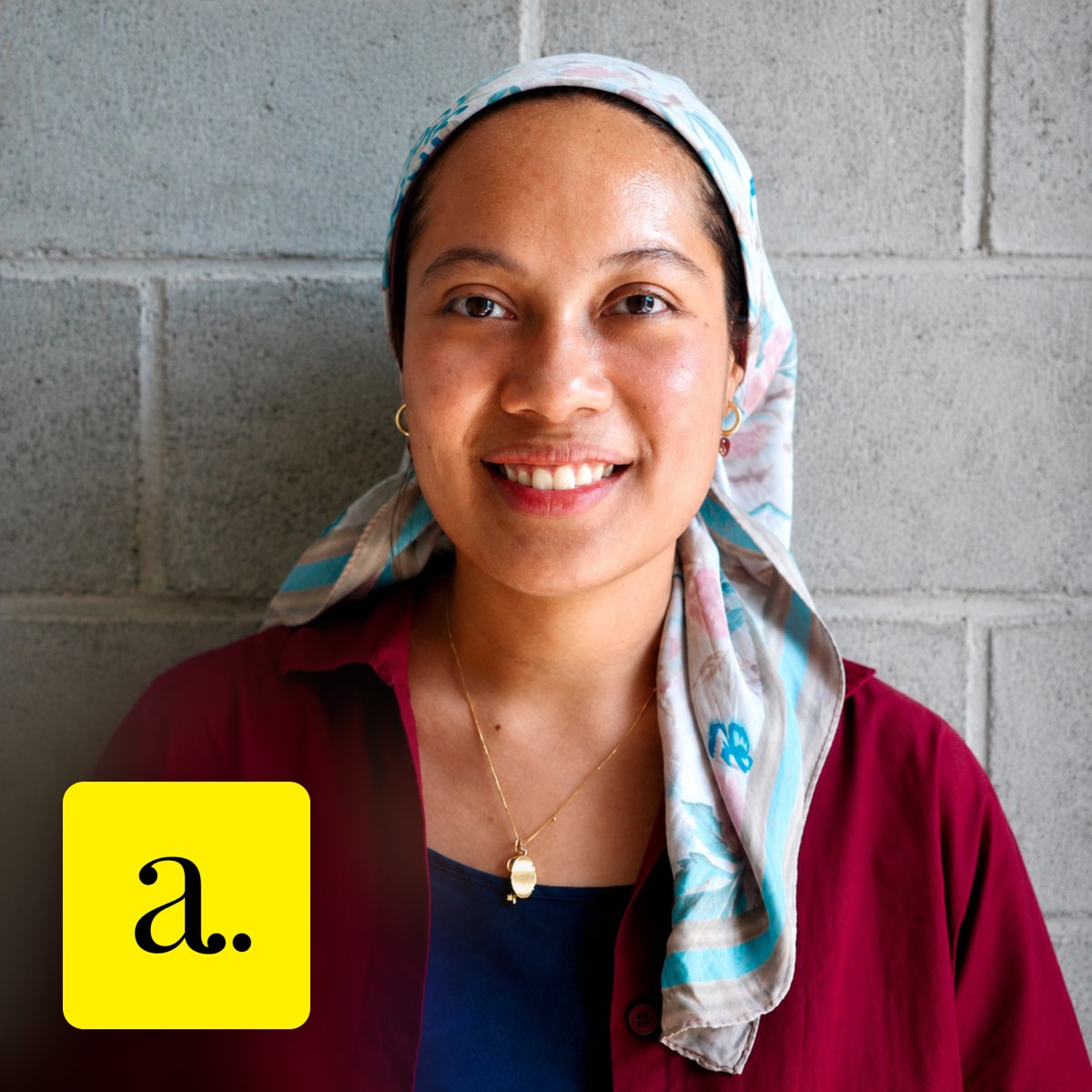
Bernard Leong: Many thanks for coming on the show and sharing how humanitarian organisations really think about the use of AI. It is not clear cut. I have learned a lot simply from understanding that this is not about efficiency — it is about trying to solve real-world problems. In closing, I have two last questions. Any recommendations which have inspired you recently?
Nur Hafiza Mutalif: I recently started reading the new Robert Langdon book, The Secret of Secrets. I know it is a bit late. I really like it, and it inspired me to think about the different ways you can think about something. Everyone has a different perspective on a very foundational thing. That made me think.
Bernard Leong: That is the Dan Brown fiction book. Where can my audience find you, and the work the Singapore Red Cross is doing across the world?
Nur Hafiza Mutalif: We are on Instagram and LinkedIn. You can find us at Singapore Red Cross.
Bernard Leong: Many thanks for coming on the show. I look forward to hearing what you have to say later at the conference. Thank you.
Nur Hafiza Mutalif: Thank you.
Podcast Information: Bernard Leong (@bernardleong, Linkedin) hosts and produces the show. Proper credits for the intro and end music: "Energetic Sports Drive" and the episode is mixed & edited in both video and audio format by G. Thomas Craig (@gthomascraig, LinkedIn).