

Innovationism: A New Philosophy for the Age of AI with James Liang

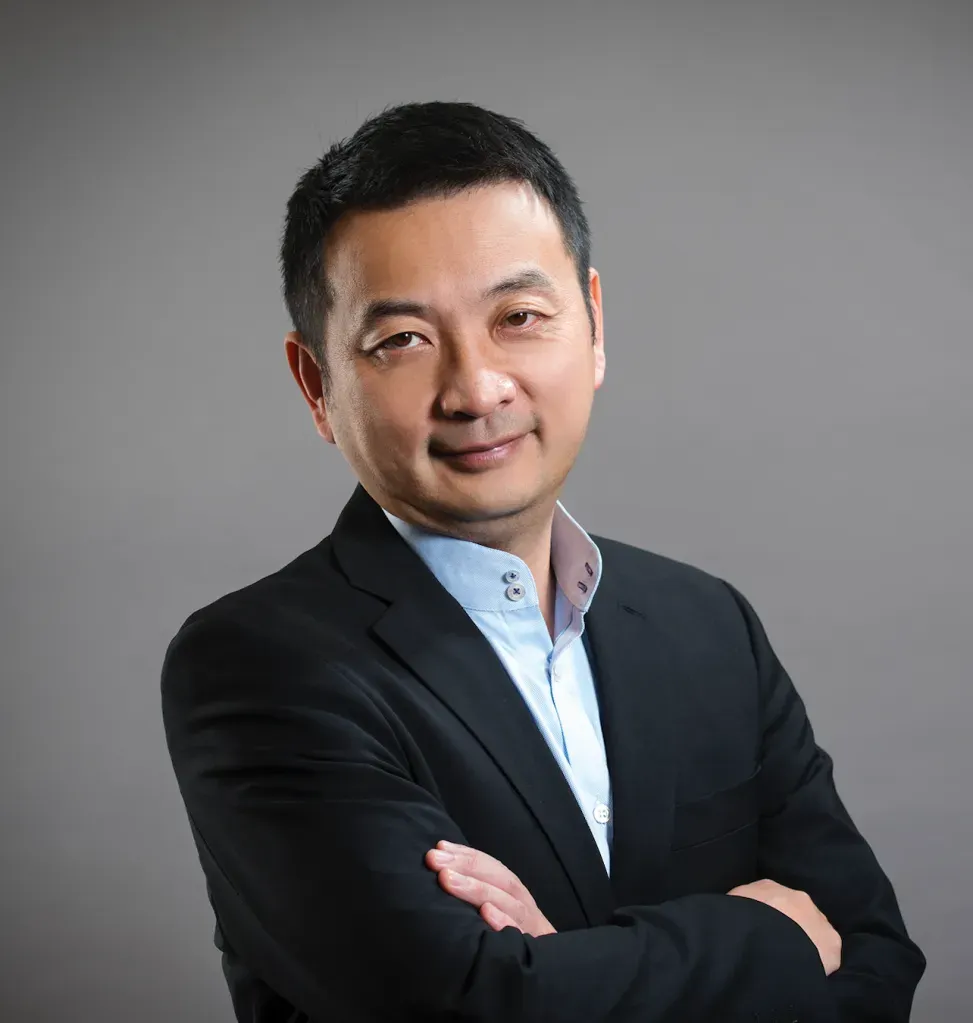
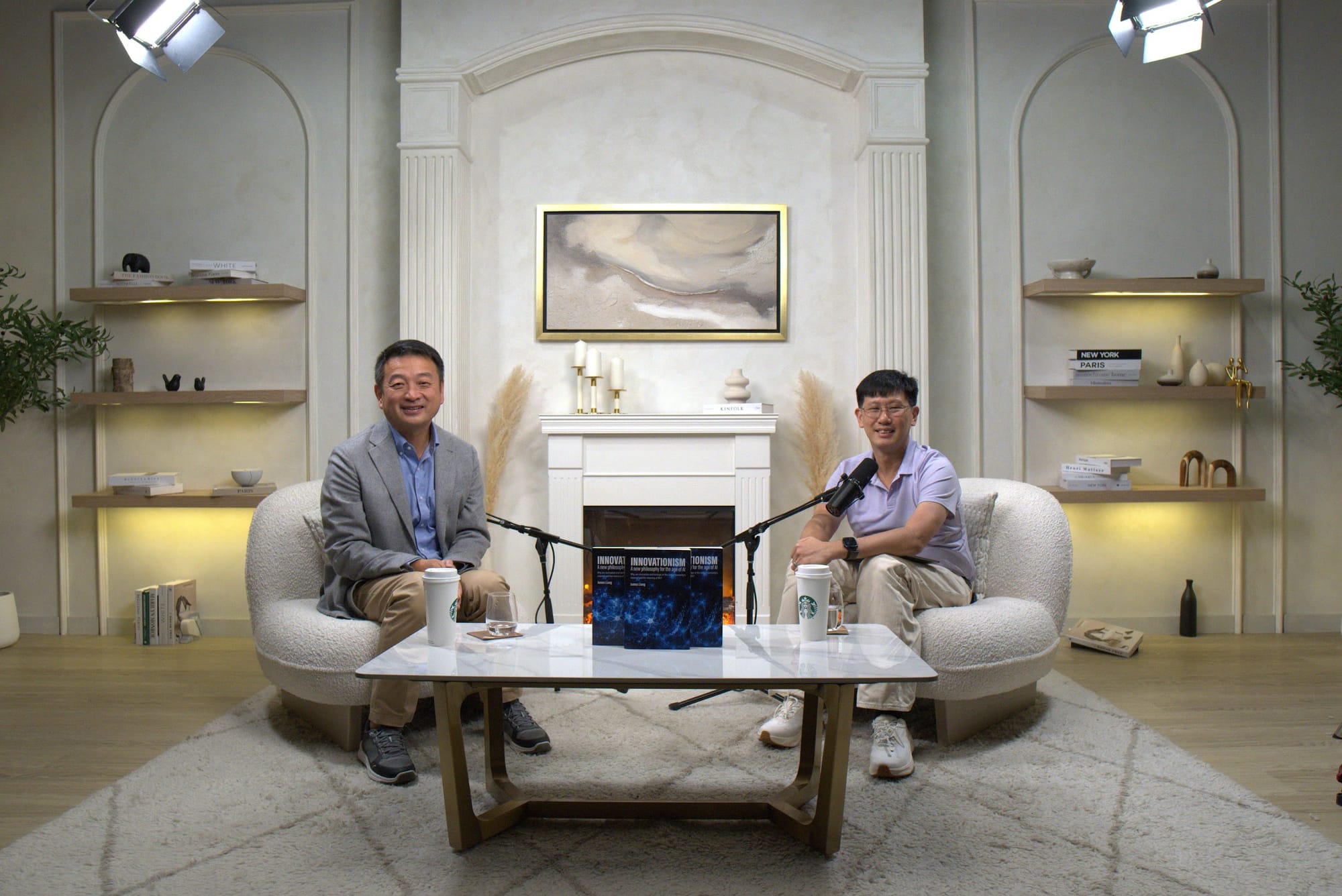
Fresh out of the studio, James Liang — Chairman of Trip.com Group, economist, and author of Innovationism: A New Philosophy for the Age of AI — joins us to explore what becomes of human meaning when AI does the work. James argues that innovation and heritage are "the same coin": innovation measured by how much heritage it leaves behind. He unpacks why the individual, not the nation or firm, is the binding constraint on innovation, why aging societies stop producing startups, and how his Nature 2024 hybrid-work study reframes family-friendly policy as economically rational. Closing the conversation, James explains why he is bullish on China mid-term but bearish long-term — and why population, not chips, is the real race.
"To innovate and to innovate successfully is measured by how much heritage you generate. But you know what's a good innovation? What's innovation can have a lasting impact? In my definition, the good news is it's going to last." - James Liang
Profile: James Liang, Co-founder, Executive Chairman of the Board, Trip.com Group and Author of "Innovationism: A New Philosophy for the Age of AI" (LinkedIn, Trip.com)
Here is the edited transcript of our conversation:
Bernard Leong: Welcome to Analyse Podcast, the premier podcast dedicated to dissecting the pulse of business, technology, and media globally. I'm Bernard Leong, and for the last decade we have been told that AI will reshape work. But the question James Liang puts on the table is harder: if AI does more of the work, what becomes of human meaning? Today's conversation explores three angles. First, his arc from a gifted student at Fudan University, to Silicon Valley engineer, to co-founder of what is now Trip.com Group, to a demographer, and now a public philosopher. Second, his new book, Innovationism: A New Philosophy for the Age of AI — the thesis that innovation and heritage, not work alone, are humanity's organizing purpose. Third, what his population and innovation lens tells us about the China–U.S. technology race and where it is actually heading. James Liang is the chairman of Trip.com Group, a research professor of economics at Peking University, and co-founder of the Yuhua Population Research Institute (育娲人口研究智库).
So James, welcome to the Analyse Podcast. It's a pleasure.
James Liang: Of course.
Bernard Leong: Your origin story fascinated me. You entered Fudan University's (复旦大学) gifted program at the age of 15, worked at Oracle in Silicon Valley, and then came home in 1999 to co-found Ctrip — now Trip — when most Chinese consumers had never booked anything online. Today they're travelling all around the world, and everyone, including myself, uses Trip.com to go everywhere. What did you see in China in 1999 that the people who stayed in the Valley did not?
James Liang: At that time the Chinese economy was still rapidly developing, so a lot of infrastructure was not there. Obviously there was no internet, but even the call-centre-based travel agencies were not normal or widespread. There was very little online or credit card payment infrastructure, and little logistics infrastructure. Given all these constraints, a lot of the other e-commerce models were not as valuable as travel. We thought travel would be able to work around online payment, because you can pay at the hotel and the hotel gives you a commission. You don't need delivery. So you could get around some of the bottlenecks. The sweet spot was offering both the call-centre-based travel agency and the online travel agency. There was no mobile internet back then. Customers could book travel on their notebook or PC, but they could also call the call centre with a mobile phone — not a smartphone, just a real old-school Nokia phone — which offered very good reservation service.
Bernard Leong: After that, Trip.com grew and expanded into a very large company. One of the big questions is that you stepped down from the CEO role twice — once in 2006, when you went to do a PhD in economics at Stanford, and again in 2016. Both times you came back at pivotal moments. Looking back, what became visible to you about the role only after you stepped away from it? What were the lessons from those pivotal moments?
James Liang: You thought all the innovations were already there — that there wasn't much on the horizon. You didn't see any rivals or competition. Once we dominated the PC internet, we became very successful, profitable, and listed, and our competitors didn't seem to be making any progress. But that was obviously an illusion, because what was looming on the horizon was the mobile internet — the iPhone, then Chinese mobile phones. When I stepped down and pursued a different career, I didn't see that. After a few years there was a lot going on in the market, and we had to work really hard to catch up.
Bernard Leong: Was that because, when you were living in the Bay Area working on your PhD at Stanford, you suddenly saw everybody talking about iOS and Android? Did that trigger the realisation that you needed to get onto mobile?
James Liang: No. I really immersed myself in academics. I didn't look at the home market or our business very closely at all. Only when I graduated and became a professor — I taught economics in Beijing for at least a year — and went back to China did I realise our company was not innovating as fast as some of the rivals. By around 2012 it was showing up in our earnings and our profitability. Our company suffered quite a bit from not being able to catch up with the mobile internet revolution. So I was asked by the board to come back and lead the company again.
Bernard Leong: This is founder mode in its truest sense. You have to be there and drive that innovation. From the outside, your CV looks like three careers: a great business operator, a scholar, and a public philosopher. From the inside, what is the single question you have been chasing across all three roles?
James Liang: That's a very good question. People say the things I'm passionate about — travel, business, demography, having children — seem quite unrelated, and AI is a different dimension again. But looking at it from a humanity perspective, you want humanity to flourish. How do you define flourishing? You're a theoretical physicist — we have a four-dimensional universe, space and time. We want to expand in space: we want humanity to go all around the world, and maybe out into space. That's the space dimension. But the time dimension is innovation and heritage. You want to pass down your knowledge, but also your genetics, to your children. So it's all about human flourishing, especially in the age of AI. You need to think philosophically: what is the meaning of humanity, and what defines flourishing?
Bernard Leong: We're about to get there, but I have one more question. If I were to ask you to share the key lessons from your career with my audience — the three important lessons of life you learned across your entire journey as operator, scholar, and philosopher — what would you share?
James Liang: In the book I say you want to pursue an innovating life. But innovating is a big word. First, you want to pursue a rich life — a variety of experiences, even though some of them may seem hard, full of work, or uncertain. Having a child has a lot of uncertainty: for your health, your lifestyle, your career. But it's a rich experience, part of the human experience. A daughter is very different from a son, so you want to have both. Those give you richness and help you realise your full life. Travel experience does the same — different destinations give you different perspectives. If you're creative — creating unique content the way you do, or doing research — many of the most valuable companies in the future will be innovation-related, so if you're part of that endeavour, you should enjoy and capitalise on it. It's important that we make our lives very busy, but also take a step back, look at everything from afar, reflect, and then go on to our next journey.
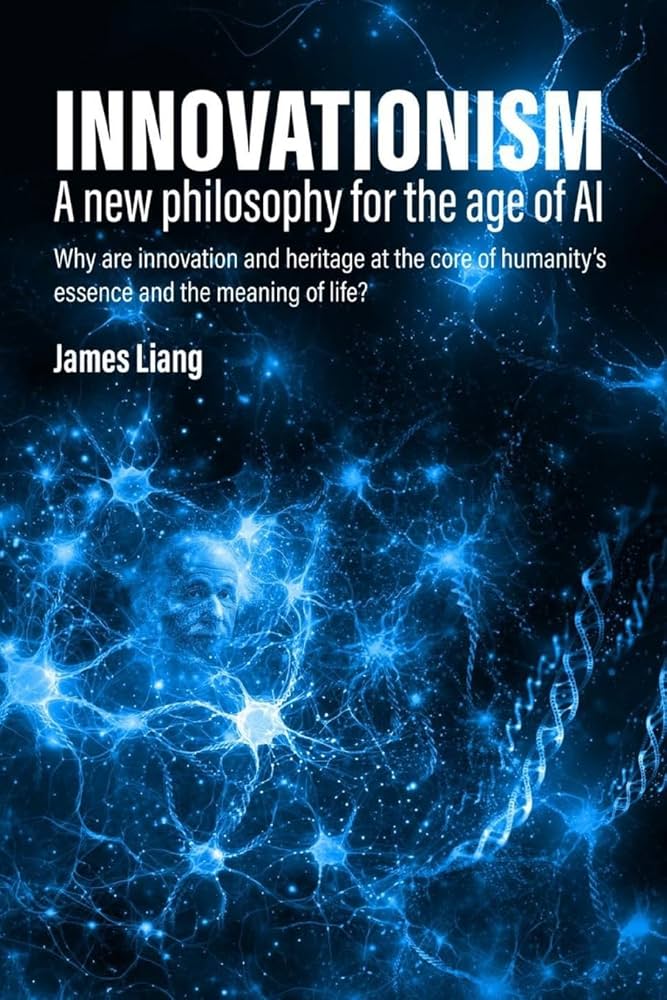
Bernard Leong: Yes, that's what you're implying. But of course, there is the main subject of the day. I want to talk about your book, Innovationism. First, thank you for sending me the book — I spent some time reading it and really enjoyed it. I like how the book starts: with a story about your daughter. Many philosophical books begin with abstraction; you begin with a child. What were you trying to help the reader understand before asking them to think about the big subject of the book?
James Liang: Philosophically, the meaning question is one of the most important questions, and it really emphasises the time dimension — it's about transcending yourself over time. You think about what kind of world you want to help bring to your children, or your children's children. With AI, that's accelerated. My daughter could be facing a very different world — a different job market, a different family structure. So what kind of world does she want to live in? That's a conversation with my daughter: why would you still want to explore the world? Why would you still want to study? Why would you still want to have curiosity in the age of AI? That's the most important question.
Bernard Leong: I picked up a couple of key tenets — innovation, heritage, meaning. Can you explain the core tenets of your book, and what the term innovationism means in the context of heritage and innovation at the core of humanity's essence and meaning of life?
James Liang: The one thing I have not seen in a lot of philosophy books is the concept of heritage.
Bernard Leong: As an overseas Chinese living elsewhere, I read many Chinese books — the Confucian classics — and I think about the self, the family, and the country from that point of view. So when you talk about heritage, it resonated with me as I read the book.
James Liang: The religions and philosophies we study now are at least a few hundred years old — sometimes a few thousand. Those philosophies don't treat innovation or progress as the theme, because progress was still very slow in the old days. In your lifetime, you probably wouldn't see much progress or innovation having any effect. We've now seen four waves of innovation, and today is completely different — so you need a new philosophy. But Chinese philosophy, compared to other philosophies or religions, is more time-based, because it's a lineage.
Bernard Leong: You work for a lineage.
James Liang: You want to pass down your lineage — not just your genetics, but also li yan: your knowledge, your philosophies, your values — to your children and your offspring. Sometimes in a family book you have your value system written down by some of the most successful ancestors. So this time dimension is quite unique and very important in Confucian traditional values. Of course, Confucians don't treat innovation directly, but the way to have impact or a heritage is to be innovative. If you want to pass down a value system that lasts for many generations, you first have to be first — otherwise you just inherit it — and it has to have a very good impact for future generations. So to innovate, and to innovate successfully, is measured by how much heritage you generate. That's the same coin. What's a good innovation? What's an innovation that can have a lasting impact? In my definition, the good is what's going to last. The longer it lasts, the better the heritage, and then you say it's a good innovation.
Bernard Leong: I think a lot of Western corporations don't understand this part of Chinese culture. But as you say it, for any company — whether in China or in any Asian culture — innovation is at the core, because innovation is also the writing of the values. When you innovate, you're writing the cultural values of the company.
James Liang: Exactly.
Bernard Leong: And how successful your company is — your cultural values actually shine through that. That's what you mean by the time dimension, as the company goes further. Whether it's a company, an organisation, or a family, as they go on, the cultural values — the original innovation of where it began — is where that innovation drives forward. Did I understand this correctly?
James Liang: Exactly. Technology innovation is very recent, but when we talk about innovation in the ancient days, it's the value in art, and it passes down generations. Successful cultures and successful organisations usually have some sort of value system passing down. Those values shape the behaviour of future success.
Bernard Leong: One word that really catches me is heritage. Is it just children, family, culture, institutions — or all four at once? Which is doing the most work in your framework as you think about innovation moving ahead?
James Liang: Children are of course one form of heritage. But technology, art, philosophies, culture — those also require you, first of all, to study. You have to innovate on top of the giant, and then incorporate new information or new technologies. Technology is one thing that's progressing independently, but all your value systems are taken in. With so much going on — four revolutions in your lifetime — you need the philosophies to catch up, which begs a new kind of philosophy. Heritage is about learning, and sometimes you need to be very concise. I didn't write this in the book, but you need to distil your existing knowledge, because otherwise it would be too complicated to make sense of. Physics is a great example: you distil a very few simple theories, and then you're able to innovate on top of that. That's one reason I think humans want to continue to be in control of innovation — humans are not very good at memorising huge amounts of things; they want it very concise. Fortunately, the world is actually based on simple principles and mathematics. The most beautiful theory innovation comes from simplicity. So you want to learn and simplify as much as you can, then you'll have a higher-level perspective and be able to innovate. It's not that you don't need to learn. In the age of AI, you need to learn more — to compete with the AI, or to manage robots and agents — to be innovative.
Bernard Leong: I'm very much influenced by Chinese culture. I read the Confucian classics — the Great Learning, 大学. When you were talking about physics just now, I thought of a Chinese phrase, 学无止境 (xue wu zhi jing) — that you can never stop learning. Because if you never stop learning, every day is an exciting day, and that's the meaning of life. So I have a different question here, because you've done some very interesting research. Most management literature treats family-friendly policy as a cost the firm absorbs for moral reasons. You ran a hybrid work experiment, published in Nature in 2024 — a very prestigious journal — and you had a RMB one billion childcare subsidy in 2023 that pointed in the opposite direction: flexibility raises retention without hurting performance, and childcare support can be economically rational rather than just benevolent. What are the counterintuitive lessons you've learned about the economics of family-friendly design that most CEOs still get wrong?
James Liang: Most businesses think some family-friendly practices are costly — and some are. If you're giving a baby bonus, that comes directly from your profit. But some measures — for example, allowing flexibility so people can work two days a week from home — I'd call triple-win policies. It's a win for the employees, a win for the company, and a win for society. The first cut is just reducing commuting hours. In big cities like Shanghai, or in Silicon Valley, you could spend an hour and a half each day commuting. If you save that three days a week, that's five hours of extra time you can spend on more productive things. Think about how much time at the office you actually need to talk to somebody versus work independently. If you work independently 50% of the time, you can have half your week working from home — and people often find it more productive, because there are fewer distractions. The rest of the time you participate in big meetings, which you can do effectively over Zoom. It's only on a few occasions that you need really intense conversations — engaging discussions, brainstorming, like we're doing now. Two days a week in office is more than enough, as long as you can coordinate your colleagues for those meetings effectively. That shouldn't hurt productivity, but it saves a lot of time for employees.
Bernard Leong: If you think about the world's richest billionaire, John D. Rockefeller — if you read his biography, Titan — he worked from home three days a week and there was no internet access. He used the technology of the telegram to communicate with his teams building oil pipelines across the US. Think of those days, when communication was nothing like today. We can send each other a message instantly, almost at the speed of light. But back then communication wasn't there, and he still could do it. One concept that made me think a lot while reading your book was innovation capacity — how population affects it. Population size leads to a scale effect, population capability leads to an aging effect, and internal and external communication volume leads to something called the agglomeration and mobility effect within society. Can you share these concepts and your thoughts, to help my listeners understand more of what the book talks about?
James Liang: This model tries to analyse the drivers of being innovative at a company level or at a macro, country level. I got the insight from large neural models, or the human brain. The brain's power comes from the number of brain cells, or neurons — but, more importantly, the connections between them. How much you can connect to other intelligent units determines how powerful or innovative your brain is. At a society level, it's how many people have an innovative mind. They have to reach a certain subsistence level — above subsistence — to do that. A poor country spends all its effort just feeding itself; it's not going to be innovative, even with a lot of people. But once a country moves past subsistence or middle income, what matters is the number of talents and researchers, plus how much they can leverage other researchers within the country or outside it. That's internal communication — exchange within the country — and external, international exchange. Internal exchange, as in the US or China, is usually much more friction-free and vibrant than international exchange. So with a large population you have a bigger talent pool, more connections, more exchange within your country, and a bigger market. I'd argue that recently — with the internet and AI — users also participate in innovation: creating content, or helping improve your algorithm. So a large population or market also helps innovation. That's the scale effect of internal population. But you also need to be open to the world — to exchange talent and research with the rest of the world. Mobility is very important.
Bernard Leong: The book also fleshes out that innovationism plays out at three levels: nation, firm, and individual. From where you sit today, which level is the binding constraint — which one, if it fails, collapses the other two?
James Liang: Currently the world is really innovating. Let's not talk about the uncertainties of what's happening in the world, but just from a mental-model point of view. The stability of the nation is quite important, because it ensures that firms can prosper and thrive. From the Chinese perspective, we always think about nation, family, and individual. I think the bottleneck is probably at the individual level. People see very successful entrepreneurs making a lot of money, but most innovators don't make much, or aren't as successful. They have to go through so much hard work and uncertainty. In Japan, and even in China, people talk about lying flat — giving up, both on their career and their family life. I always think having a child is like innovation. People are giving up trying these things because they could be enjoying a pretty pleasant life by themselves — living off their parents' savings or a government basic income. They can live a good life, but it's not as meaningful a life as if they continued to pursue harder things: having a family, pursuing a creative career. So the individual is probably the constraint. That's why it's philosophically an important problem — you need to put it in the value system, where people value career and family.
Bernard Leong: So the individual is still the basic unit of everything from your point of view.
James Liang: Yes. Nobody knows — no country, no company knows — what the next breakthrough innovation will be. If a company or a nation knew, then it's not innovation; we'd just be living in a very top-down world where a few big companies or the state plan all the innovation. That's not a good scenario. By definition, innovation cannot be planned. It has to come from the grassroots, bottom-up. Individuals really need to be the driver.
Bernard Leong: One interesting thing was a paper you co-authored. Older countries do display lower entrepreneurship at every age, and the effect is especially pronounced for people in their 30s and 40s. It's not that old people don't start companies — it's that in aging societies, even young people start fewer companies. What is the mechanism, and how does that change the way countries like Japan, Korea, or Italy should think about innovation policy? If you think about Japan 20 or 30 years ago, there was Sony, Toyota — very well-known businesses. Today you hardly hear of any interesting new Japanese companies. Same with Korea.
James Liang: When I looked at the problem 15 years ago, it was still quite debated what the culprit of the Japanese recession was — two or three decades of downturn. But now it's quite obvious. The difference between Silicon Valley in the US and Japan is that Japan doesn't just lack startups; the existing companies aren't doing well either, and we can explain why — it's also related to aging. The eye-popping fact is that Japan just doesn't have any successful startups like Silicon Valley. Korea is maybe 20 years behind Japan demographically, so Korea has some startups, but not as vibrant — though Korean people are very innovative and entrepreneurial. China is the opposite: it's very young demographically and growing fast, so you have a huge number of new companies popping up, and that trend seems to be continuing. The US and China have all the new dominant and breakthrough companies in these new technology fields — partly due to their young generation, partly due to their size. As for the mechanism: the golden age of starting a family, starting a company, or writing your influential research paper is around 30. People in their 40s and 50s can still start companies, but at a much lower frequency. There's another effect: in an aging society, your hierarchy matters. Every economy or company has a hierarchy, and you have to go through the ranks. If you have many older people compared to young people — a top-heavy demographic structure — your speed of promotion to important positions is much slower. So even if you're creative and very young with a lot of good ideas, you're blocked by the older folks who've been there a long time, who have inertia in their mindset and vested interests — they don't want to change. That also dampens the creativity and innovative vitality of young people.
Bernard Leong: We talk about AI. There's a framing you've made on an earnings call: that general AI agents make vertical operators more defensible, not less, because fulfilment, trust, inventory, and supplier relationships still matter. Help me understand this. In an AI era, is the moat the model — or is it the data plus workflow plus supply chain plus partnership ecosystems and organisational learning? Where does the thesis actually break down?
James Liang: You're asking a very big question. It's hard to know now, because things are progressing so fast. But over the next few years: AI is very good at information processing. It'll break down all the information asymmetry at a non-physical, non-dynamic level, relatively fast. So if you're in the process of organising information — not real-time information, and not connected to the physical world — you're prone to being replaced or disrupted by AI. But if you're connecting to the physical world — like this hotel or this office: how many rooms are left at this minute, and what's the price, which keeps changing dynamically; all the flights, the last seats and their price — that's different.
Bernard Leong: But trust is still very important. I'll still use Trip.com. As a user, I've used your platform before, I've built trust with it, so I'll book flights on there. Trust is very hard to break. Once we give a lot of autonomy to AI agents to do everything, they start to lose that.
James Liang: Agents aren't really reliable yet, but I think that can be solved. Eventually agents will be quite reliable at getting that information — if the information doesn't change often and doesn't connect to the physical world. For the physical world, where things change often, AI will do a much better job than some of the current companies.
Bernard Leong: One interesting part of the book is about education reform. You've been critical of exam-driven, memorisation-heavy education systems — I know it because I lived through it too. If you could change one thing about how Asia educates its next generation of innovators, what would it be, and why is that change so hard?
James Liang: The background is AI's impact on the job market: people will have to go through longer training. Their internship jobs aren't there anymore, so you may have to pay tuition to get the internship. Training, education, and degree programs are all going to get longer. So it doesn't make sense to test or filter talented kids too early. You need some filtration sooner or later — that's inevitable — but you want to postpone it as late as possible. You don't want all the pressure early on in childhood. It's not a happy childhood, and it's not happy for the parents. If you study hard in college, that's from your own motivation — parents don't give you pressure. But filtering students when they're 10 or 15, as in China or some other Asian countries, makes sense only when education resources are scarce. If you don't have enough good college or high school spots, you want to filter the most talented students. But with today's AI tutor technology, you really don't need to go to college to study college material — you can just use AI. You do need some social networking, socialisation, and filtering at the end. So I'd treat today's college general education like high school education: everybody should get it. People live to 100 now, versus 50 before — why not spend 20 years for everybody just to finish college and get the general education? Not just for jobs, but to be a good citizen, to have a cultural and humanistic foundation — to learn about everything in the world, including science and maths. At the end of college you have a test. You should probably get rid of all the elite undergraduate programs in the world, and only at the graduate level start filtering for an elite. Because working with a professor on research projects is the only scarce resource you then need to allocate.
Bernard Leong: I agree with you. One of the things I feel is that our education system is an answer-based system. But now we have an abundance of intelligence, where the answer is in abundance too — so we should focus on a more question-based education system, because our children and grandchildren have to be the ones thinking about the correct questions to ask in order to drive humanity forward. From your point of view, what would be your mental model for the education of the younger generation if it were today? I'm struggling now, thinking about my three children — two of them below 12, and one a teenager. I struggle quite hard, even as someone who's an AI practitioner, building an AI company serving customers' needs and teaching AI to different people. It would be good to get your thoughts.
James Liang: Understanding is still very important. It's not that, because AI understands everything, you don't need to understand the world. You need a very concise model of the world, coming from you. Otherwise, when a new technology or a new thing comes at you, you won't be able to assemble the new information, and you can't rely on AI to handle this uncertain future. My experience is that if you don't worry about exams or practising all these problems, you can go much faster.
Bernard Leong: I agree with you 100%.
James Liang: But you still need a little bit of checking that you understand it — to be able to work out the problems without AI, without a calculator. Just a little bit, though. The purpose is to understand, not to get good grades on an exam. Eventually, at the end of college, when you start applying for those scarce research positions, you need to come up with your own project — project-based work. But at the elementary and even undergraduate level, it's pretty much standard material. You can go much faster and explore much wider subjects if you're not bogged down preparing for tests.
Bernard Leong: So what's the one thing you know about Innovationism — about how it actually works inside a real company, not on the page — that almost no one reading the book from the outside is going to pick up?
James Liang: There are a few new things in this book. I think there will be more and more philosophical books written for the age of AI, because the shock, for me, is really philosophical. The thing people worry about most, in the recent months since the book was published, is asking: what's the end game? Let's take three scenarios. Is the human going to continue to be the master, managing AI? Or are we going to be like children of the AI? Geoffrey Hinton said, very surprisingly, that AI taking over is inevitable, and the best thing we can do is teach AI to be a good mother — maternal love — to take care of humans. So the second scenario is that humans become the children of AI: still loved, still able to explore, but not in control anymore. The third, and worst, is that you'd be like a pet or a slave — and pet and slave are very close; we'd be treated as house cats, basically. They didn't mention it, but you need a large, well-educated, hardworking population to prevent that third or second scenario from happening. If it were such a great technology and you were a very small country at the end of the world, there's not much you could do — you could only buy products from the US and China, and outsource most critical decisions to them. If the US and China themselves had only half the population, or a much smaller population in future generations, eventually there wouldn't be enough brainpower to manage the innovation going forward. If you calculate how many brain cells there are in the world and compare that to how many parameters — digital brain cells — we're building, we're still many times bigger; maybe not a million times, but tens of thousands of times bigger than the silicon brains. But in 10 or 15 years it's going to reverse: they'll consume more energy and have more brainpower, at the same time as we're reducing our population — in China, by half each generation. So having a large population is very important. It determines how we're going to live with AI.
Bernard Leong: The last part of your book ends with an interesting chapter on technology ethics, applying it to the frontier areas. We've talked a lot about AI. There's also energy, virtual reality, gene and longevity tech — and even space migration; Starship just launched, so we may be getting to Mars. Of the five, which is the most likely place where innovationism's ethical claims will actually be tested in the next decade, and which one are you most worried we'll get wrong?
James Liang: I always worry about population more. I wrote a science fiction about immortality — post-immortality — and that's actually happening very fast. In one generation, people can probably extend life to maybe 150, maybe even longer. When people live that long, they think we don't need as many young children anymore, because the population keeps increasing as we have more and more older people. But that could be problematic if you don't have fresh blood — it's going to stagnate the whole system. You have vested interests and people whose mindsets aren't progressing. So humanity could hit a point where you have a lot of older people and not many young replacements.
Bernard Leong: But suppose we can do space migration. Unfortunately, due to the laws of physics, getting to the nearest star system will take ages — the closest, Alpha Centauri, is 4.3 light years away. With longer longevity, don't you think our capacity to expand into interstellar space also grows?
James Liang: That's the thing I worry about. Space travel is obviously such an important pursuit — to continue extending humanity indefinitely, and for the meaning question, it's very important philosophically. But space travel is much harder than Elon Musk suggests. That's the one thing I disagree with him on. Of course, he wants to advocate that within a lifetime we can go to certain places, because people don't think that long-term. But space travel is so much harder, and it's an almost limitless pursuit. It's good that it's limitless — otherwise we wouldn't find extra room to innovate. Longevity might be a 200-year pursuit, but space is unlimited room for exploration. On the other hand, space travel is not very profitable, so it just doesn't make sense — unless we find profitability along the way. People talk about mining energy.
Bernard Leong: Or we might find profitability along the way.
James Liang: Unless people make it into a tourism industry — where people find it interesting, a good experience to go into space, minus the risk. I'm not sure.
Bernard Leong: Maybe that's the next frontier for the culture of Trip.com — where trips become interstellar instead of on Earth.
James Liang: We're looking at some very interesting investment opportunities in this arena. But overall, it's really at the societal level that you need to allocate a lot of money and resources into space travel. Otherwise it wouldn't be business-viable.
Bernard Leong: As someone who looks at technology not just from the US but also from China — thankfully, because I can read Chinese, I know what's going on there — what do you think are the biggest misconceptions about China when it comes to innovation, from the rest of the world, including the US?
James Liang: I felt very strongly — I was in the minority 10 or 15 years ago when I started looking at innovation in China and how it relates to population size and demographics. My conclusion was very clear: China will be super strong, and will continue to be strong for the next 10 to 20 years. Only in recent years have people started to appreciate the advantage of a big country. In the '80s and '90s, even 30 years ago, you had very successful multinationals from smaller countries — Finland and Nokia, Germany. But if you look at the latest technologies — internet, mobile internet, AI, search engines — those all come from the US or China. Why? Because those are digital technologies, which can replicate at almost zero cost. And users participate in the innovation: when you use Google more, those long-tail searches help Google enhance its algorithm. The same with AI, and the same with our company — the more people use our service, the better our coverage. The user scale advantage is much bigger than the manufacturing-technology advantage. So the future will increasingly favour companies and countries with large talent or large market size. From that perspective, China should be very strong, looking back to 15 or 20 years ago when I was looking at the problem. Even during downturns — a housing crisis, COVID — those are just short-term fluctuations. Over the long run, technology and innovation are basically the one factor. The R&D people at our company, at Huawei, at Google — even during COVID, they weren't resting; they kept doing their experiments. So coming out of COVID, China is super strong. The electric cars now dominate the world after just a few years, and nobody predicted that. Twenty years ago, people still thought China was just a low-cost producer — its innovation strength wasn't even on the radar. In just the last two or three years, China's medical and life-science research has advanced at much more speed. If you look at China's input into innovation — the size of the talent, not just the size of the market — it's three times bigger than the US. So China should continue to do so. But unlike most economists, I'm very bullish on China mid-term, and kind of bearish on the long term — a 20-year horizon — because the fertility collapse of recent years will hit China 20 years later, when those kids would have grown up.
Bernard Leong: Your own work has pointed to an innovation speed bump for China in the 2030s and 2040s if the fertility rate doesn't recover. In Singapore we call this the NFR — natural fertility rate. It's a very important number. But I want your perspective from China: looking at the China–US technology race now, with chips and export controls dominating almost every Western headline, is the real bottleneck for China's growth going to come down to whether there are more births, more kids, a bigger population?
James Liang: Ultimately, it's the number of researchers trying to explore different paths for innovation. China today is actually leading in more fields than the US, because China has more researchers to explore different paths to innovation. Of course there are bottlenecks — NVIDIA has been there for 20 years; the technology, infrastructure, and ecosystem have been built up over 20 years. But that's not the end game. There must be better ways than NVIDIA to do things; there must always be a better way to make chips. And you're getting pretty close now. China is researching all these options, together with America and the Europeans. But the sheer size of Chinese researchers means they can explore all these different paths. In 10 or 20 years, no technology can stand still for more than 10 or 20 years — there will be different champions, and they could come from China. Of course, if the whole world is blocking China, that's a different story. Even though China has more researchers than America, at a world level China is still small — especially as demographics decline. So China needs to continue to work with everybody else, just as the US works with everybody else. If the US blocks China, it will hurt China, but it'll probably hurt the US more. So the best game the US and China can play is to be as open as possible — strategic cooperation, as indicated in last week's summit. If NVIDIA isn't restricted from selling to China, all the Chinese companies will be using its GPUs — that's a huge amount of money going to the US economy, and the ecosystem would remain US-based for much longer. In the current situation, China will invent a different path to work around that. I look forward to both countries continuing to cooperate, because it's in both our interests.
Bernard Leong: I have one penultimate question before my traditional closing. What is the one question you wish more people would ask you about innovationism, but they don't?
James Liang: The people I interview are quite successful business people — they understand innovation. But average people still ask: well, how do I innovate? Maybe I'll just ask you that — if I'm just a normal person, how do I think about innovation from my point of view? First, there will be more innovators. Currently it's about 2% of the population; it's going to 5%, maybe 10%, because there's just not that much routine work to do. Second, in the future there will be more experience-related innovations, not efficiency-related. For example, you're a travel blogger, you take a good picture, or you find a hiking trail that at a certain point or time of day gives a great experience, and you want to publicise it and lead your friends, or even customers, to that experience — and make some money. Not a lot, but good money. So there's more cultural, experience-related innovation that ordinary people can participate in. Third, making a good family — raising good children — is a very rewarding and meaningful experience.
Bernard Leong: Agreed. So my traditional closing question: what does success mean for innovationism? What would you want your readers to walk away with — and does that answer change whether the reader is a 25-year-old founder in China, the US, or anywhere in the world, or a civil servant or CEO thinking about the future of their company with AI?
James Liang: People are very nervous; they're trying to find the next direction. But just relax a little bit. Get a vacation, or have children. Those experiences will bring fresh perspectives. If you have a good time raising children, or a good time consuming a product or travelling, innovative ideas come along. The research says that when you're travelling away, you have more fresh ideas coming at you. So take a different perspective — relax, and enrich your life with different experiences. It will bring you new insights.
Bernard Leong: Thank you so much. That's a good place to end. James, many thanks for coming on the show, and thank you for spending this quality time with me. I have three children, I'm totally happy — despite both my wife and I being founders of companies, so you can see the 0-0-7 hours that we work. In closing, two quick questions. Any recommendations that have inspired you recently — books, or something you've thought about?
James Liang: I should have thought about that. Actually, people don't need to read as many books, because a lot of the most up-to-date content is on podcasts. I regularly go to technology and philosophy podcasts.
Bernard Leong: Nice — so you're recommending technology and philosophy podcasts. Where can my audience find you and your book? Are you on WeChat, or do you write a personal account?
James Liang: I have a number of accounts — one talks about travel, one about innovation. I haven't set up the one that talks about philosophy yet.
Bernard Leong: That's a good idea. I'll check with your team, get the links, and make sure I put them in the show notes. You can find the podcast everywhere — subscribe to us, and of course, give us your feedback. I highly recommend this book, which I had the opportunity to read in the English version first, but I'm definitely going to read the Chinese version. Many thanks for coming on the show, James. I look forward to speaking to you again.
James Liang: Thank you.


Podcast Information: Bernard Leong (@bernardleong, Linkedin) hosts and produces the show. Proper credits for the intro and end music: "Energetic Sports Drive" and the episode is mixed & edited in both video and audio format by G. Thomas Craig (@gthomascraig, LinkedIn).