Incorruptible: The Chapter The Lean Startup Missed with Eric Ries

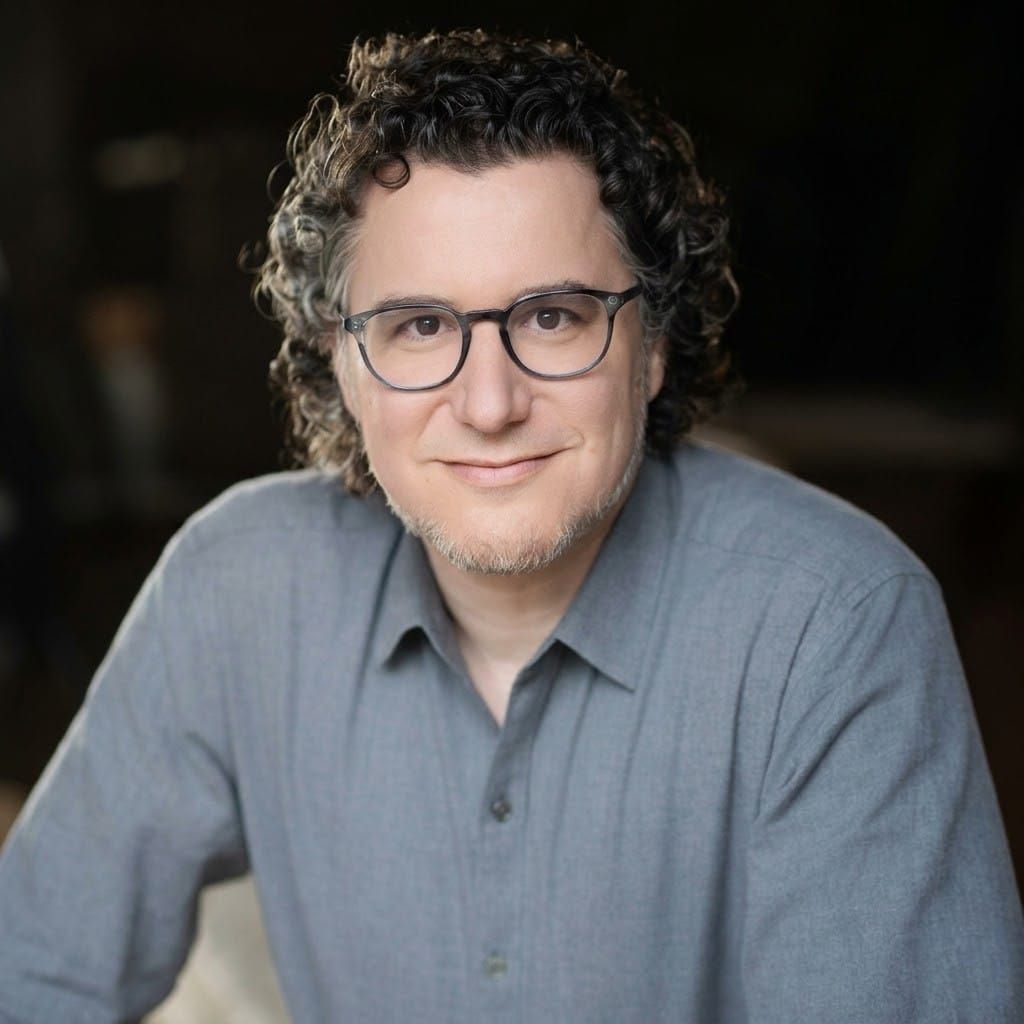
Fresh out of the studio, Eric Ries — author of the new book Incorruptible, joins Bernard Leong to discuss his blueprint for building mission-controlled companies that resist financial gravity. Eric explains why trustworthiness is the most underrated asset in business and why success, far from being a shield, makes companies a target worth capturing. He walks through the governance fortresses that have kept Costco, Novo Nordisk, and Patagonia true to mission for decades, and argues that today's so-called best practices have destroyed billions in shareholder value. The conversation turns to AI: which parts of the Lean Startup it accelerates, which parts it cannot, and why validated learning still lives only between the ears. Eric closes with a radical redefinition of profit as the maximization of human flourishing, and a challenge to Asia-Pacific leaders to leapfrog the governance failures the West is about to live through.
"We're helping people create this asset and we're teaching them the wrong idea. We're teaching them that success will protect them. But that's backwards. Success makes you a target worth capturing. And so that explained to me all these companies I saw that failed—not because they went out of business, not because they failed to create value, they failed because of their success." - Eric Ries
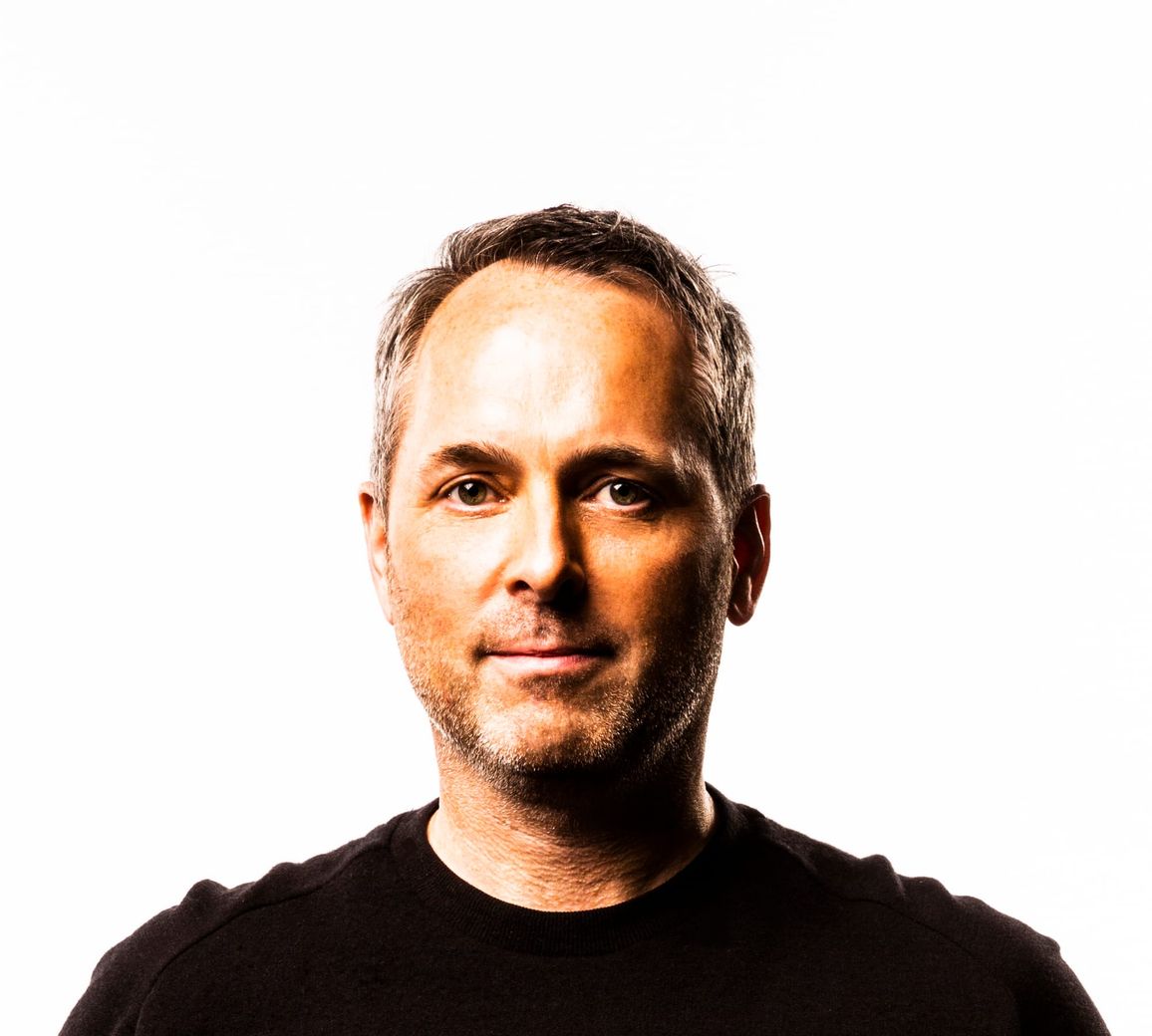
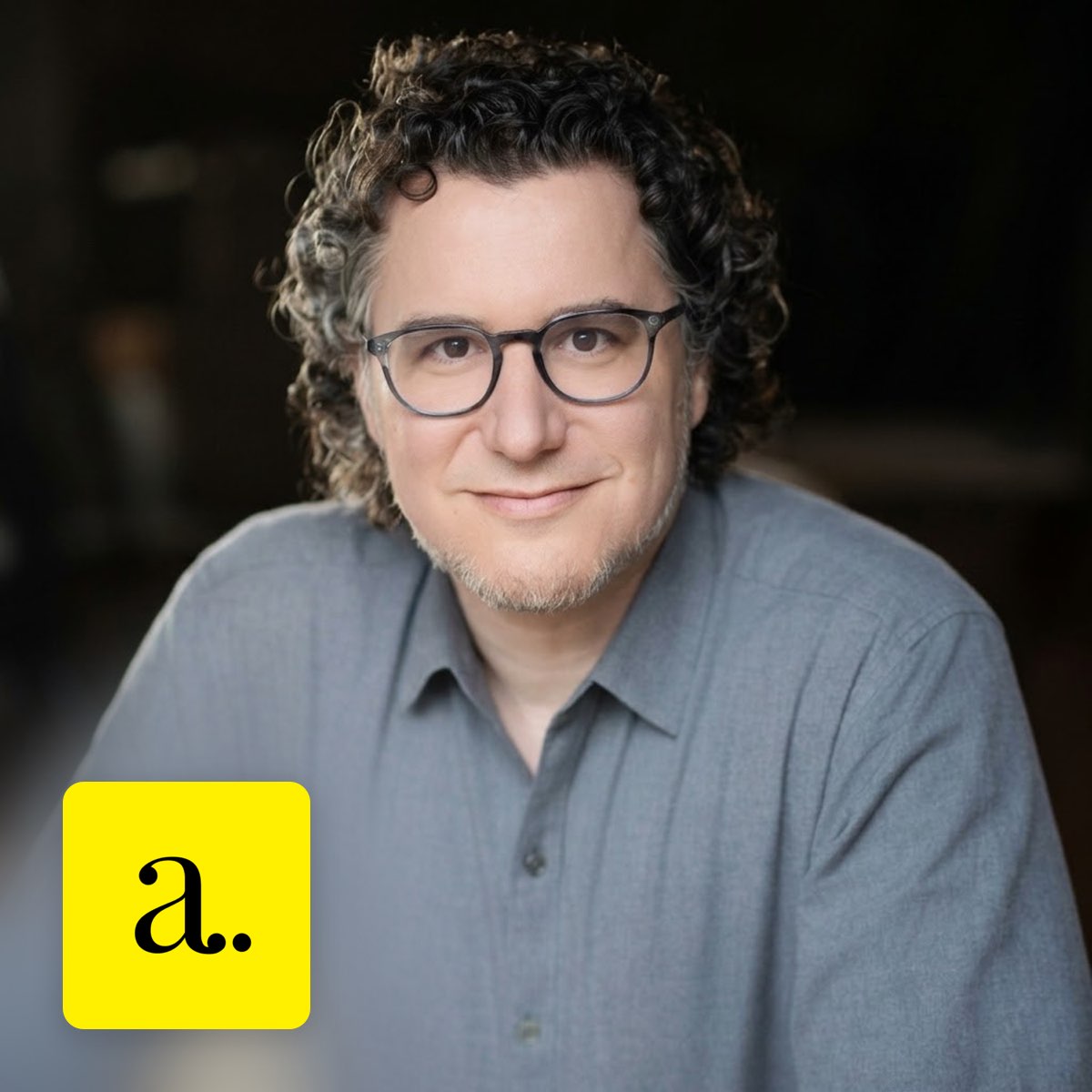
Profile: Eric Ries, Author of Incorruptible & The Lean Startup, Founder of the Long-Term Stock Exchange, Co-founder of Answer.AI. (LinkedIn)
Here is the edited transcript of our conversation:
Bernard Leong: Welcome to Analyse Podcast, the premier podcast dedicated to dissecting the power of business, technology, and media globally. Today we are examining why successful companies lose their way — from how financial gravity corrupts mission, to how governance can be redesigned to protect what matters, and ultimately how great companies stay great. With me today is Eric Ries, founder of the Long-Term Stock Exchange (LTSE), co-founder of Answer.AI, and author of an upcoming book, Incorruptible — which is probably out today when we release this podcast — where he lays out the blueprint for building mission-controlled companies. I'm a first-time caller, long-time fan since The Lean Startup. Eric, welcome to the show.
Eric Ries: Thank you so much. A pleasure to be here.
Bernard Leong: Eric, your career arc has been remarkable. You founded IMVU, which you talk about in The Lean Startup. Then you went to build a stock exchange, which is extremely difficult. Now you're co-founding an AI research lab. My first question: what's the trend that connects all of these, and what drew you from product building to institutional design?
Eric Ries: For me it's been a very consistent and smooth process of just pulling on the thread of the sweater of the truth. I wanted to know the answer to some very basic questions, and I kept having to go deeper and deeper to understand them. The first time I ever saw a personal computer, I was transformed. I love technology. I love programming computers. Since I was a kid, I didn't really know it was a job you could do — I just did it for the love of the thing itself. I was sure that programming was the most powerful force in the universe when I discovered it. It was a rush. Later I came to understand — no, programming is just one little piece of something called technology. So technology is the most powerful force in the world. Then I later learned that technology is just one way of making products, but products are the most powerful force in the universe. Of course, if you've read The Lean Startup, you know my journey to understanding that actually human beings make products. So in fact, management is the most powerful force in the universe. If you've read The Startup Way, you know I eventually learned that accounting and accountability is even more powerful.
Each time I felt I'd mastered some important element of a simple task. I just want to take ideas and put them out into the world, see them be successful, see them have positive impact. Yet so often it doesn't happen. We build a company, we build a product, nobody uses it. We build a product that's harmful to our customers. They use it because they're addicted to it. So many ways for it to go wrong. We build an organization that has success, but then someone takes it away from us. We lose control. Each time I go deeper, I feel I'm learning more about what really is the essential truth of what it means to try to build organizations that have positive impact in the world. In this latest turn, I feel I've gotten even deeper underneath the surface characteristics we usually talk about with organizations. Those surface characteristics are important — business model, strategy, vision, culture. But underneath all that is a deeper set of forces that shape organizations, even if the people involved are unconscious of what's happening. Those forces are what I try to turn my attention to in this book.
Bernard Leong: The way I draw the arc: The Lean Startup gives founders the tools to build quickly and scale. But in Incorruptible, you write that your solution almost had to fail to anticipate what came next — that you taught people how to build something worth protecting, but didn't teach them how to protect it. As a startup founder, I think about this question all the time. It's a striking admission. When did that realization hit you?
Eric Ries: I wish I could say it was on a certain day. It dawned on me over a very long period of time. I believed the best practices just like everybody else, because that's how I was taught. So when I saw company after company fall into darkness, I assumed it was somebody's fault — greedy investor, naive founder, unruly employees, whatever. I bought into the narrative that this is a personal failure. But it happened too often, and I started to ask: why is this happening? When I asked people, they said it's the market. Market forces. We all know the market rewards value creation. So if people are failing, it's because they're not creating as much value as whoever took it over.
That doesn't seem right when we have so many examples of companies being taken over and then destroyed. That's an act of value destruction, not value creation. I started to see both the dark side of failure — companies failing when they didn't have to — and the dark side of success. People succeeding, building great companies, but making moral compromises along the way that left them rich and miserable. I started asking: if it's making us rich and miserable, who's it for? Who are the compromises for? I always thought if you got to be super rich and powerful, you'd be really happy. But you can tell from watching social media for five minutes, there's a lot of very rich people having a nervous breakdown in front of everybody. They don't seem very happy to me. Do they seem happy to you? So I started to feel there's something wrong here, and I need to get my bearings as to what it is.
Meanwhile, I was trying to help people create companies, and increasingly those people were asking for help on this issue: how do I make sure that what happened to that founder doesn't happen to me? I'll never forget — I was talking to a really cool founder building something in the space of humane technology. He told me a story that blew my mind. He saw one of the founders from a previous generation — I want to say it was one of the Google founders. He was at a party where this billionaire founder was. The guy was dancing alone on the dance floor, hitting on 20-year-olds. The founder I was talking to said: is that my fate? Am I going to wind up like this guy? He has everything. He owns everything. This is what he spends his time doing. He's so alone. It was a really powerful statement to me of the problem we're dealing with. It took me a while to understand what's going on, why is this happening, and what could we do about it.
One of the big breakthrough insights for me: eventually I realized we were teaching people how to create these superpowers for their organization, but I knew them as separate superpowers. The power of alignment. The power of magnetic attraction for talent. The power of customer loyalty. The power of long-term partnerships. I could see that mission-driven companies do this a lot better and a lot more than conventional companies. So I knew it in my bones before I could understand it. What is the superpower that makes this all possible? I eventually realized: the most underrated and valuable asset in all of business is trustworthiness. When you build a character of someone who can make and keep promises, customers and employees and partners can trust you — and that's what creates all these other good things in the business. The problem is, because we don't account for trustworthiness as an asset, we don't protect it. It's as if we have this massive trove of this asset just lying on the floor. Anyone could pick it up. There's no vault, no locks, no door, no protection. At that point it hit me: we're helping people create this asset, and we're teaching them the wrong idea. We're teaching them that success will protect them. But that's backwards. Success makes you a target worth capturing. That explained to me all these companies I saw that failed — not because they went out of business, not because they failed to create value. They failed because of their success. That is what turned me onto this problem and got me interested in finding a solution.
Bernard Leong: It reminds me of Clayton Christensen's The Innovator's Dilemma — it's not the poor managers who fail to spot innovations. It's actually the capable managers who fail to realize it's going to threaten them. They're making the smart decisions, but they were the wrong decisions. One more question, inspired by my last 500-plus episodes. From your journey so far — across entrepreneurship, institutional reform, and now AI — what are the key lessons you share with my audience about building organizations with intention rather than default assumption? What do you share with the younger generation as short advice?
Eric Ries: There's a lot. I struggled to keep this book to a manageable length because there's so much I want to teach, but I don't want people to feel overwhelmed. The biggest thing you've already just said: unless you do this design intentionally, you will get the default best practices. So the first thing I want people to understand is that today's best practices destroy value.
I'll give you some examples. Since 2008, companies rated by governance ratings agencies as having bad governance have outperformed the companies that have good governance. I tell a story of something called the Harvard Shareholder Rights Project, which attacked many companies for having non-standard governance. A later independent analysis found that this project destroyed roughly a hundred billion dollars of shareholder value in the name of protecting shareholder rights. It's absurd. In the book I give the example of Costco, obviously one of the heroes of the book. Costco has been able to defend its ethos for a long time because it's protected by what I call a governance fortress — a set of best-practice governance worst-practices that are actually very effective at insulating management from outside pressure. Over the years, many investors, investor activists, and governance experts have attacked Costco for things like spending money that rightfully belongs to shareholders on improving the customer experience, as if that's a criticism. That's the whole point. That's why customers love Costco.
We see this again and again with best practices that are actually value-destroying. So a huge part of it is: we can't just fall into the trap of assuming that just because someone's teaching us the best practice, it's actually any good. One of the stories I tell is about Novo Nordisk — makers of Ozempic and other GLP-1 medicines. That company was set up in the 1920s by a Nobel laureate and his wife. The wife actually had diabetes. They wanted to create a company that would synthesize insulin to cure her. They didn't want to just cure one person — they wanted to bring that technology to their home country of Denmark. That's how the company was started. They adopted what at the time was not an uncommon structure but is today considered heretical worst practice. Novo Nordisk is a scientific research foundation that owns a for-profit subsidiary. The for-profit subsidiary, by the way, is a full-on public company traded on the New York Stock Exchange. It's a huge company, unfathomably large today. That structure has kept Novo Nordisk true to its mission of scientific discovery for more than 100 years.
So I always tell people: when you're hearing someone give you advice about best practices, I'm sure they seem very smart. I assume they seem very well credentialed — they're a lawyer, a banker, an investor, whatever. But before you listen to them, ask yourself this one simple question. Are you sure that you're smarter than a Nobel laureate? Because if you're not a hundred percent sure, you might want to study what has worked for a really long time that is in violation of these so-called best practices.
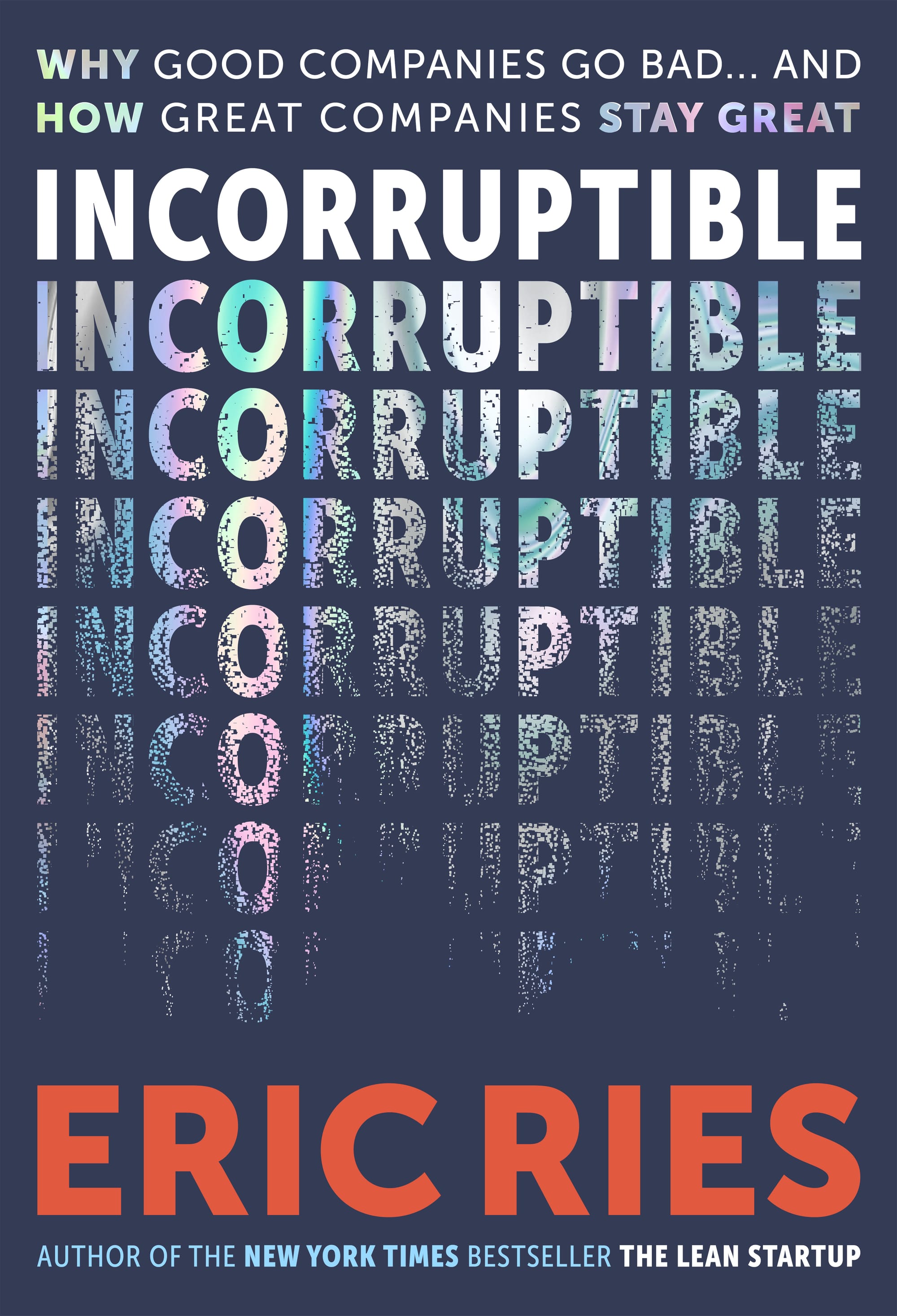
Bernard Leong: That comes to the main subject of the day. Incorruptible asks why some good companies go bad and how great companies stay great. We're now in the era where AI can generate prototypes, write code, iterate at machine speed — like The Lean Startup on steroids.
Eric Ries: That's an exciting time.
Bernard Leong: Which parts of the Lean Startup does AI make easier, and which parts become harder — or more important — precisely because of AI? When I think about AI today, I tell myself: if I could ask Eric Ries one question, that would be the first one.
Eric Ries: Sure. There's a lot going on in that question. Let's take it piece by piece. The first thing: in general, the principles of Lean Startup have held up very well, if I do say so myself. It's been 15 years, and the stuff I said in 2011 about the future — I didn't predict generative LLMs or anything like that, but I did say what we were going to see in general with technology was a consistent increase in two dimensions. One, we were going to see a reduction in cycle time — an increase in velocity of development. The democratization of the means of production, so that more and more people could bring world-class technology to bear on any problem in the world. Secondly, in part as a result of the first thing, we were going to see a world of increased uncertainty. Lean Startup has always shined in the top-right quadrant of high speed, high uncertainty, because we have both the economic opportunities to discover new things and the competitive advantage of being faster in our learning environment than others — which is what you need in times of high uncertainty. That seems a pretty apt description of the last 15 years and probably will continue to be pretty good.
Is this new technology good for founders? That depends. Here's what's really interesting to me. People always assume that if a technology makes a certain process more productive, therefore it's good for the people doing that process, because it will make the industry overall more productive. But not necessarily. I always do this exercise when I'm in audiences now. I ask: how many people have asked ChatGPT to turn three bullet points into a proposal of some kind? Everyone raises their hand. That's right. Everybody does that — just give ChatGPT a few bullets. Then I ask: how many people have taken a proposal and asked ChatGPT to summarize it down to three bullets for them?
Bernard Leong: A lot of people [do that].
Eric Ries: A lot of people raise their hand. If I send you a proposal I generated from three bullet points, and you turn it back into three bullet points — have we actually made anything more productive? We've taken the same three bullet points and spent thousands and thousands of dollars, hundreds of thousands of tokens, the water, the electricity, the GPUs — we burned out all these GPUs to generate a proposal we then used the same GPUs to turn back into its original form. There's no guarantee of productivity improvement ever, even if you make any individual sub-step more productive. You see that with traffic capacity improvements — more freeways just create more traffic.
The other side of it is really interesting. Just because you can now make an MVP faster than before, does that give you a competitive advantage? Not necessarily. If you have the advantage and nobody else has it, sure. But what if all your competitors get the advantage at the same time? The crazy thing about AI is it's being made available to everybody simultaneously — incumbents and new entrants alike. I can't tell you how many people have pitched me a startup since the advent of LLMs saying: I just had this great new idea, I built this cool MVP. I say: I've heard that pitch three times already. The same "great idea" is occurring to everybody because it's super obvious. That doesn't necessarily mean you're going to win. We'll have to see what the net effect is for entrepreneurship. Obviously the concentration of power of platforms can be antithetical to entrepreneurial flourishing. We'll see. But if I look at the people who have had those same ideas who won, it's always the one who learned fastest from customers. In some ways the acceleration of the technology has made the human limits more of the critical bottleneck — and therefore created returns to those who can learn the best. At the end of the day, one of the key ideas of Lean Startup is that the unit of progress in entrepreneurship is validated learning. It exists only between the ears, and that can't be accelerated with a GPU. Those who are figuring out how to use the technology to enhance their own skills and capabilities are the ones who are going to come out ahead.
Bernard Leong: I enjoyed the opening of Incorruptible. The professor whose biotech breakthrough could either save lives or create bioweapons, terrified of losing control of the creation. A little bit sounds like an AI company that's having issues with the government. You wrote that you felt like you were feeding one company after another into a meat grinder. What prompted you to write the book, through the lens of that story?
Eric Ries: This is a real story. I anonymized certain stories in the book because I wanted to protect the identity of the people involved. But this is a real person. The professor gave me permission to tell the story this way. He's a tenured university professor — a very intelligent, very serious person. He called me for advice because he was having trouble recruiting other scientists to join his lab. First of all, they're all tenured professors themselves, so what do they need? They don't need a new job. But they were very excited about the possibility of commercializing this technology. It's a super cool product, but also a very dangerous product.
The issue wasn't compensation. It wasn't equity splits or any of the usual stuff. Every person was asking the same question: how can I trust you're not going to use this for evil? If I leave my university lab and join you, am I going to be complicit in a moral disaster? I don't want to become another tobacco company. What's the deal? He'd say: no, no, no, don't worry, trust me. He has a very altruistic mission. He's interested in saving lives. Then they'd say: yeah, but what about your investors? He'd say: no, they're aligned too. They'd say: are they? What if they fire you? What if they change their mind? He was getting all these questions from them. Meanwhile, when he met with investors, if he asked them those kinds of questions, they'd tell him: you don't seem very serious about business at all. We don't want to invest in some hippie who's only concerned about doing good. We want to make money. He had this realization — this is why he called me — that many of the investors he was talking to would be very happy if he made them a lot of money, no matter what kind of disaster happened as a result. As long as they profited from it, they wouldn't care. They were amoral actors.
By the time he met me, I had had that conversation a bunch of times. It was not my first rodeo. I said: if you stay on the conventional path, the very thing you fear the most is almost guaranteed to happen to you. I told him a bunch of stories, some of which are in the book, about people this happened to. He said: oh my God, is it too late? I said: it's not too late, but you're already on the wrong track. If you honestly want to do this, there are some things you need to do right away. He was very willing to make those changes. But most companies don't have those protections. As a result, I had that feeling of: what is the point of all this work? We're just creating these great companies only for them to be destroyed.
I wanted to honor the professor and people like him who come to this book already with the conviction that the best way to make money is what I call the builder's intuition. You make money by creating new value in the world and capturing some of it for yourself — not by squeezing every dollar out of the world you can find. This book doesn't try to persuade anybody to be like that. If you're already a sociopath and you just want to make money, this book's not for you, and I can't help you. I have nothing to say to you. I will not try to convince you to give that up. That's a deeper, more personal question about what you really want out of life, and I'm not equipped to help you answer that question.
For people who've already answered the question in the affirmative — I want to create something that will last. I want to create something that stands for quality and craftsmanship and human-scale achievement. I want to take care of the people under my responsibility. Yes, I want to make a lot of money because I made the world a better place. For those people, I wanted to give them a blueprint, a playbook they could follow to defend themselves from the people trying to take it away.
Bernard Leong: There's also your personal experience. You co-founded Answer.AI with Jeremy Howard —
Eric Ries: Yes.
Bernard Leong: — deliberately structured as a public benefit corporation, with long-term SPV investors. How did that experience of building the Long-Term Stock Exchange and watching companies get surgically deboned shape how you structured Answer.AI from day zero?
Eric Ries: It was really important. Jeremy Howard is a genius. For those who don't know, he was one of the first people ever to build a large language model, and to propose that training neural networks on a corpus like Wikipedia would produce intelligible outcomes. At the time he had that insight, I would have said that's absolutely, positively impossible. What are you talking about? He saw this a lot sooner than other people did. He's been a very successful entrepreneur. People mostly know him for FastMail. He was involved in the creation of Kaggle and a bunch of other companies. He's most known these days for having created fast.ai. Fast.ai was a non-profit, almost anti-profit organization where he worked really hard in machine learning and tried not to make any money from it, because he wanted to democratize access to the technology itself. Many of the people who learned machine learning or deep learning and now work at one of the major AI labs got their start from one of fast.ai's courses.
When we were talking about this new wave of AI companies a few years ago, we were really focused on: what could we be doing that would be helpful? I said: look, Jeremy, I think you're in a position now where if you created a company around your research, we could amplify the good you're doing in the world quite a bit. But I was very wary — and he was very wary — of bringing investors into that research, because the gravitational influence of those investors might warp the research in just the ways he'd been trying for ten years to avoid. It was a match made in heaven. I said: if you want to start this company, I will help you raise money for it, and help you structure it in such a way that you'll be able to maintain control of it and protect it against these forces. That experience of having done it myself and helped lots of other people get it right — and get it wrong — meant I could bring that advice to Jeremy and help him set up the Answer.AI research lab in such a way that it will be immune from these forces.
Bernard Leong: One interesting concept I thought about: organizations as superorganisms. They have a certain emergent intelligence, their own character preferences and will to survive. You draw a lot on the Weizmann Institute's animal experiments and MIT's collective intelligence research. What should leaders actually think about this? If the CEO isn't really in charge — who is the bank?
Eric Ries: The chapter is called "Who Is the Bank?" because I named it after a famous story in Steinbeck's The Grapes of Wrath, where tenant farmers are being evicted by representatives of the bank during the Dust Bowl. What's so fascinating about this story is they're telling the bankers: look, this doesn't make sense. We've defaulted on our loans obviously, because it's a Dust Bowl — there are no farms here, nobody can farm at all. So technically, yes, you can evict us from our land, but when the Dust Bowl passes, you're not going to have anybody to farm this land. You're going to have repossessed a useless asset. They don't talk like that because they're tenant farmers — I'm putting the language of economics in their mouth. Steinbeck's a much better writer than that. Meanwhile, the bankers agree: yeah, this doesn't make any sense. The farmers say: why are you doing it? The bankers say: we're not doing it. The farmers: who's doing it? You're the bank. You're doing it. The bankers: no, no, no. We hate this. Every person who works in the bank thinks this is wrong, and yet the bank still does it. The farmers: why? You're just a bank — a bank is nothing but human beings. The bankers: that's where you're wrong. The bank is made up of human beings, but it is not itself a human being. It is a creature that breathes profits instead of air. That's what it is.
That metaphor in Steinbeck stayed with me all these years. Who is the bank? What's going on there? It turns out — I won't spoil the whole book, but just to give a sneak — organizations are literally alive. That's my conclusion. They are a category of a phenomenon called emergent properties. Interestingly, it's the same scientific field of study that makes transformers turn into generative LLMs. That is the same thing that's going on. Emergent intelligence is an intelligence that is a property of the whole that is not located in any part.
You're right that I cite this study from the Weizmann Institute — because this is not metaphysics. This is not science fiction. This is not a metaphor. This is a literal scientific fact: certain kinds of collections of organisms exhibit this weird property. If you're skeptical, the best demonstration I've ever seen is an experiment done at the Weizmann Institute — they literally created something called the Piano Movers puzzle. You should really watch the video rather than hear me describe it. There's this T-shaped object that has to fit through this gap. It's one of those classic difficult things to do. Have you seen that viral clip of Friends where the guys are trying to move a couch, going "pivot, pivot"? It's actually a very difficult geometrical puzzle. You have to do it in just the right way. Obviously if you give the puzzle to a single human being, they can figure it out. If you give the puzzle to a single ant, they cannot figure it out. But the more ants you put in the puzzle, the faster they figure it out. The difference between a single ant, a thousand ants, and 10,000 ants is amazing to watch, because you're watching an intelligence at work. It makes the same kinds of attempts you would make. It bumps into things. It rewinds and tries a different way. You can see it working out the solution.
Here's a really wild part of the experiment. They also gave the problem to groups of humans. It turns out — although with ants, the more ants you add, the better the emergence, the faster it solves the puzzle — with humans it's the opposite. The more humans you add, the worse everything gets. Just like ant colonies, just like all kinds of other groupings of things, groups of human beings exhibit emergent properties. An organization is an emergent intelligence. We do not own it. When we found it, we birth it. It is alive. It has its own moral compass, its own character, even its own sense of ethics. In one study I thought was really cool, researchers measured how ethical different companies are. They discovered that if you understand how ethical the company is — not how ethical the people who work there are, that's not correlated — but if you know how ethical the company is, you can predict how many compliance failures and other kinds of problems it's going to have in the future. Moral character is also an emergent property.
A big part of why founders, leaders, and board members lose control of their organizations: sometimes they lose control because outside hostile investors take it away from them. But sometimes they lose control of the thing itself, because they don't really understand how to motivate and bind a superorganism to their values.
Bernard Leong: I want to come to the blueprint — redefining profit and building mission-controlled companies. I see this happening at Intel. It was such a great company, but when it changed from making the engineer the CEO to making the sales guy the CEO, they missed mobile, they missed AI, they missed almost everything. Epic did the same. I've always had this view that the CEO who'll run the company in the future will be a software engineer. That comes to the point of what you propose: a radical redefinition of profit as the maximization of human flourishing. You walk readers through a thought experiment — from Ponzi schemes to toxic waste to a hitman marketplace — to show that conventional profit accounting has pretty fatal blind spots. Share a bit of the definition. I don't want to give away the book — everybody should read it — but share why it matters.
Eric Ries: Thank you. This is a tough one for people just coming cold through a podcast, so I urge you to read the book to hear the whole argument in full. The basic idea: the way we currently define profit has a huge problem. This is not unknown. Economists — if you take an economics class, you'll have learned about these problems. Generally speaking, we just accept that it has problems. We don't realize that every company today — even under today's very limited definition of profit — has to define profit for itself, and then publish how it does that accounting. The idea that every company follows a standard interpretation of profit is not really true, despite GAAP and all that. Most companies still produce their own proprietary version.
The question is: is the version we're using any good? What I discovered is that most builders — people who make things for a living, whether they're a founder or not — carry two definitions of profit around with them. The intuitive version — the builder's intuition — is that profit is about making something more valuable. Creating net new value in the world. They also carry a formal definition of profit they learned in school. The formal definition: revenue minus cost. That's it. I take a $50 piece of wood, I turn it into a $200 table, I made $150 in profit. Very simple, very simplistic. But if you probe people about this definition, you will find lots of situations where their intuitive understanding of profit and their formal definition are at odds.
Take the Ponzi scheme example. Is a Ponzi scheme profitable? Most people will say: of course it isn't. Why not? Revenue minus cost. This Ponzi scheme made a million dollars, paid out 500,000. Isn't that $500,000 of profit? People say: no, no, no. Because although we didn't pay out the expenses this month, we're going to have to pay them out eventually. Although we created value in this period, we created far larger liabilities deferred down the road. So deferred liabilities also have to count against profit. Good to know. What about a toxic waste dump? Isn't that a deferred liability? Are companies that pollute really profitable? That's making it worse. What if I dump the pollution in the river and it makes the people down the river sick — and, imagine, I get away with it, so nobody ever finds out and I never have to pay the cost? Is that profitable? People say: no, you stole. That's stealing. If I steal a $200 piece of wood and make a $100 table out of it, that's not profitable. What are you talking about? So what are called negative externalities also have to be accounted for.
But now what about that $100 table I made out of a $200 piece of wood? What if I use human beings as one of my input factors of production? Am I profitable? People say: what? Nobody would ever do that. I say: indulge me for a second. Imagine I committed murder for hire. Literally, I create Bitcoin-murder-dot-com, blockchain, whatever app. Go on the dark web, pay me money, kill anyone you want. Is it profitable? People say: that's absurd. That's illegal. But what if I made so much money doing it that I could make it legal? Now is it profitable? They say: it's immoral. I say: I know, but that's not the question, is it? Are you telling me immoral things can't be profitable? If you really press people on this point, they eventually concede that no, it's not profitable. If you ask why, they say: if someone pays you $100 to commit murder, you're not accounting for your cost properly. You just killed something of infinite value in exchange for a finite amount of money. That's negative value. That's not positive value creation.
So if our current mental model of profit cannot see deferred liabilities, cannot see negative externalities, and is willing to see a human being as an input factor of production — I would say that definition is fatally flawed. We shouldn't try to tinker around the edges with double bottom line, triple bottom line, good profits, bad profits. We can have whatever definition we want. We are the ones who make the things for a living. We can define profit however we like. So I say we define it as the maximization of human flourishing, and be done with it. Then all those scenarios are automatically accounted for. Yes, we'll have to do some extra work to figure out if our product is in fact making people's lives better or not. But wouldn't you like to know anyway? That seems like very valuable business intelligence. Every company should be very eager to track and find.
Bernard Leong: That's a good point. It's Tim O'Reilly's principle: create more value than you capture. But it runs through the book. What you're showing is that current measurement tools are designed to miss certain positive externalities. Costco's supplier loyalty has no ledger entry. GitLab's radical transparency gets competitors to debug their code for free. If I want to implement something like that — how do you think leaders and boards should rethink this? Everybody wants a measurement, and that runs you into Goodhart's law — your measurement becomes the problem.
Eric Ries: In the academic literature, this is called surrogation. When you measure and reward people in the Goodhart's-law way, people wind up thinking the measurement becomes a surrogate for the thing itself. You reward people for average hold time in customer service. People start thinking that if average hold time goes down, then customer service is improved. That's not true. We all know from having called a cable company that they have lots of ways to get you off the phone that don't involve actually satisfying your problem.
We create perverse incentives, and it runs all through our economy. In the book I give a bunch of examples, including the fact that customer service on average has gotten twice as bad in the last 50 years. It's being caused by this pervasive problem, even though we're spending billions of dollars improving it. It's also why transit costs are out of control in this country. There are 20 other things that affect your daily life being driven by surrogation. If we want to build organizations that don't fall to this corruption, we have to learn to wield a more accurate — what I call holistic — measurement system that avoids false proxies like average hold time, and instead tries to really get at the underlying things that create trustworthiness in a business.
Bernard Leong: One thing I want to get to: you describe a scene I couldn't get my head off after reading the book. The moment a CEO leaves the room, his professionals laugh at his mission-protective structures. It's as if they've performed this play before, and the script never changes. How can founders recognize and resist this pattern?
Eric Ries: This is a real story. This really happened to me. I was sitting in a pre-IPO prep meeting with a CEO and his top team — CFO and all the other fancy people he'd hired to "land the plane" of the IPO. He'd brought me to the meeting because we were working on a whole bunch of mission-protective provisions for the company to demonstrate as part of its IPO that this wasn't just a bunch of Silicon Valley kids getting rich — this was a serious company invested in broadly shared prosperity. He was getting a lot of resistance from his team: we already have the IPO, why are we doing this stuff, come on. But he said: no, no, no, this is my top priority, I insist on these things being done. He gave them a list: my top priority. Then he left the room, and everyone started laughing. One of the people said: I'll just add this to my other list of top priorities he's given me. They all looked around the room and said: he'll blink. The IPO date's already set. What's he going to do?
I said: guys, I'm sitting right here. This is my personal friend you're talking about. Won't you all be in a lot of trouble if I tell him what you said? They said: you better not. We're going to make life really difficult for you if you tell him. But they didn't really care. I said: I'm going to tell him anyway. They said: fine. Honestly, we don't care. He knows. He's just blowing off steam. He's not serious about this. At the time, I thought: these guys are showing such bad judgment telling me all this stuff when he's not there. But when I look back on it now, I realize they actually understood the situation a lot better than I did. Because they had been in this play before. They'd taken multiple other companies public. They'd sat with a lot of other idealistic founders and placated them by patting them on the head and saying: no, no, it's too late for that stuff. They were right. That's the sad part of the story. I was wrong and they were right. Almost every idea we talked about that day wound up on the cutting-room floor. The company didn't do all that stuff. I talk in the book about some of the consequences for the company as it evolved later. I think it could have been really different if it had been able to differentiate itself by showing it was sincerely committed to these principles.
My goal for people reading this book: you and your co-founders don't have this laugh. Don't have these ideas laughed out of the room. Instead, you'll have the strength and the knowledge to insist — first of all, on doing it early so it's already done by the time you get to this stage. But even if you missed a stage, if you feel it's too late, it's not too late. As long as you know how to talk about these issues, as long as you understand them in a deep enough way, you can implement them at any time.
Bernard Leong: Given the time we have, I want to get to AI. You recently spoke at the Vatican Conference on AI governance with representatives from OpenAI, Anthropic, Google, Meta, and Palantir. You observed that none of these companies accept the standard governance defaults. They all agree shareholder primacy will be catastrophic for transformative AI, yet they're taking very different approaches. What's your assessment of AI governance today, given the technology is actually moving even faster than previous technologies?
Eric Ries: It's incredible. It's an extremely dangerous moment and also an extremely rewarding moment. This is going to be a transformative and really powerful technology, but unfortunately we've wedded it to a really antiquated, outdated governance model. The popping of the bubble and a lot of collateral damage seems almost inevitable to me. People are vibe-coding their way into all kinds of software and systems that they themselves do not understand, that no human being can understand. We're obviously going to see some carnage along the way. In the long run, the technology ultimately will be extremely powerful and extremely useful.
The fact that you have all these companies that have taken such extreme measures to get away from standard governance is not so much about their personal greed, but about how terrible standard governance is. In the book I talk about the downsides of some of the approaches they've taken. Obviously OpenAI has had very public issues with governance. But even Google and Meta — companies that have unlimited power vested in the founders themselves — being emperor for life is no picnic either. A lot of the problems we see in those companies stem from the fact that we've put individual people in a socket that needs to be an institutional solution. We're asking human beings to carry far too heavy a burden — being the individual who's got their finger in the dam preventing the flood of the markets from ravaging their company. It's much better to take an approach like Costco, Novo Nordisk, or Patagonia, where the architecture of institutional longevity is encoded into the company structure rather than relying on individual good intention.
Bernard Leong: A question for leaders in Asia-Pacific. Governments here are simultaneously trying to attract AI investment and build regulatory frameworks. What governance lessons from your book should they be paying attention to?
Eric Ries: The power of having an opportunity to leapfrog a frontier technology is something countries should be much more excited about than they are. Think about the countries that were able to skip landline phones altogether and go straight to mobile. They had the opportunity to build an economy around that new technology from scratch, instead of having to go through the growing pains that the inventor of the technology goes through. If you watch what's going wrong with AI governance now — and I think we're going to see a bunch of disasters — people should be thinking already past that. How, when there's an inevitable backlash against AI in the countries where those disasters take place, can we be positioned to avoid those disasters, avoid that backlash, and profit from that opportunity? That could be pretty powerful.
Bernard Leong: I have a couple of quick questions. My first: the epilogue itself, the Coda, is unlike anything I've read in a business book. It's literary, a little mythic. You address the reader directly and present a choice — turn upward, or turn away to the dusty ground. What drove you to end the book that way?
Eric Ries: Thank you for asking. I don't want to give spoilers. My intentional design with this book was that it should begin like a conventional business book and, over the course of the book, gradually break the form and become something else. That was my intended goal, because what we're talking about here — yes, it has its origins in business, it has a lot of business implications — but at the end of the day, this is a human question, a philosophical question, not actually a business question. I wanted to invite readers, whether they come at it from business or some other place, to have an opportunity for deeper reflection and find deeper meaning in the work itself. That was my intentional design. I can't tell you how many people tried to talk me out of it. We'll see how people respond. For certain readers, what they've reported to me is that the last chapter makes them feel seen in a way that no other business book ever has. That really was my intention. If you're someone grappling with these issues for real, you will feel that kinship we all have as part of a universal brotherhood and sisterhood who care about these issues. It's not for everybody, but that's okay. It's for us.
Bernard Leong: What's the one thing you know about organizations and governance that very few people understand, but should?
Eric Ries: Today's best-practice ideas about the governance and structure of organizations are extremely young. For the vast majority of the time there have been joint stock corporations, they were governed by a completely different philosophy of what organizations are for. We have forgotten this ancient wisdom, and we need to urgently rediscover it.
Bernard Leong: What's the one question you wish more people would ask you about your current work, but they don't?
Eric Ries: For all my books, I wish people would ask me about the later chapters. So I'm very glad you asked me about the end. People only read the early chapters, and they don't get a lot of the good stuff that comes later. Anything about the later chapters would be my pleasure.
Bernard Leong: I make a point every time I interview a book author — I read the book end to end.
Eric Ries: I love that.
Bernard Leong: It makes me really appreciate what the book is. When I have the conversation with the author, it's a great feeling. This is exciting. I want to hear this. Last question. What does great look like for you? How do you define success — whether it's for Incorruptible, Answer.AI, or the institutional architecture you're trying to drive through? The structures that are going to be built for the next decade, the new Novo Nordisks, the organizations you're trying to inspire founders to build.
Eric Ries: The thing I'm most proud of so far with the book — I had maybe 500 people test-read it. I'm a big believer in feedback. Believe me, the early test readers were saints. They had to endure a much worse version of the book than you do. It's gotten a lot better. I have more than 10,000 reader comments on the manuscript, so I know for sure it got a lot better as I worked on it. I know the parts that people struggle with, the parts that were good. What I'm most proud of is actually not the 10-star reviews and that kind of stuff. The thing I'm most proud of is the people who have written me already saying: thanks to this book, I've started a new company that I wouldn't have thought to start before, because it made me realize there was a business opportunity staring me right in the face and I had the blinders on — the profit blinders. I couldn't see it. Now I see this new possibility. As those ideas roll in, it makes me feel we're onto something here. This is going to be, I hope — knock on wood — a movement for change.
Bernard Leong: That is a very good place to end. I took a lot of inspiration for myself — this is a question I've been thinking about a lot for the startup I'm building now. I also want to push a lot of founders to think about their constitution. It's a document everybody does for admin purpose, but they don't really think about what it is for the organization even beyond the founder itself. Eric, many thanks for coming on the show. I would love this conversation to be much longer, but all of us have our time and space. In closing, two quick ones. Any recommendations that have inspired you recently? Could be books, podcasts, ideas, people.
Eric Ries: This book has a huge bibliography — you can see all the many books I found helpful in writing it. I don't even know where to start. There's so much — music, podcasts. I'll give special credit to the Acquired podcast.
Bernard Leong: I know those guys.
Eric Ries: Those guys are awesome. I've known them for a long time. There are two of their episodes that have their fingerprints all over the book. They did an episode about Costco and an episode about Novo Nordisk. In the Novo Nordisk episode especially, they talk about a famous episode that's also in the book — a time when the non-profit directors of Novo Nordisk created more than $500 billion of shareholder value. I really appreciate that they brought those stories to life and gave me a lot to work with — how do you tell the story in a humorous, human way that makes it more accessible than would otherwise be a very dry corporate governance story.
Bernard Leong: One thing that's really interesting about them: they built their podcast with a mission. They only focus on stories of how great businesses are built from the business point of view, telling all their stories in tech. I see them sometimes in Zoom calls when we have the conversation. My last and final question. How do my audience find you and, of course, your book?
Eric Ries: Please go to my website, incorruptible.co. You can get everything there. Please join my newsletter if you want to get extra bonuses and all kinds of stuff. If you pre-order the book, or order it right when it comes out, there's a bunch of bonuses you're going to get, including a secret chapter, implementation guide, reader guide — lots of good stuff. We tried to make it really worth the while to be an early adopter of the book. The thing I'm most proud of on the website is we have a list of as many different independent bookstores as we could find who are carrying the book. You can buy the book in hardcover, in ebook, in audiobook. I actually recorded the audiobook myself. There's special bonus content in the audiobook — I think it turned out really great. You can also buy it at a local community bookstore, and then you're helping support your local community as well as supporting me as an author. Thank you to everyone who chooses to do that.
Bernard Leong: Eric, many thanks for coming on the show. This is a dream interview I've always wanted to have. Many thanks, and hopefully you will write some more books that will challenge our minds. Thank you for your time.
Eric Ries: Thank you very much. I appreciate it.

Podcast Information: Bernard Leong (@bernardleong, Linkedin) hosts and produces the show. Proper credits for the intro and end music: "Energetic Sports Drive" and the episode is mixed & edited in both video and audio format by G. Thomas Craig (@gthomascraig, LinkedIn).